
Abortion is legal in the United States but only if you live in the right zip code. Since the Supreme Court overturned Roe v. Wade in 2022 through Dobbs v. Jackson Women’s Health Organization, the legal landscape has fractured into a patchwork of protections, restrictions, and outright bans that vary dramatically from one state to the next.
If you’re trying to figure out what your options are right now, this guide gives you a clear, honest answer. We break down exactly which states allow abortion access in 2026, what gestational limits apply, which states have near-total bans, and what your real options are including traveling for care and telehealth access.
How Abortion Access in America Changed After Dobbs
Before June 2022, federal constitutional protection under Roe v. Wade meant that abortion was legal in every U.S. state up to fetal viability, generally around 22–24 weeks of pregnancy. The Dobbs decision eliminated that federal floor entirely.
What Dobbs did was return the question of abortion legality to individual state legislatures. The result was immediate and dramatic. States with pre-written “trigger laws” enacted bans within days. Others passed new restrictions in the months that followed. A smaller but meaningful group of states moved in the opposite direction enshrining abortion rights into state constitutions or passing protective legislation.
By 2026, the United States effectively operates with three categories of states:
- Protected states — where abortion access is legally secured, often by state constitution
- Restricted states — where abortion is legal but limited to earlier gestational ages
- Banned or near-banned states — where abortion is illegal in most or all circumstances
Understanding which category your state falls into is the first step toward accessing care.
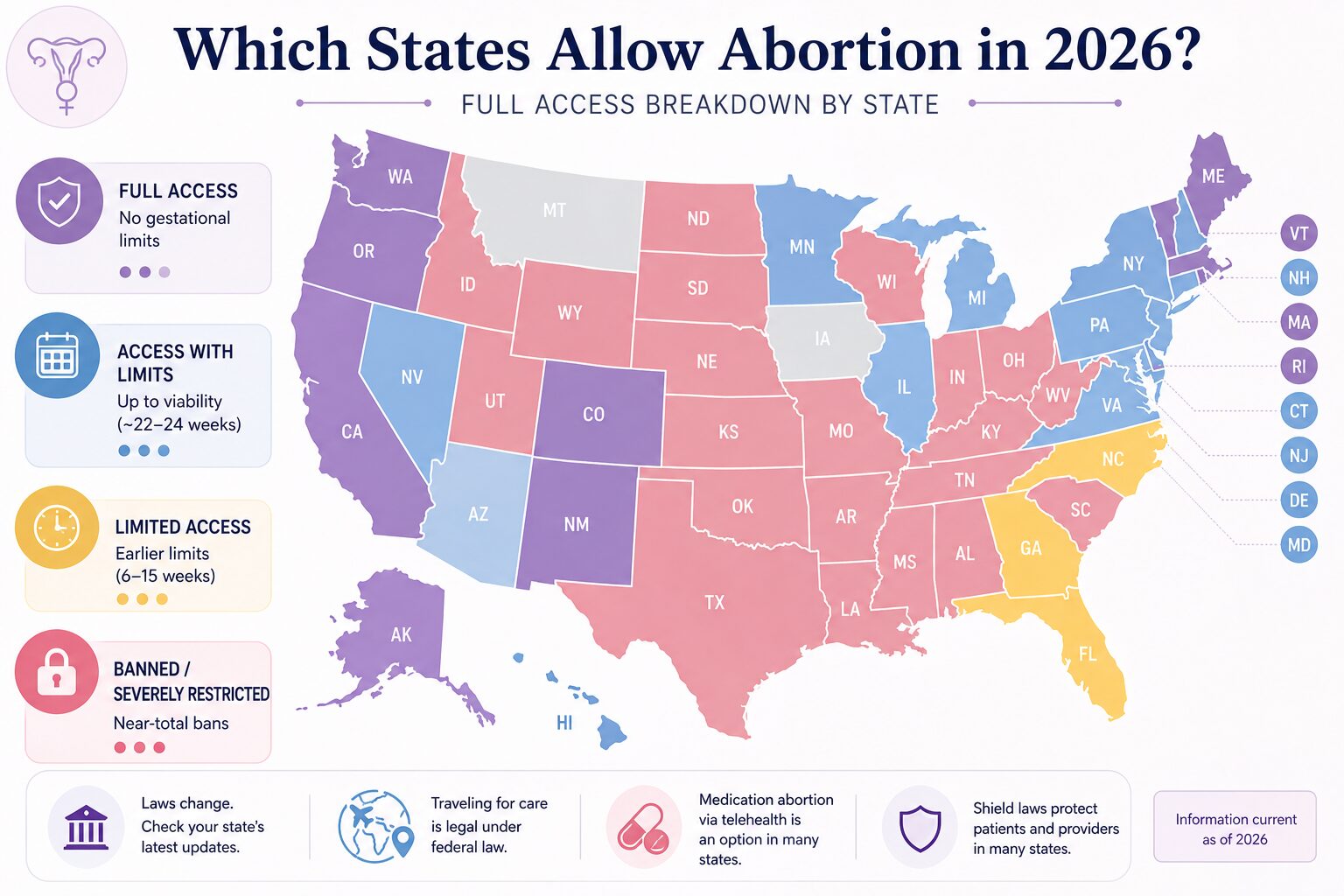
Which States Allow Abortion in 2026? Full Access Breakdown by State
States With No Gestational Limit
A group of states have codified the broadest possible abortion protections. In these states, abortion is available through all stages of pregnancy, though most abortions still occur in the first trimester by patient choice. These states include California, Colorado, Oregon, Vermont, New Mexico, Alaska, and Washington, D.C., among others. Several of these states explicitly protect the right to abortion in their state constitutions, making legislative reversal significantly harder.
States With Access Up to Viability (Approximately 22–24 Weeks)
The largest category of protective states follows a viability standard that mirrors what Roe v. Wade established. States in this group include Illinois, New York, New Jersey, Connecticut, Massachusetts, Maryland, Minnesota, Nevada, and Hawaii, among others.
Illinois deserves particular attention. The Illinois Reproductive Health Act, passed in 2019 and strengthened since, guarantees the right to abortion as a fundamental right under state law. Illinois also has active abortion shield laws protecting both patients and providers — meaning out-of-state patients who travel to Illinois for care are specifically protected from legal interference by their home state. For people living in Indiana, Missouri, Wisconsin, Kentucky, or other nearby states with near-total bans, Illinois is often the closest and safest option for legal care.
If you’re considering traveling to Illinois or live there already, you can schedule an in-clinic appointment or explore telehealth abortion care depending on your gestational age and preference.
States With 15-Week or Earlier Limits Where Abortion Is Still Legal
Some states allow abortion but have passed gestational limits earlier than viability. As of 2026, states like Florida, Georgia, and North Carolina fall into complicated territory — Florida and Georgia both enacted 6-week bans, which in practical terms means most people don’t know they’re pregnant before the legal window closes. North Carolina has a 12-week limit with narrow exceptions. These laws are subject to ongoing litigation and may have changed; check current status before relying on access in these states.
States Where Law Is in Litigation or Flux
Several states have laws that have been blocked or partially blocked by state or federal courts. Arizona, Iowa, and Wyoming have experienced significant legal back-and-forth. In these states, the practical availability of abortion care may differ from what the statute technically says. If you’re in one of these states, contact a provider or a resource like the National Abortion Federation Hotline to verify what’s currently available.
States Where Abortion Is Banned or Severely Restricted
As of 2026, more than 13 states have near-total abortion bans in effect. These include Texas, Missouri, Indiana, Kentucky, Tennessee, Alabama, Mississippi, Arkansas, Oklahoma, South Dakota, North Dakota, Idaho, and West Virginia. Most of these states allow extremely narrow exceptions typically for life endangerment of the pregnant person but the process for qualifying for those exceptions has been legally and practically difficult even in genuine medical emergencies.
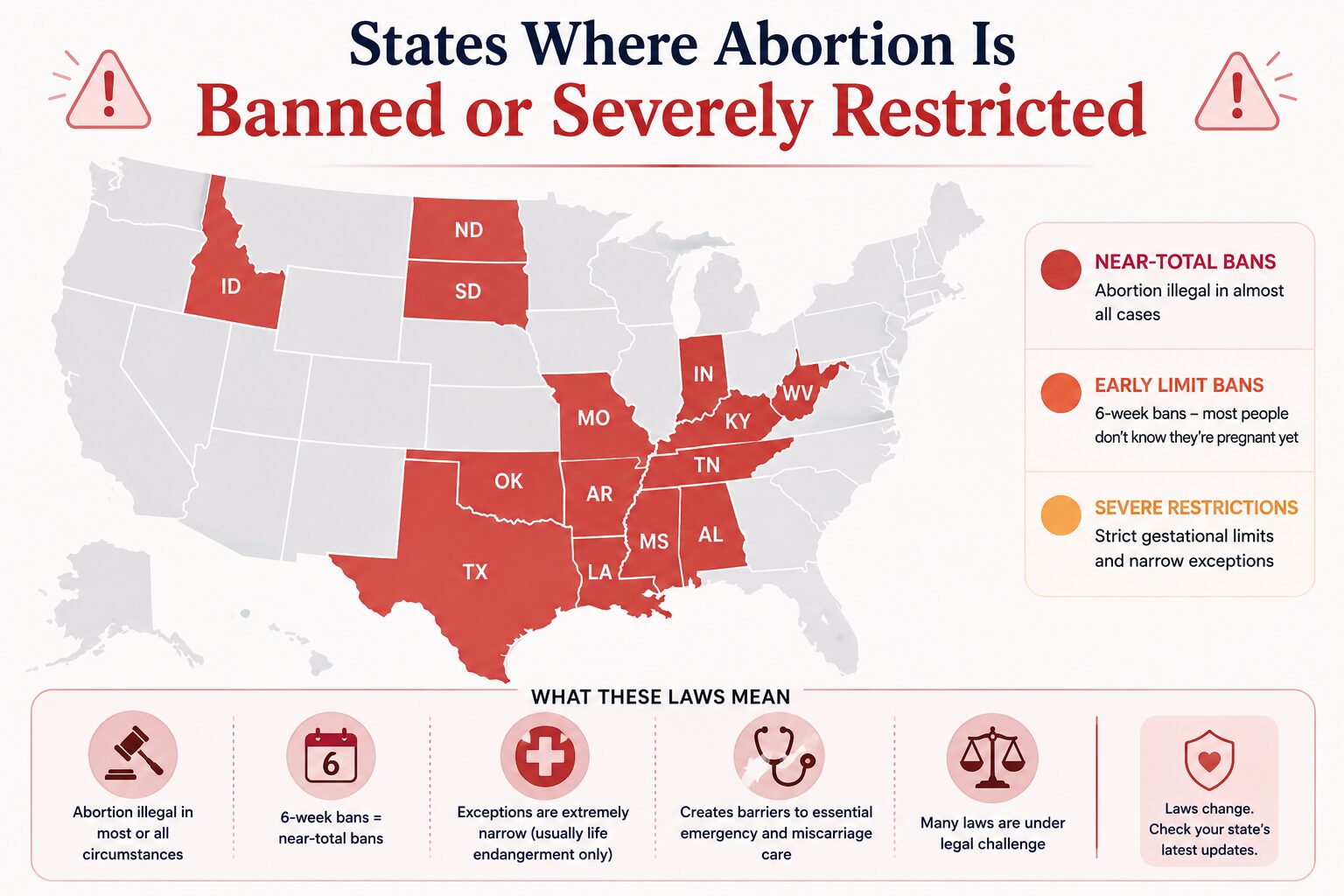
A 6-week ban is, functionally, a near-total ban. Most people don’t receive a positive pregnancy test until week 5 or 6 of pregnancy, measured from the last menstrual period. Scheduling a provider appointment, arranging time off work, securing transportation, and obtaining care within that window is nearly impossible for most people, particularly those without flexible schedules or financial resources.
In states with criminal penalties for providers, healthcare workers face prosecution for performing abortions even in cases of miscarriage management or ectopic pregnancy, which has created documented gaps in emergency obstetric care across ban states.
Traveling to Another State for Abortion: What You Need to Know
Traveling across state lines to access abortion care is legal under federal law. No state currently has an enforceable law that successfully criminalizes a patient for traveling elsewhere to receive abortion care, though several states have attempted to pass such legislation. As of 2026, federal courts have consistently blocked attempts to penalize patients for out-of-state travel.
That said, legal protection isn’t the same as legal certainty the landscape shifts. Protecting your digital privacy before, during, and after traveling is strongly advisable. Use encrypted messaging apps, disable location sharing on your phone, and avoid searching for care on devices connected to shared accounts.
For people in the Midwest traveling to Illinois, the process is relatively straightforward. Illinois providers are experienced working with out-of-state patients and can often accommodate same-week appointments. Serenity Choice Health’s in-clinic abortion services are available to patients from any state, with complete confidentiality. If you want to consult with a provider before traveling, a telehealth pre-visit is often available.
Financial assistance for travel is available through multiple national organizations, including the National Abortion Federation Hotline, Planned Parenthood’s travel assistance programs, and many regional abortion funds that operate specifically in ban-state regions.
The Abortion Pill by Mail: Telehealth Access in 2026
Medication abortion using mifepristone and misoprostol together is effective through approximately 10–12 weeks of pregnancy, depending on the protocol and provider guidance. Telehealth abortion services allow a licensed provider to consult with a patient remotely, prescribe medication, and have it delivered by mail, all without an in-person visit.
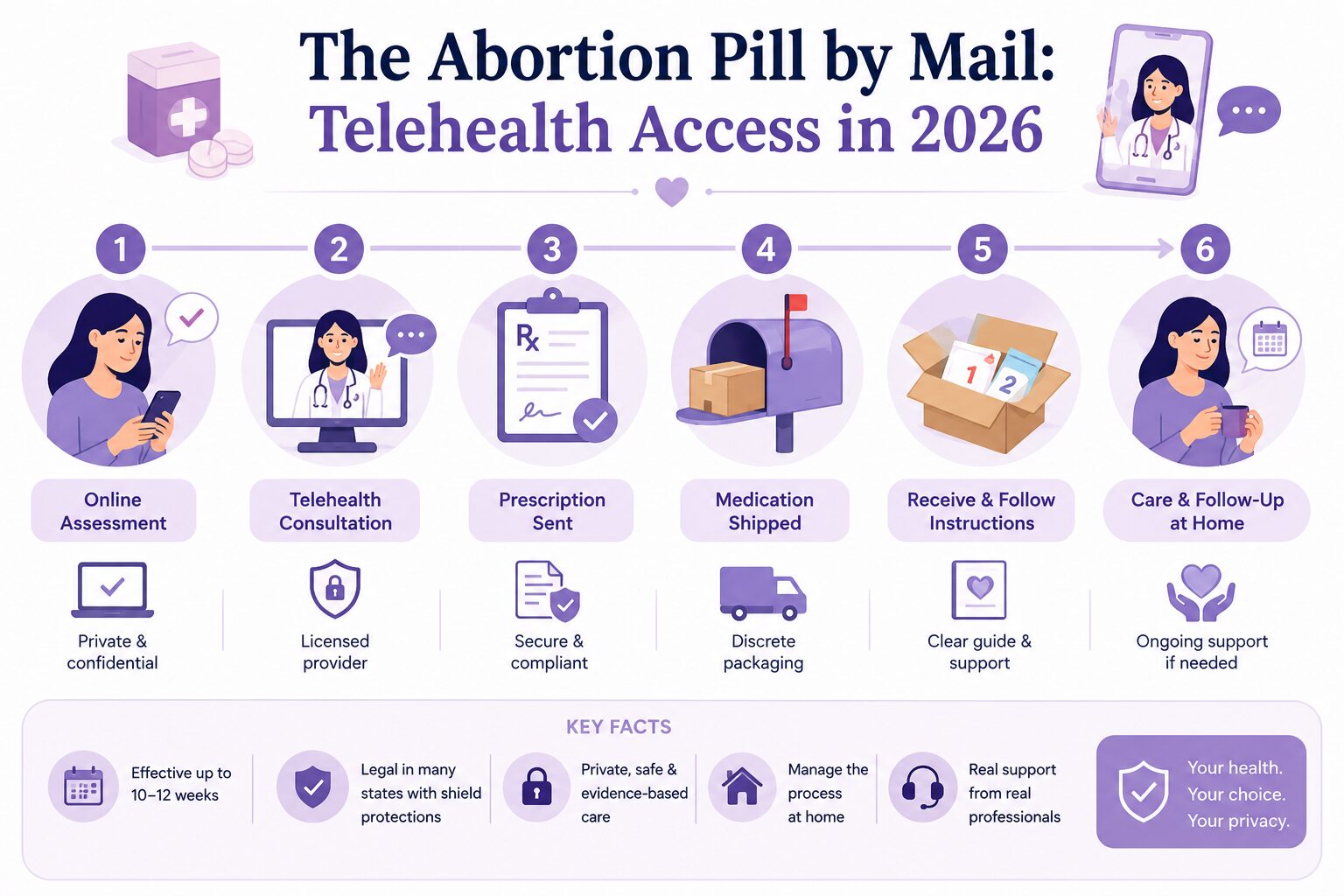
Telehealth abortion is legally available in protected and viability-standard states, including Illinois, New York, California, Colorado, Massachusetts, and others. Shield laws in states like Illinois explicitly protect telehealth providers from legal action by other states meaning an Illinois-licensed provider can offer telehealth care to patients in those states without risking their medical license.
For patients in states where abortion is banned, telehealth access is more complicated. Several organizations operate specifically to serve patients in ban states, using provider networks in shield-law states and leveraging legal protections built around the federal shield law framework. Aid Access is one such organization.
If you’re in a state where telehealth abortion is legal, this option offers maximum privacy, comfort, and convenience. You consult with a licensed clinician via video, receive your medication by mail, and manage the process at home with full clinical support.
Abortion Shield Laws: Which States Protect Out-of-State Patients
An abortion shield law is a state-level statute that prohibits state officials from cooperating with other states’ investigations into abortion care. In practical terms, this means that if you travel from Texas to Illinois to receive an abortion, Illinois authorities cannot be compelled to hand over your medical records or assist a Texas investigation.
As of 2026, states with active shield laws include Illinois, California, Colorado, New York, New Jersey, Massachusetts, Washington, Oregon, Minnesota, Connecticut, Maryland, and Vermont, among others. The scope and strength of these laws varies; some cover patients only, while others specifically protect providers, clinic staff, and even people who help someone access care.
When choosing a state to travel to for abortion care, prioritizing a shield-law state offers the strongest legal protection available. Illinois, in particular, has been deliberate in strengthening its shield protections for both in-person and telehealth care, making it one of the most protective states in the country for patients traveling from the Midwest.
State-by-State Gestational Limits at a Glance
| Access Level | States (Examples) |
| No gestational limit | California, Colorado, Oregon, Vermont, New Mexico |
| Up to viability (~22–24 weeks) | Illinois, New York, New Jersey, Massachusetts, Maryland, Minnesota |
| 15-week limit | Some states with partial restrictions — verify current status |
| 12-week limit | North Carolina (with exceptions) |
| 6-week limit (near-total ban) | Florida, Georgia — litigation ongoing |
| Near-total ban | Texas, Missouri, Indiana, Kentucky, Tennessee, Alabama, and others |
How to Find Abortion Care in 2026 Regardless of Where You Live
The most important thing to know is this: there are options, even if your state has banned abortion. Access requires planning, but it is possible for most people.
Start with a trusted provider. If you’re in a legal state or can travel to one, connecting with a licensed clinic is the clearest path. Serenity Choice Health offers both in-clinic and telehealth abortion care for eligible patients, with same-week availability in many cases. All care is confidential and provided by licensed medical professionals.
Know the difference between legitimate clinics and crisis pregnancy centers (CPCs). CPCs are facilities that present themselves as abortion providers but do not offer abortion care. They are often operated by anti-abortion organizations and have been documented using misleading information to deter patients from accessing abortion care. A legitimate abortion provider will give you accurate, medically sound information about all your options, including abortion.
Protect your digital privacy. Before searching for abortion care, consider using a private browsing window, a VPN, and an encrypted email address. Avoid searching on work devices or shared accounts. This is especially important for people in ban states.
Use national hotlines. The National Abortion Federation Hotline (1-800-772-9100) provides confidential referrals, financial assistance, and practical guidance for patients across the country. The Repro Legal Helpline (844-868-2812) offers free legal advice for people with questions about their rights.
Know your gestational age. The options available to you medication abortion versus in-clinic abortion, telehealth versus in-person depend significantly on how far along you are. If you’re unsure, a provider can help you determine gestational age through your last menstrual period or an ultrasound. The sooner you act, the more options you have.
Frequently Asked Questions
How many states is abortion legal in 2026?
Abortion is broadly legal in approximately 21 or more states, with varying gestational limits. The exact number depends on how states currently blocked by court orders are counted, as legal status remains in flux in several states.
Which states have no gestational limit on abortion?
Colorado, California, Oregon, Vermont, New Mexico, and Alaska are among the states with no statutory gestational limit on abortion access.
Can I get in legal trouble for traveling to another state for an abortion?
Under current federal law, no. Traveling across state lines to access abortion care is legal. Several states have attempted to criminalize this, but courts have blocked those efforts as of 2026.
Does Illinois protect out-of-state abortion patients?
Yes. Illinois’s shield laws specifically protect patients, providers, and those who assist someone seeking abortion care from legal action by other states.
What is the closest legal state for people in Indiana, Missouri, or Wisconsin?
Illinois is the closest state with broad abortion protections and active shield laws for patients traveling from neighboring ban states.
If you have questions about your specific situation, gestational age, or options available to you, reach out to schedule a confidential consultation. You deserve accurate information and compassionate care and you have more options than you might think.

Dr. James Carter is a board-certified physician and lead clinician at Serenity Choice Health, specializing in reproductive health access and medication abortion protocols. With over 20+ years of experience, he combines clinical expertise with patient-centered care to ensure safe, compassionate, and confidential reproductive healthcare.