Millions of people open TikTok every day looking for answers to questions they feel too embarrassed, too afraid, or too rushed to ask a doctor. Reproductive health, especially abortion has become one of the most searched and most watched topics on the platform. And while some of what’s out there is genuinely helpful, a significant portion of viral abortion advice on TikTok is incomplete, misleading, or outright dangerous.
This isn’t about shaming anyone for turning to social media. When healthcare feels inaccessible, stigmatized, or just confusing, people go where they feel heard. But the stakes around abortion information are high enough that it’s worth separating what TikTok gets right from what could seriously harm you.
Why TikTok Became a Go-To Source for Abortion Information
The short answer: it’s accessible, anonymous, and fast.
For many people, especially younger women, TikTok fills a gap that the traditional healthcare system hasn’t. You don’t need insurance to scroll through a video. You don’t need to sit in a waiting room. You don’t have to say the word “abortion” out loud to anyone. The algorithm learns what you’re looking for and serves it up, often within seconds.
After significant restrictions on abortion access were introduced in several U.S. states, search traffic for abortion-related content spiked dramatically on social platforms. TikTok saw a surge of videos from creators ranging from licensed OBGYNs to anonymous users sharing personal experiences and the algorithm doesn’t always distinguish between them.
There’s also a trust factor at play. Younger audiences, in particular, are more likely to trust someone who feels like a peer sharing a real story than an official health authority they perceive as bureaucratic or inaccessible. That emotional connection is powerful and it’s exactly why misinformation spreads so easily in this space.
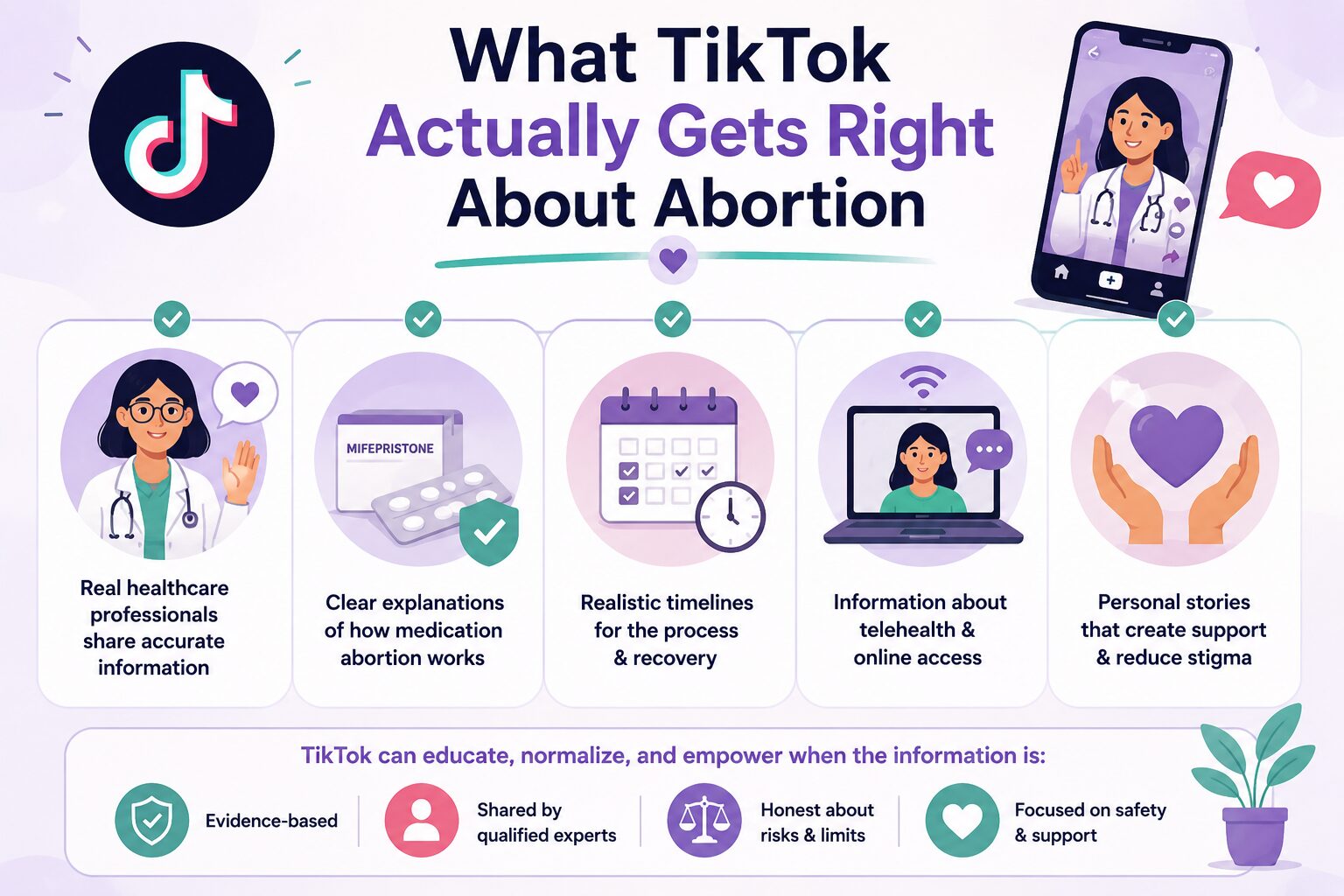
To be fair, not everything circulating on the platform is wrong. There’s a growing community of real, credentialed healthcare providers who use TikTok to share medically accurate information and they’re doing genuinely important work.
Videos from licensed physicians and nurse practitioners often explain how medication abortion actually works, what to expect during the process, and when to seek medical care. Some creators do a solid job explaining the two-medication protocol mifepristone followed by misoprostol including realistic timelines for bleeding, cramping, and emotional recovery.
Telehealth abortion access is also covered well in some corners of the platform. Creators who work in reproductive healthcare have helped normalize the idea that you can access a licensed telehealth provider from home, legally, in many states, something that many people simply didn’t know was possible.
If you want to understand how medication abortion actually works, the foundational information is out there just not always easy to find amidst the noise.
The Dangerous Side of Viral Abortion Advice
Here’s where things get serious.
For every credible healthcare provider on TikTok, there are dozens of creators sharing advice that ranges from inaccurate to genuinely life-threatening. Some of the most dangerous content includes:
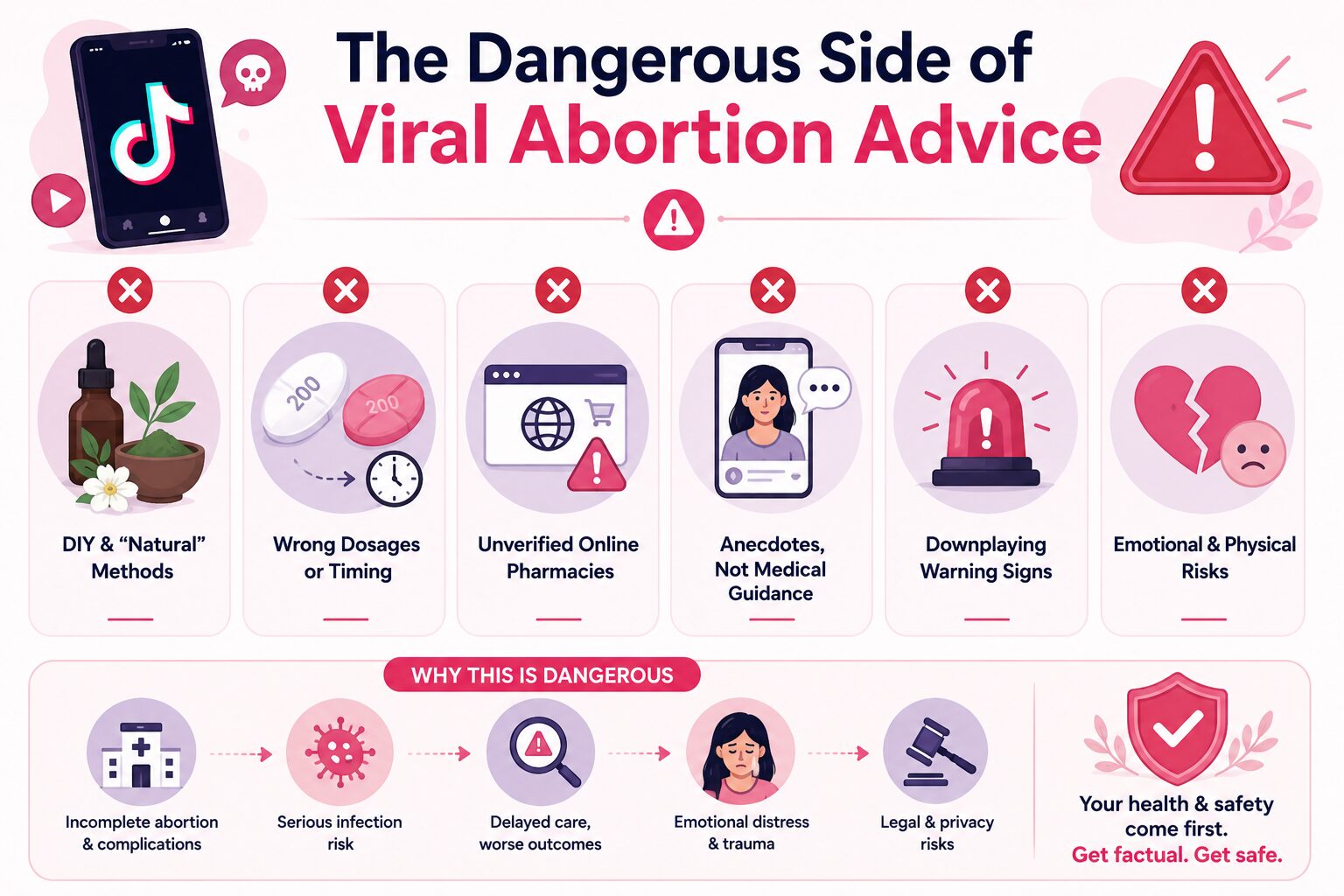
DIY and “natural” abortion methods. Videos promoting herbal supplements, high-dose vitamin C, or other unproven remedies as ways to end a pregnancy are not just ineffective, they can cause serious harm. Some substances promoted in these videos are toxic at high doses. None of them have clinical evidence supporting their use for ending a pregnancy.
Misinformation about abortion pill dosages. Medication abortion requires specific dosing at specific intervals. Viral content sometimes gets these details wrong either understating or overstating how much misoprostol to take, or leaving out critical timing instructions. Incorrect use doesn’t just reduce effectiveness; it can lead to incomplete abortion requiring emergency care, or to dangerous side effects. Understanding when abortion pills don’t work and what to do next is important information that TikTok rarely covers completely.
Recommendations for unverified online pharmacies. Some TikTok creators direct viewers toward overseas or unregulated sources to obtain abortion medication. Counterfeit pills are a real risk. Pills obtained outside of legitimate medical channels may be mislabeled, improperly dosed, or entirely fake and without medical oversight, you have no way to know.
Anecdotal stories presented as universal experiences. Someone who had a smooth, pain-free medication abortion at eight weeks and someone who needed emergency intervention for an incomplete abortion at ten weeks can both be telling the truth. One person’s experience is not a roadmap for someone else’s body or pregnancy. TikTok’s short, personal, emotionally resonant content makes anecdotal content feel authoritative when it isn’t.
Advice that delays emergency care. Some content minimizes warning signs that actually require urgent medical attention. Heavy, sustained bleeding, severe abdominal pain, fever, or no bleeding at all after taking abortion medication all warrant medical evaluation. If viral content convinces someone that these symptoms are “normal,” the delay can have serious consequences.
How to Tell If Abortion Advice Online Is Actually Trustworthy
Not all social media health content is created equal. Here are a few things to look for before trusting what you see.
Check credentials, not just confidence. Anyone can sound authoritative on TikTok. Look for creators who explicitly state their medical qualifications MD, NP, APRN, PA and who cite established sources like the FDA, WHO, or peer-reviewed medical guidelines.
Be skeptical of anything that sounds too simple. Medication abortion is a medical process. Videos that promise quick fixes, herbal solutions, or “all-natural” methods with zero risks are not being honest with you.
Look for red flags in the comments. If the comments section is full of people reporting problems, side effects, or failed outcomes after following advice that’s a meaningful signal. If the creator is deleting negative comments, that’s another warning sign.
Cross-reference with established sources. Before acting on anything you see online, check it against resources from licensed medical providers or reputable organizations. If you’re not sure whether information you’ve encountered is accurate, a quick consultation with a real clinician is worth more than a hundred TikTok videos.
If you’re trying to understand whether abortion information you’ve found online is safe and verified, that’s a question worth asking a real provider.
The Real Risks of Getting Abortion Information Wrong
Medical misinformation isn’t an abstract concern. When it comes to abortion, the consequences of following dangerous advice can include:
An incomplete abortion that requires emergency surgical intervention. Serious infection from attempting DIY methods. Overdose or toxicity from unregulated substances. Delayed treatment because someone was told warning signs were “normal.” And real emotional harm from following advice that fails especially without a support system in place.
There’s also the privacy dimension. Some TikTok creators promoting abortion services or information are affiliated with unverified platforms that may collect your data in ways that aren’t safe, particularly if you live in a state where abortion access is restricted. Understanding how to keep your abortion private matters and it’s not a conversation TikTok is equipped to have with you.
Safer Alternatives to Relying on Social Media
If you need abortion information or care, there are options that don’t require trusting an anonymous creator.
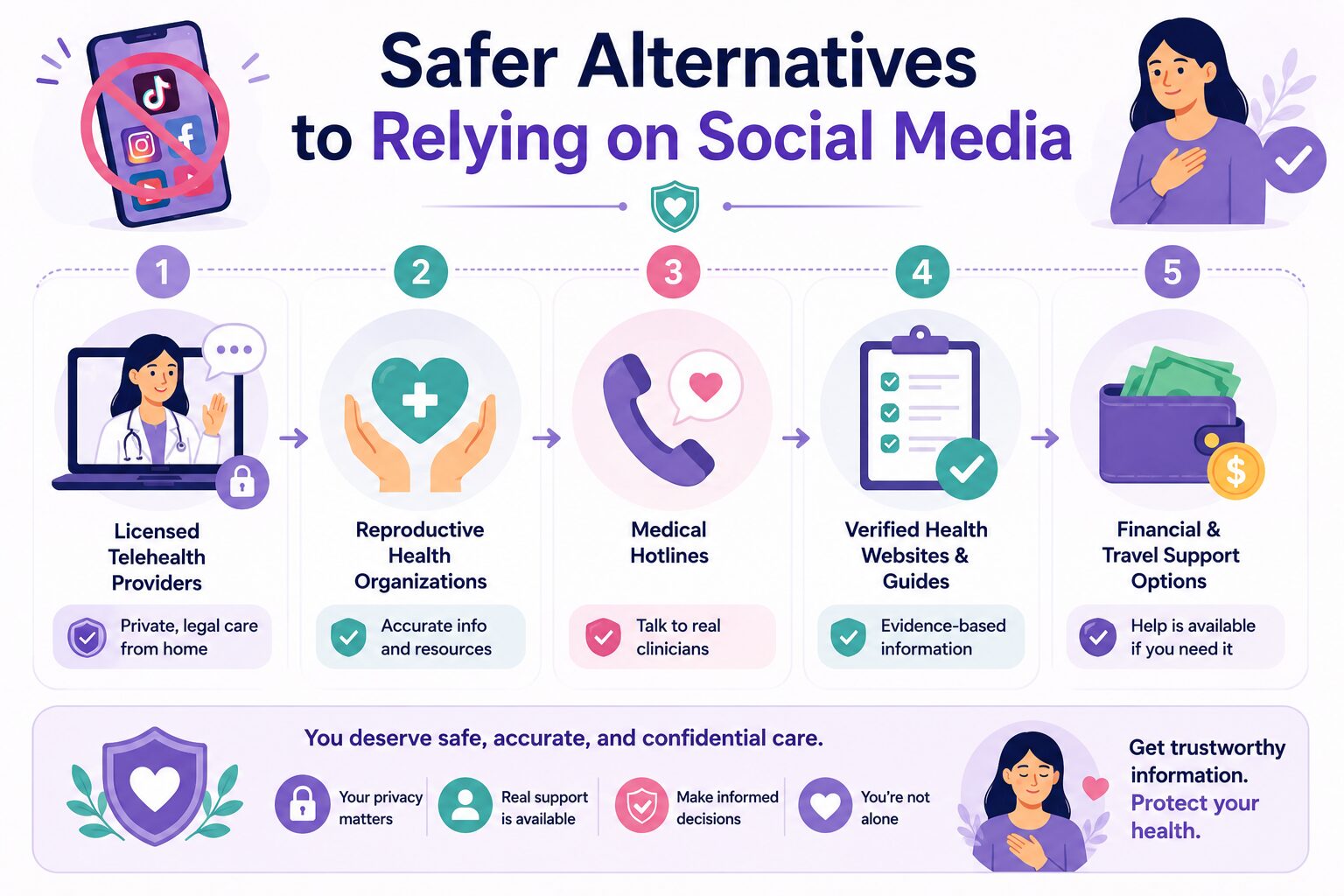
Licensed telehealth abortion providers can consult with you privately, assess your specific situation, and where legally permitted provide FDA-approved medication with proper guidance. This is not the same as ordering pills from an unverified source. A real telehealth provider reviews your medical history, confirms gestational age, and follows up with you. You can learn more about what telehealth abortion access actually looks like and whether it might be right for your situation.
Reproductive health organizations exist specifically to provide accurate, non-judgmental information and connect people with care. They are not TikTok influencers. They have medical and legal accountability for the information they provide.
Medical hotlines staffed by licensed clinicians can answer questions in real time often confidentially without requiring you to make an appointment or travel anywhere.
If cost is a barrier, financial assistance programs exist specifically for abortion care. If geography is the issue, traveling for abortion care or accessing care across state lines is often more feasible than people realize.
What Doctors Are Actually Saying
Physicians who work in reproductive health are not dismissing TikTok entirely. Many are on the platform themselves, trying to push accurate information into an algorithm that doesn’t always reward nuance. But they are raising serious concerns.
The core issue, as many clinicians describe it, is this: TikTok’s algorithm optimizes for engagement, not accuracy. Content that’s dramatic, emotionally charged, or counterintuitive tends to go viral and that creates a built-in incentive to overstate, simplify, or sensationalize. Medical information, by contrast, is often nuanced, context-dependent, and unsexy.
Doctors are also specifically concerned about the rise of content promoting abortion reversal, a controversial and medically unsupported claim and DIY methods that have no place in any serious clinical conversation.
The Bottom Line
TikTok is not a clinic. It is not a licensed healthcare provider. It cannot examine you, review your medical history, confirm your gestational age, or follow up with you if something goes wrong.
That doesn’t mean every piece of abortion-related content on the platform is wrong. But it does mean you should approach viral abortion advice the same way you’d approach any health information from an unverified source with real skepticism and a commitment to checking it against something more reliable before acting on it.
If you’re navigating an unplanned pregnancy and need accurate, confidential support, understanding all of your options is the right place to start, not a comment section.
Reproductive healthcare decisions are serious. You deserve information that’s as serious as the decision itself.
Frequently Asked Questions
Is abortion advice on TikTok trustworthy?
Some of it is particularly content from licensed physicians, OBGYNs, and nurse practitioners who explicitly state their credentials and cite established medical sources. However, a significant portion of viral abortion content on TikTok is inaccurate, incomplete, or potentially dangerous. The platform’s algorithm rewards engagement, not medical accuracy, which means misleading content often spreads faster than verified information. Always cross-reference anything you see on TikTok with a licensed healthcare provider before acting on it.
What abortion misinformation is most commonly spreading on TikTok?
The most prevalent and dangerous misinformation includes promotions of “natural” or herbal abortion remedies with no clinical basis, incorrect abortion pill dosages and timing instructions, recommendations for unregulated or overseas online pharmacies, anecdotal experiences presented as universal medical guidance, and content that downplays genuine warning signs that require emergency care. If you want to understand what a medically accurate abortion pill process actually looks like, reviewing clinician-reviewed information is a far safer starting point.
Are TikTok abortion pill videos medically accurate?
Some are particularly those made by credentialed healthcare professionals. But many videos get critical details wrong, including the dosage of misoprostol, the timing between medications, what symptoms are normal versus alarming, and what to do if the medication doesn’t work as expected. Medication abortion is a specific medical protocol. Videos that simplify or generalize it can lead people to use it incorrectly, which reduces effectiveness and can create serious health complications. You can read a detailed, medically accurate breakdown of how the abortion pill works to compare against what you may have seen online.
What are the warning signs of dangerous abortion advice online?
Watch out for content that promotes herbal, supplement-based, or DIY methods to end a pregnancy; recommends purchasing medication from unverified or overseas sources; presents one person’s anecdotal experience as a universal guide; downplays symptoms like heavy bleeding, fever, or severe pain; promises guaranteed outcomes with no mention of risks; or lacks any credentialed medical source. If advice sounds too simple for a medical procedure, it almost certainly is.
How can you verify abortion information you find online?
Start by checking whether the source has stated medical credentials as an MD, NP, PA, or APRN. Then cross-reference the information against guidance from established bodies like the FDA or WHO. Look for whether the content acknowledges nuance, risks, and individual variation legitimate medical information rarely comes with blanket guarantees. When in doubt, the most reliable step is a direct consultation with a licensed clinician. A telehealth provider can often answer your specific questions privately and quickly you can learn more about whether telehealth abortion is right for your situation.
Are online abortion pills safe?
Abortion pills obtained through a licensed telehealth provider, following FDA-approved protocols, are considered safe and effective with an effectiveness rate above 95% when used correctly within the recommended gestational window. The risk comes from obtaining pills through unverified sources, without medical oversight, or based on incorrect dosing instructions found online. Counterfeit or mislabeled pills are a genuine danger when sourced outside of legitimate medical channels. If you’re considering this option, learn about how to access safe, verified abortion pills online through a proper provider.
Why do so many people turn to social media for abortion information?
Several real barriers push people toward social media for healthcare guidance: stigma around discussing abortion openly, fear of judgment in clinical settings, lack of insurance or affordable access to providers, geographic barriers, and the desire for anonymity. TikTok and similar platforms offer the feeling of community and privacy that traditional healthcare often doesn’t. Understanding why people seek this information online without judgment is important. But emotional accessibility is not the same as medical reliability. If cost or access is a concern, abortion financial assistance programs and telehealth options can lower many of those barriers without the risk that comes from relying on unverified content.
What are safer alternatives to getting abortion information from TikTok?
The safest alternatives include consulting with a licensed telehealth abortion provider, reaching out to a reproductive health organization, calling a medically staffed hotline, or visiting a verified reproductive healthcare platform. These options are often more private, faster, and more accessible than people realize and they come with actual medical accountability. If you’re not sure where to start, reviewing all of your options for an unplanned pregnancy is a good first step.

Dr. James Carter is a board-certified physician and lead clinician at Serenity Choice Health, specializing in reproductive health access and medication abortion protocols. With over 20+ years of experience, he combines clinical expertise with patient-centered care to ensure safe, compassionate, and confidential reproductive healthcare.