

Most people assume they would know if something was wrong. That assumption feels reasonable and our bodies usually signal when something is off. But when it comes to sexually transmitted infections, that assumption is one of the most dangerous misconceptions in sexual health.
The reality is that many of the most common STIs produce no symptoms at all particularly in women. You can feel completely healthy, have no visible signs, no pain, no unusual discharge, no discomfort whatsoever and still have an active infection that is quietly causing damage, and that you can unknowingly pass to a partner.
This isn’t a rare edge case. It’s the norm for several of the most widespread STIs. Understanding why silent infections happen, which ones are most likely to go unnoticed, and what the consequences of delayed diagnosis look like that’s not just useful information. For many women, it’s genuinely important for their long-term health.
Can You Have an STI Without Symptoms?
Yes and it happens far more often than most people realize.
The medical term is asymptomatic infection meaning an infection that is present and active in your body without producing noticeable symptoms. Asymptomatic STIs are not unusual. For several of the most common sexually transmitted infections, the majority of cases in women produce no symptoms at all, at least in the early stages.
This happens for several reasons. Some infections operate below the threshold that triggers obvious immune responses. Others produce symptoms so mild a brief discomfort, slight discharge that they’re easily attributed to something else and quickly forgotten. Some infections cause internal changes, like inflammation of the cervix or fallopian tubes, that produce no external symptoms the patient would notice at home.
The uncomfortable truth is that feeling healthy is not a reliable indicator of STI status. The only way to know with certainty whether you have a sexually transmitted infection is to be tested. Symptoms or their absence tell you very little.
And critically: an asymptomatic infection is still transmissible. You can pass an STI to a partner without having any idea you’re infected. This is one of the primary reasons STI rates remain high, infections cycle through partners silently, with no one aware they’re infected or that transmission is happening.
Which STIs Are Most Likely to Have No Symptoms?
Not all sexually transmitted infections behave the same way. Some reliably produce noticeable symptoms. Others are specifically known for their tendency to go undetected. Here’s what women need to know about the most common silent infections:
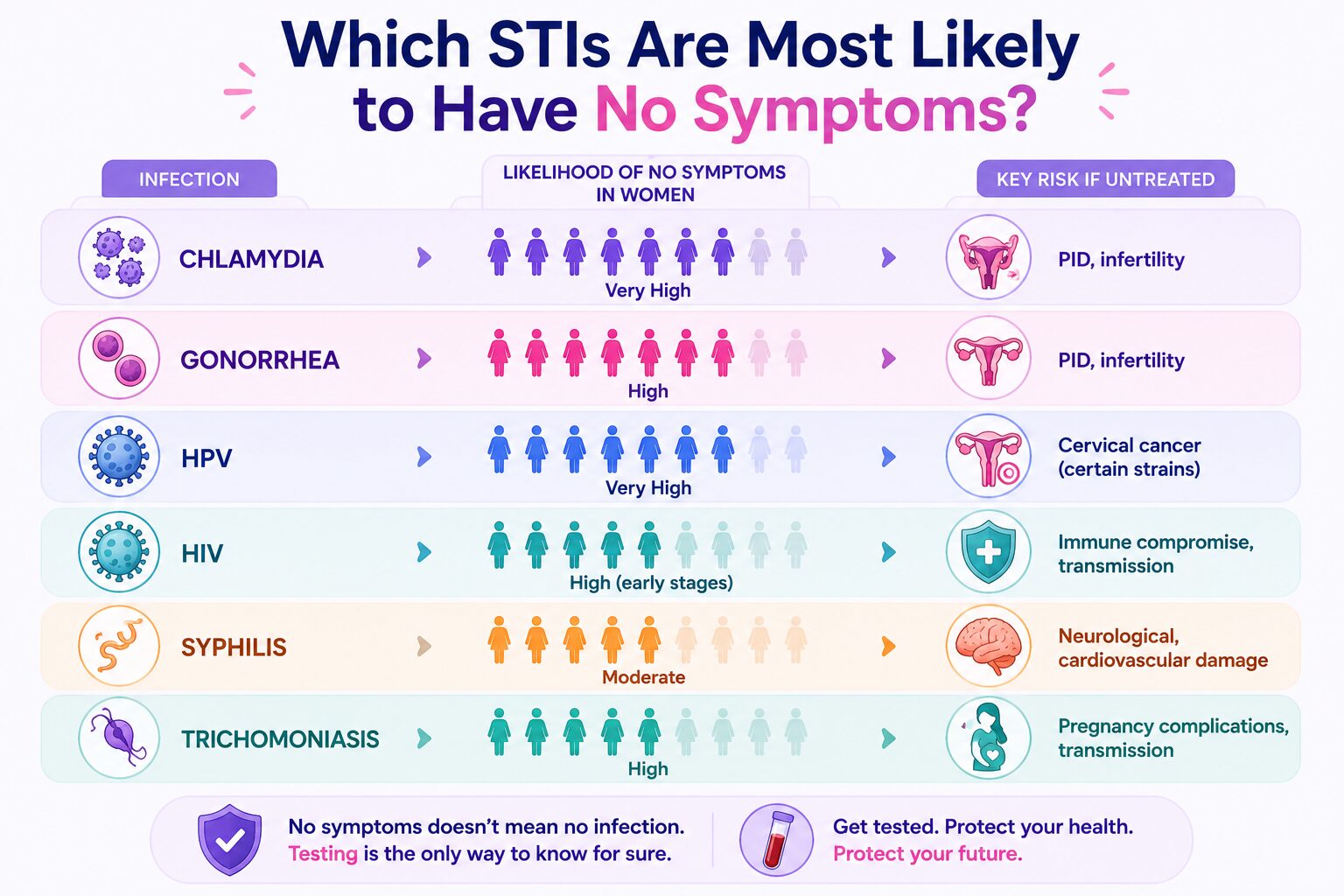
Chlamydia is probably the most well-known asymptomatic STI and for good reason. Research consistently shows that the majority of chlamydia infections in women produce no symptoms. It’s sometimes called the “silent infection” specifically because of how effectively it evades detection. When symptoms do occur, they can include unusual discharge, burning during urination, or pelvic discomfort but these are often absent entirely, or mild enough to dismiss.
Gonorrhea has a similar pattern. While some women experience symptoms of discharge, pelvic pain, burning urination a significant portion of cases show nothing at all. Gonorrhea is particularly concerning because of how quickly it can progress to more serious complications when untreated.
HPV (human papillomavirus) is the most common sexually transmitted infection in the United States, and the vast majority of HPV infections produce no symptoms and clear on their own. However, certain strains cause cervical cell changes that can progress to cervical cancer if undetected which is why routine Pap smears and HPV testing are essential even for women who feel completely healthy.
HIV in its early stages frequently resembles a mild flu or produces no symptoms at all. Many people live with HIV for years without knowing they’re infected, during which time transmission can occur and the virus continues to affect the immune system. Early detection through testing is essential because treatment initiated early dramatically improves outcomes.
Syphilis progresses through stages, and in the initial stage a painless sore called a chancre often goes unnoticed because of its location or because it heals on its own. The infection doesn’t heal with the sore, however. It progresses silently to later stages that carry more serious health consequences.
Trichomoniasis is extremely common and frequently produces no symptoms in women. When symptoms do appear itching, burning, unusual discharge they can be confused with other common conditions like yeast infections, leading to misdiagnosis and delayed treatment.
| Infection | Asymptomatic Rate in Women | Key Risk if Untreated |
| Chlamydia | Very high | PID, infertility |
| Gonorrhea | High | PID, infertility |
| HPV | Very high | Cervical cancer (certain strains) |
| HIV | High (early stages) | Immune compromise, transmission |
| Syphilis | Moderate | Neurological, cardiovascular damage |
| Trichomoniasis | High | Pregnancy complications, transmission |
Why Silent STIs Are Especially Dangerous for Women
The absence of symptoms doesn’t mean an infection is inactive. While you feel nothing, an undetected STI can be causing progressive damage and for women, the consequences can be particularly serious.
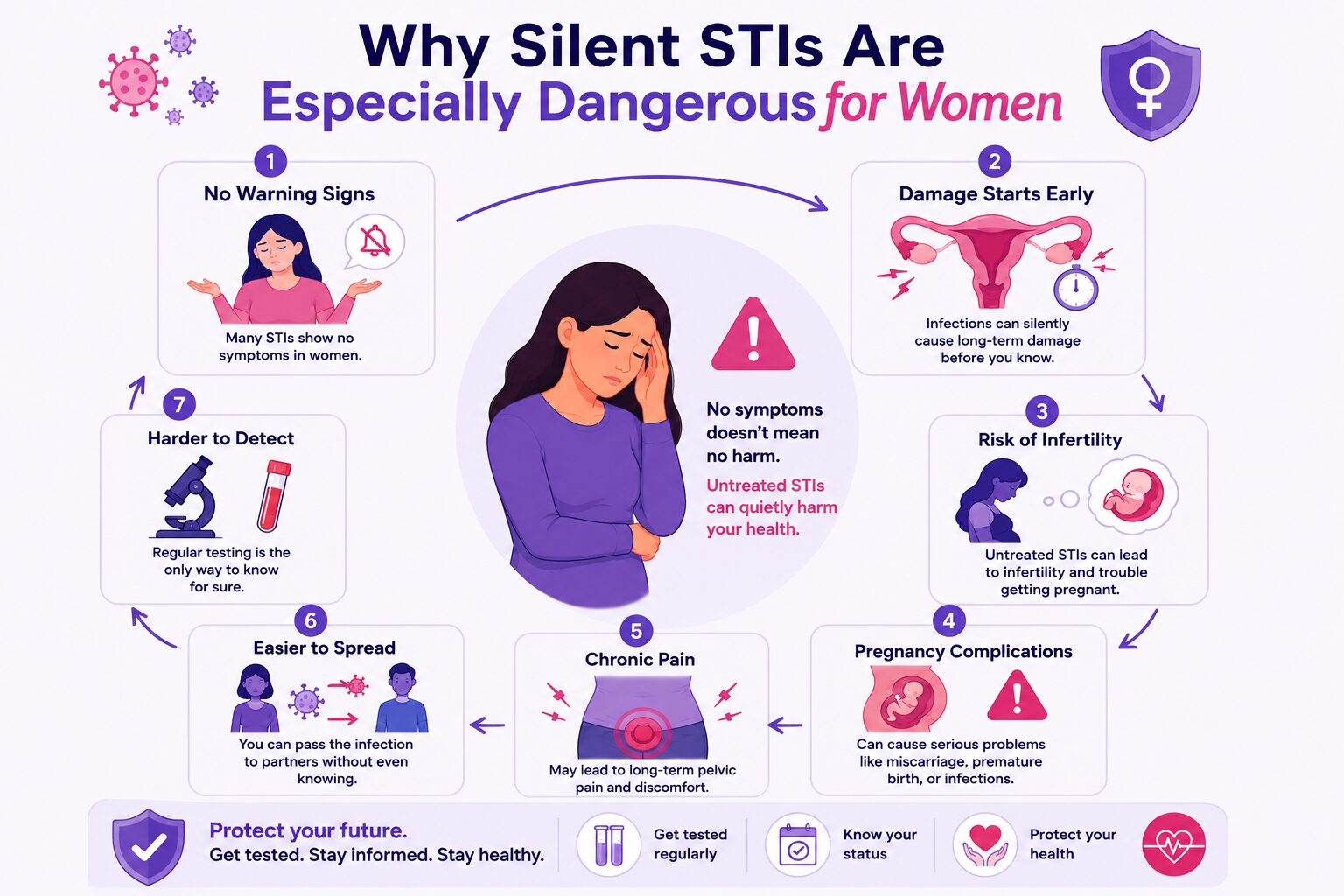
Pelvic inflammatory disease (PID) is one of the most significant risks. PID occurs when a bacterial infection most commonly chlamydia or gonorrhea spreads from the cervix to the uterus, fallopian tubes, and ovaries. It can cause chronic pelvic pain, scarring of the fallopian tubes, and permanent damage to reproductive organs. Many women who develop PID had no idea they were infected in the first place.
Fertility impact is real and significant. Scarring caused by untreated chlamydia or gonorrhea can block the fallopian tubes, making conception difficult or impossible. Ectopic pregnancy where a fertilized egg implants in a fallopian tube rather than the uterus is also more common in women who have experienced PID or fallopian tube scarring from untreated infection. These are consequences that develop silently, over time, without any warning symptoms.
Pregnancy complications associated with untreated STIs include preterm labor, low birth weight, and transmission of the infection to the baby during delivery. Some infections, including chlamydia and gonorrhea, can cause serious eye infections or pneumonia in newborns when transmitted at birth.
Increased HIV susceptibility is another documented consequence. Untreated STIs, particularly those that cause inflammation or sores, can increase susceptibility to HIV transmission during sexual contact. An undetected infection can therefore compound your risk in ways you wouldn’t be aware of.
The pattern across all of these complications is the same: the damage happens during the period when the infection is silent, when no symptoms are present, and when most women have no reason to seek care. This is precisely why routine screening, not symptom-based testing, is the standard of care for sexually transmitted infections in women.
How Would You Know If You Have an STI Without Symptoms?
The honest answer is: you wouldn’t, without testing.
This isn’t a worst-case scenario, it’s the clinical reality. There is no reliable home assessment, no symptom checklist, no gut feeling that tells you whether you have a silent STI. Testing is the only way to know.
That said, certain factors increase your risk and should inform how frequently you get tested:
Having a new sexual partner particularly without barrier protection increases exposure risk regardless of how either partner feels. Having multiple partners amplifies that risk. A history of previous STIs increases susceptibility to reinfection. Inconsistent condom use, even with regular partners, creates ongoing exposure risk. And being under 25 is itself a risk factor, chlamydia rates in particular are highest among young women, and screening guidelines specifically account for this.
The important reframe here is shifting from “I’ll get tested when I have symptoms” to “I get tested as part of routine care.” These are fundamentally different approaches to sexual health, and the evidence strongly supports the latter. Symptoms are an unreliable trigger for STI testing. Regular, proactive screening is what actually catches asymptomatic infections before they cause complications.
Our STI and STD testing services provide confidential, comprehensive screening in a private, supportive environment designed specifically for women who want to take proactive control of their sexual health.
When Should Women Get Tested Even If They Feel Fine?
Clinical guidelines are clear that routine STI screening should happen independent of symptoms for sexually active women. Here are the situations where testing is specifically recommended:
After unprotected sex with a new partner, even a single encounter. Many infections can be detected within a few weeks of exposure, though some require a longer window period for accurate results.
When starting a new relationship, before or shortly after becoming sexually active with a new partner. This protects both people and establishes a baseline of sexual health information.
During annual well-woman exams. Many healthcare providers include STI screening as part of routine gynecological care chlamydia and gonorrhea screening is recommended annually for all sexually active women under 25, and for older women with risk factors.
Before and during pregnancy. Screening for chlamydia, gonorrhea, HIV, syphilis, and hepatitis B is standard practice in prenatal care because of the potential consequences for both mother and baby.
After any potential exposure including situations where a partner discloses an STI diagnosis, or where you learn a past partner had an infection.
If you are sexually active and have not been tested recently, the absence of symptoms is not a reason to delay. It’s the entire point of routine screening that it happens before symptoms appear.
Can You Transmit an STI If You Don’t Have Symptoms?
Yes and this is one of the most important facts to understand about sexually transmitted infections.
Asymptomatic transmission is the primary driver of STI spread in the general population. When someone doesn’t know they’re infected, they don’t take precautions, don’t disclose to partners, and don’t seek treatment. The infection moves through sexual networks silently, with no one aware it’s happening.
This dynamic explains why STI rates remain high even as awareness increases. It’s not primarily people who know they’re infected driving transmission, it’s people who have no idea.
Herpes is a particularly clear example. Many people with genital herpes have no symptoms or such mild symptoms that they never receive a diagnosis. But the virus can be shed and transmitted even during asymptomatic periods meaning people with herpes can unknowingly infect partners throughout their lives without ever experiencing a noticeable outbreak.
HIV transmission during the acute infection period before most people would be diagnosed is also disproportionately high. The viral load is high in early infection, and because most people haven’t been tested yet at this stage, transmission risk is significant.
Understanding this dynamic is important not to create fear but to clarify why testing is an act of care — for yourself and for the people you’re intimate with. Knowing your status is the only way to make informed decisions.
What Happens During STI Testing?
STI testing is typically straightforward, quick, and far less daunting than many people expect. The specific tests used depend on which infections are being screened for:
Urine tests are used for chlamydia and gonorrhea; a simple urine sample is all that’s required, with no invasive procedure involved.
Blood tests are used for HIV, syphilis, herpes (in some cases), and hepatitis B and C. A standard blood draw, similar to any routine blood test.
Swab tests are used for gonorrhea, chlamydia, herpes, and HPV samples may be taken from the cervix, vagina, throat, or rectum depending on exposure history and symptoms.
Pap smear with HPV co-testing screens for cervical cell changes and high-risk HPV strains as part of routine gynecological care.
Results timelines vary; some rapid tests provide results within an hour, while standard lab testing typically returns results within a few days. A clinician reviews results with you and discusses next steps, which for most positive results means a straightforward course of antibiotics or antiviral medication.
Our women’s primary care services include comprehensive sexual health screening alongside routine gynecological care making it straightforward to integrate STI testing into your regular healthcare without needing a separate specialist visit.
Common Myths About STIs Without Symptoms
A few persistent misconceptions continue to prevent women from getting tested when they should:
“If I had an STI, I would know.” This is the central myth this entire article addresses and it’s simply not true. The majority of chlamydia cases, a significant proportion of gonorrhea cases, and most HPV infections produce no noticeable symptoms. Feeling fine tells you nothing about your STI status.
“Only people with many partners get STIs.” STIs don’t make judgments about sexual history. A single encounter with an infected partner is sufficient for transmission. Women in long-term monogamous relationships have contracted STIs when a partner was unfaithful. Sexual health is not a moral category.
“Testing is only necessary if I have symptoms.” This is the most consequential myth because it’s the one that leads to delayed diagnosis and complications. The entire point of STI screening guidelines is that they apply to asymptomatic people. Symptom-based testing catches infections late. Routine screening catches them early.
“STIs aren’t that serious if they can be treated.” Many STIs are treatable but treatment is only possible after diagnosis. The damage caused by untreated chlamydia to the fallopian tubes doesn’t reverse when you finally get antibiotics. Early detection and early treatment are what prevent serious complications.
How to Protect Yourself From Undiagnosed STIs
Consistent condom use with new or non-exclusive partners reduces transmission risk for many STIs though it doesn’t eliminate it entirely, particularly for infections spread through skin-to-skin contact like herpes and HPV.
Open communication with partners about testing history is valuable though it requires both people to actually know their status, which circles back to testing.
Integrating STI screening into your routine healthcare at the same cadence as your annual well-woman exam is the most reliable protective habit. It normalizes testing as part of health maintenance rather than a response to a scare.
Accessing birth control and contraceptive services alongside sexual health screening creates a more complete picture of your reproductive health and ensures that a single provider has the context to give you advice that accounts for your full situation.
If you’re ready to take a proactive step toward your sexual health, booking a confidential appointment is the most direct way to get accurate, personalized guidance from a licensed clinician who can recommend the right screening for your specific situation.
Frequently Asked Questions
Can you have an STI and not know it?
Yes and it’s common. Many of the most prevalent STIs, including chlamydia, gonorrhea, HPV, and HIV in early stages, frequently produce no symptoms in women. You can be infected, transmissible to partners, and experiencing no symptoms whatsoever. Testing is the only reliable way to know your status.
Which STIs commonly have no symptoms in women?
Chlamydia is the most well-known; the majority of cases in women are asymptomatic. Gonorrhea also frequently produces no symptoms. HPV almost always produces no symptoms and is only detected through cervical screening. HIV in early infection often produces no noticeable symptoms or symptoms that resemble a mild flu. Trichomoniasis frequently goes unnoticed in women. Syphilis in its early stage produces a painless sore that often goes undetected.
Can you spread an STI if you don’t have symptoms?
Yes. Asymptomatic transmission is the primary driver of STI spread in the general population. You can transmit chlamydia, gonorrhea, herpes, HIV, HPV, and other infections to partners without having any symptoms yourself. This is why knowing your status through regular testing matters not just for your own health but for your partners’ health as well. Our STI and STD testing services make confidential screening straightforward and accessible.
How long can an STI go unnoticed?
It depends on the infection. Chlamydia can remain undetected for months or years without causing noticeable symptoms. HIV can go undiagnosed for years in people who aren’t tested. HPV can be present for years before causing cervical cell changes detected on a Pap smear. The longer an infection goes undetected, the more time it has to cause internal damage and be transmitted to others which is why regular routine screening matters regardless of how you feel.
Should I get tested if I feel completely healthy?
Absolutely in fact, feeling healthy is the normal state for many women with active STI infections. Routine STI screening is recommended for all sexually active women, with annual chlamydia and gonorrhea screening specifically recommended for women under 25. Testing when you feel fine is the entire point of preventive screening it catches infections before symptoms appear and before complications develop. Book a confidential appointment to discuss a screening schedule appropriate for your situation.

Dr. James Carter is a board-certified physician and lead clinician at Serenity Choice Health, specializing in reproductive health access and medication abortion protocols. With over 20+ years of experience, he combines clinical expertise with patient-centered care to ensure safe, compassionate, and confidential reproductive healthcare.