

Vaginal discharge is something most people with a vagina experience throughout their life. It is the body’s way of keeping the vaginal environment clean, balanced, and healthy. Most of the time, discharge is completely normal. But changes in color, smell, texture, or amount can sometimes signal that something needs attention.
This article explains what normal discharge looks like, what changes are worth monitoring, and when getting tested for an infection is the right next step.
What Is Vaginal Discharge and Why Does It Happen?
Discharge is produced by glands inside the vagina and cervix. It carries away dead cells and bacteria, helping to keep the vaginal canal clean and preventing infection. The amount, consistency, and appearance of discharge naturally changes throughout your menstrual cycle, during pregnancy, and at different life stages.
This is a normal biological function not a hygiene problem.
What Does Normal Vaginal Discharge Look Like?
Normal discharge varies from person to person, but there are consistent patterns that indicate a healthy vaginal environment.
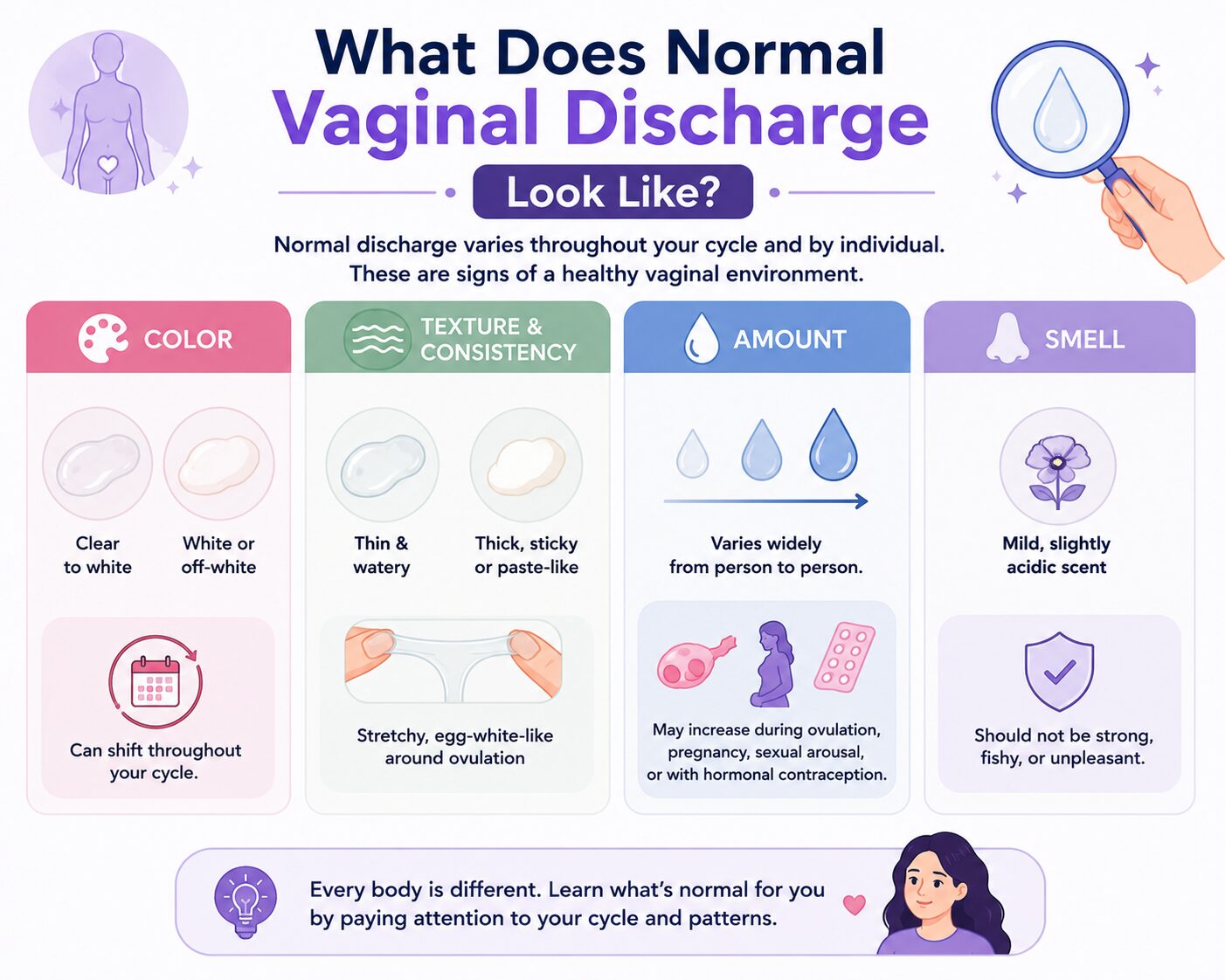
Color
- Clear to white is the most common and typically healthy
- Slightly off-white or cream-colored is also usually normal
- Color can shift slightly throughout your cycle more clear and stretchy around ovulation, thicker and whiter before your period
Texture and Consistency
- Thin and watery at some points in the cycle
- Thick, sticky, or paste-like at others
- Stretchy and egg-white-like around ovulation this is a sign of fertility
Amount
- Varies widely between individuals
- Can increase during ovulation, pregnancy, sexual arousal, or when using hormonal contraception
- Some people produce very little; others notice discharge daily
Smell
- Normal discharge has a mild, slightly acidic scent
- This scent can vary slightly but should not be strong, fishy, or unpleasant
How Discharge Changes Throughout the Menstrual Cycle
Understanding your cycle helps you recognize what is normal for your body specifically.
| Cycle Phase | What Discharge Often Looks Like |
| Just after period | Little to none; may be dry |
| Pre-ovulation | White or cloudy; thicker |
| Around ovulation | Clear, stretchy, egg-white texture |
| Post-ovulation | Thicker, white or cloudy again |
| Before period | May be thicker or slightly yellow-tinged |
Tracking your own discharge over a few cycles is one of the most useful things you can do for your reproductive health awareness.
When Discharge May Not Be Normal
Changes in discharge are not always a sign of something serious, but certain shifts consistently point to a possible infection or imbalance that warrants attention.
Color Changes to Watch
- Yellow or green especially if thick or accompanied by itching or odor, this can suggest bacterial infection or a sexually transmitted infection
- Gray often associated with bacterial vaginosis (BV)
- Bright yellow without odor can sometimes be normal, but persistent yellow discharge with other symptoms is worth checking
- Brown or pink outside of your period can indicate spotting, cervical irritation, or in some cases something that needs evaluation
Texture Changes to Watch
- Cottage cheese-like texture thick, white, and clumpy discharge is a classic sign of a yeast infection
- Foamy or frothy discharge can be associated with trichomoniasis, a common sexually transmitted infection
Smell Changes to Watch
- Fishy odor particularly after sex is one of the most recognized signs of bacterial vaginosis
- Strong or unpleasant smell of any kind paired with other symptoms deserves evaluation
Amount Changes to Watch
- A sudden significant increase in discharge without an obvious explanation such as ovulation or early pregnancy
- Discharge accompanied by pelvic pain, burning, or bleeding between periods
Common Infections That Change Vaginal Discharge
Bacterial Vaginosis (BV)
BV is the most common vaginal infection in people of reproductive age. It occurs when the natural balance of bacteria in the vagina is disrupted. Discharge associated with BV is often thin, gray or white, and has a noticeable fishy odor. BV is not a sexually transmitted infection, though sexual activity can be a contributing factor.
Yeast Infection (Candidiasis)
A yeast infection causes discharge that is typically white, thick, and clumpy — often described as resembling cottage cheese. It is usually odorless but accompanied by significant itching, burning, or redness around the vulva. Yeast infections are extremely common and are caused by an overgrowth of Candida fungus.
Trichomoniasis
Trichomoniasis is a sexually transmitted infection caused by a parasite. It often produces yellow-green, frothy discharge with a strong odor, and may cause itching or discomfort when urinating. Importantly, many people with trichomoniasis have no symptoms at all which is one of the clearest reasons why many STIs show no symptoms and why regular testing matters even when you feel completely fine.
Chlamydia and Gonorrhea
Both chlamydia and gonorrhea are bacterial STIs that can cause changes in discharge of often increased amounts, yellow or green color, or unusual odor. However, both infections are frequently asymptomatic, meaning discharge changes may be absent entirely. This is exactly why STI testing is the only reliable way to know your status.
When Should You Get Tested?
This is the practical question most people arrive at this article needing answered clearly.
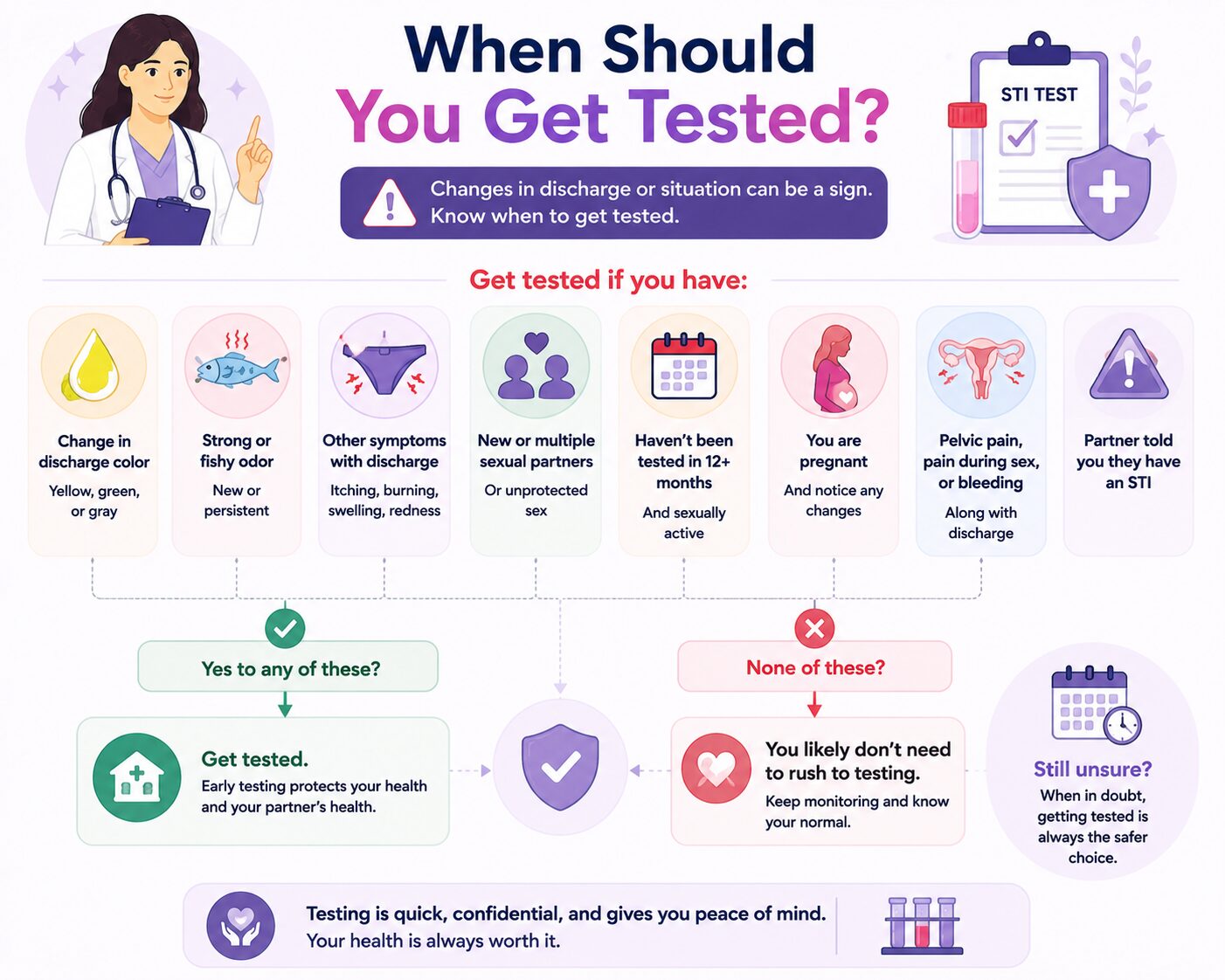
Get tested if:
- Your discharge has changed color significantly especially to yellow, green, or gray
- You notice a strong or fishy odor that is new or persistent
- You have discharge alongside itching, burning, swelling, or redness
- You have had unprotected sex or a new sexual partner
- You have not been tested for STIs in the past 12 months and are sexually active
- You are pregnant and notice any unusual discharge changes
- You have discharge with pelvic pain, pain during sex, or bleeding between periods
- You have been told a recent partner has an STI
You likely do not need to rush to testing if:
- Your discharge is clear or white, has no odor, and you have no other symptoms
- The change corresponds clearly with your cycle for example, increased clear discharge around ovulation
- You have recently started a new hormonal contraceptive and notice more discharge with no other symptoms
When in doubt, getting tested is always the safer and more informed choice. Our STI/STD testing services provide confidential, accurate testing with compassionate care. And if getting to a clinic feels difficult, it is worth knowing how telehealth makes reproductive care more accessible allowing you to speak with a provider from home before deciding on next steps.
Discharge During Pregnancy
Discharge often increases during pregnancy due to hormonal shifts and increased blood flow to the pelvic area. Normal pregnancy discharge is typically clear to white, mild-smelling, and thin.
Discharge that is green, yellow, strongly odored, or accompanied by itching during pregnancy should be evaluated promptly, as some infections during pregnancy carry additional risks and require treatment.
Any watery discharge that feels like a slow leak of fluid during pregnancy should be reported to your provider immediately, as this may indicate premature rupture of membranes.
Our women’s primary care services include reproductive health support at every stage from routine care to pregnancy-related concerns.
Discharge and Hormonal Contraception
Starting or changing hormonal birth control can affect discharge. Some people notice more discharge, while others notice less. These changes are generally normal as the body adjusts to new hormone levels.
If you have recently started a new contraceptive method and are concerned about discharge changes, our birth control and contraceptive services team can help you understand what to expect and when further evaluation is needed.
Practical Checklist: Monitoring Your Discharge
Use this checklist to track changes that matter:
- ☐ Note the color of your discharge regularly
- ☐ Pay attention to texture thin, thick, clumpy, or frothy
- ☐ Notice any smell mild is normal, strong or fishy is not
- ☐ Track changes relative to your cycle stage
- ☐ Note any accompanying symptoms itching, burning, pain, bleeding
- ☐ Record any recent changes new partner, new contraceptive, antibiotics, illness
- ☐ Schedule STI testing if you have not been tested in over 12 months and are sexually active
Common Mistakes to Avoid
Over-washing or douching
The vagina is self-cleaning. Douching disrupts the natural bacterial balance and can actually increase the risk of BV and other infections. Avoid internal cleaning products entirely.
Assuming discharge always means infection
Many people worry unnecessarily about normal discharge. Understanding your cycle reduces anxiety and helps you identify genuine changes more accurately.
Self-treating without a diagnosis
Using over-the-counter yeast infection treatments without confirming you actually have a yeast infection can delay treatment for the actual cause such as BV or an STI and worsen the situation.
Ignoring asymptomatic changes
Some infections produce no noticeable symptoms. Relying solely on how you feel is not a reliable measure of your STI status. Regular testing is the only way to know.
Skipping testing because of embarrassment
STI testing is routine and a normal part of reproductive healthcare. We offer discreet and confidential reproductive care designed to make the process as comfortable as possible your privacy is always protected.
Important Warnings
- Persistent unusual discharge that does not resolve within a few days warrants medical evaluation regardless of other symptoms
- Untreated infections like chlamydia and gonorrhea can lead to pelvic inflammatory disease (PID) understanding how untreated infections can affect reproductive health is an important reason not to delay care
- Some STIs can be passed to a partner even without visible symptoms
- Discharge changes during pregnancy always warrant prompt attention
- No article, app, or online symptom checker replaces a proper clinical evaluation and laboratory testing
Frequently Asked Questions
Is it normal to have a discharge every day?
Yes, for many people daily discharge is completely normal. The amount varies between individuals and throughout the menstrual cycle. As long as the color, smell, and texture fall within the normal range described above, daily discharge is not a cause for concern.
What color discharge is a sign of infection?
Yellow, green, gray, or frothy discharge is most commonly associated with infection. White cottage-cheese-textured discharge typically indicates a yeast infection. Clear or white discharge without odor or other symptoms is generally normal.
Can stress affect vaginal discharge?
Yes. Stress can disrupt hormonal balance and the immune system, which may affect the vaginal environment and discharge. Illness, antibiotics, and significant lifestyle changes can also alter discharge temporarily.
Does discharge mean I have an STI?
Not necessarily. Most discharge is normal or related to a non-sexually-transmitted condition like BV or a yeast infection. However, certain discharge changes are associated with STIs particularly chlamydia, gonorrhea, and trichomoniasis. The only reliable way to know your STI status is through testing.
Can I test myself at home for vaginal infections?
Some at-home tests exist for BV and pH imbalance, and at-home STI test kits are available for certain infections. However, home tests vary in accuracy and do not cover all infections. A clinical test from a qualified provider remains the most reliable option.
How often should I get STI tested?
General guidance for sexually active people is at least once per year. More frequent testing every three to six months is recommended if you have multiple partners, do not consistently use barrier contraception, or have been exposed to an STI. Your provider can give personalized guidance based on your situation.
Can hormonal birth control change my discharge?
Yes. Hormonal contraceptives can increase or decrease discharge and change its consistency. This is generally normal. If you are concerned about discharge changes after starting a new contraceptive, our birth control and contraceptive services team can help clarify what is expected and what needs attention.
What is the difference between BV and a yeast infection?
BV typically produces thin, gray or white discharge with a fishy odor, and itching may be mild or absent. A yeast infection produces thick, white, clumpy discharge that is usually odorless, with significant itching and burning. Both require different treatments, which is why diagnosis before treatment matters.
Final Takeaway
Vaginal discharge is a normal, healthy part of how your body functions. Most discharge is nothing to worry about. But changes in color, smell, texture, or amount especially when combined with other symptoms like itching, burning, or pelvic pain are your body’s signal that something may need attention.
The most important thing you can do for your reproductive health is know your own normal, track changes when they happen, and get tested when something shifts. Untreated infections do not always resolve on their own and can lead to complications that affect long-term health.
If you have noticed changes in your discharge, have not been tested recently, or simply want peace of mind, schedule a confidential appointment with our care team today.
Suggested External Sources
- Centers for Disease Control and Prevention (CDC) — STI treatment guidelines and infection statistics: https://www.cdc.gov/std
- Office on Women’s Health (U.S. Department of Health & Human Services) — Vaginal discharge and vaginal health: https://www.womenshealth.gov
- World Health Organization (WHO) — Sexual and reproductive health guidelines: https://www.who.int/reproductivehealth
- American College of Obstetricians and Gynecologists (ACOG) — Clinical guidance on vaginal infections: https://www.acog.org
- Planned Parenthood — Plain-language reproductive health information: https://www.plannedparenthood.org

Dr. James Carter is a board-certified physician and lead clinician at Serenity Choice Health, specializing in reproductive health access and medication abortion protocols. With over 20+ years of experience, he combines clinical expertise with patient-centered care to ensure safe, compassionate, and confidential reproductive healthcare.