
If you take Ozempic, Wegovy, Mounjaro, Zepbound, or another GLP-1 medication and have an unintended pregnancy, you may wonder whether you can safely use abortion pills.
The short answer is that there is not established evidence showing that semaglutide or tirzepatide directly prevents mifepristone and misoprostol from working. However, the situation deserves individual medical review because GLP-1 medications can slow stomach emptying and commonly cause nausea, vomiting, diarrhea, constipation, and abdominal discomfort.
Medication abortion generally uses mifepristone followed by misoprostol. Mifepristone is taken orally, while misoprostol may be administered by a route such as buccal, depending on the prescribed regimen.
Because your current medications, pregnancy duration, medical history, and symptoms can affect the appropriate plan, tell your abortion provider about every prescription medication you are taking before starting abortion pills.
Can You Take Abortion Pills While Taking Ozempic?
There is no established FDA-listed direct drug interaction between semaglutide products such as Ozempic and the mifepristone-misoprostol medication-abortion regimen.
However, that does not mean every person can automatically follow the same plan.
Ozempic contains semaglutide, a GLP-1 receptor agonist. FDA labeling states that semaglutide delays gastric emptying and can potentially affect the absorption of some oral medications. The same labeling also identifies nausea, vomiting, diarrhea, abdominal pain, constipation, and decreased appetite among common adverse effects.
Mifepristone is an oral medication, so your provider should know that you are taking a GLP-1 drug when determining the safest approach for you.
The important distinction is this:
A possible effect on medication absorption is not the same thing as a documented interaction that makes abortion pills ineffective.
Your clinician can consider your medication schedule, symptoms, pregnancy duration, and other health factors before prescribing treatment.
What About Abortion Pills While Taking Wegovy?

Wegovy also contains semaglutide, so many of the same considerations apply.
The FDA labeling for Wegovy states that semaglutide delays gastric emptying and has the potential to affect absorption of concomitantly administered oral medications. It also warns about its use during pregnancy and states that Wegovy should be discontinued when pregnancy is recognized.
That pregnancy warning is important, but it should not be interpreted as a reason to independently change your treatment plan.
If you discover that you are pregnant while taking Wegovy, contact the clinician who manages your medication and tell your abortion provider that you are using it. Your providers can coordinate the next steps rather than having you make medication changes on your own.
If you are researching how medication abortion works before your appointment, you can also review how the abortion pill works and what to expect.
Does Semaglutide Affect How Abortion Pills Work?
Semaglutide can slow gastric emptying, which is why clinicians consider possible effects on oral medications. However, current FDA labeling does not establish that semaglutide makes mifepristone ineffective.
Mifepristone’s approved medication-abortion regimen uses an oral dose followed by misoprostol 24 to 48 hours later.
This means the practical concern is not simply whether two drugs are “compatible.” Your provider may also need to consider:
- Whether you are experiencing significant nausea or vomiting
- Whether you can keep oral medication down
- Which GLP-1 medication you use
- When your last GLP-1 dose was taken
- Your current dose and recent dose changes
- How far along the pregnancy is
- Other prescription or over-the-counter medications
- Your medical history and possible ectopic-pregnancy risk
Do not change the timing or dose of your GLP-1 medication specifically to make an abortion pill work unless the clinician managing your medication advises you to do so.
For additional information about the medication-abortion process, you can read this guide to medication abortion.
Can You Take Mifepristone While Using Ozempic or Wegovy?
Mifepristone is the first medication in the commonly used two-drug medication-abortion regimen. It blocks progesterone, a hormone needed to maintain the pregnancy. Misoprostol is then used to cause uterine contractions and help empty the uterus.
Current mifepristone labeling identifies several important drug interactions, particularly involving CYP3A4 medications, but GLP-1 medications such as semaglutide are not listed as a specific contraindication.
That said, the absence of a listed direct interaction does not eliminate the need for individualized medical review.
One practical issue is vomiting. If you vomit shortly after taking an oral medication, your provider may need to determine whether enough medication was absorbed. Because GLP-1 medications can cause nausea and vomiting, this is particularly relevant to discuss before medication abortion.
If vomiting occurs after taking abortion medication, contact the abortion provider who prescribed the medication rather than automatically repeating a dose.
Can You Take Misoprostol While Using a GLP-1 Drug?
Misoprostol is the second medication commonly used in a medication-abortion regimen. Unlike mifepristone, it may be administered through routes that do not depend on swallowing the medication as an ordinary oral tablet.
For example, FDA labeling for the standard mifepristone regimen specifies buccal misoprostol, in which the tablets are placed between the cheek and gum for 30 minutes before remaining medication is swallowed.
Therefore, the delayed gastric-emptying effect of a GLP-1 medication should not be assumed to mean that misoprostol will fail.
However, misoprostol itself commonly causes cramping, bleeding, nausea, vomiting, and diarrhea.
If you already experience significant gastrointestinal side effects from your GLP-1 medication, tell your abortion provider. They can explain what symptoms are expected and what symptoms require additional evaluation.
For readers concerned about nausea specifically, Serenity Choice Health also provides information about nausea after taking abortion medication.
What If You Vomit After Taking Abortion Pills?
Vomiting can be especially confusing when you are taking both a GLP-1 medication and abortion medication because nausea and vomiting can be side effects of either treatment.
Do not assume that vomiting means the abortion medication did not work.
Instead, contact the clinician or abortion provider who prescribed your medication and tell them:
- Which abortion medication you took
- When you took it
- Which GLP-1 medication you use
- When your last GLP-1 dose was taken
- When vomiting started
- Whether you were able to keep the medication down
- Whether you have bleeding, cramping, fever, severe pain, or other symptoms
The FDA-approved mifepristone information emphasizes contacting a healthcare provider when concerning symptoms occur after medication abortion.
For more specific information, see what to know if you vomit after taking abortion pills.
Should You Stop Ozempic or Wegovy Before an Abortion?
Do not stop, skip, or change your GLP-1 medication schedule solely because you are planning a medication abortion unless the clinician managing your medication tells you to.
The FDA labeling for semaglutide products contains specific pregnancy-related recommendations. For example, the current Ozempic labeling advises discontinuation in women at least two months before a planned pregnancy because semaglutide has a long washout period.
But an unplanned pregnancy followed by a decision to have an abortion is different from planning a future pregnancy.
Your healthcare team can determine what is appropriate based on your individual circumstances. This is especially important if you use a GLP-1 drug to manage diabetes or another medical condition.
Do not make a medication change that could affect your health without discussing it with the appropriate clinician.
What About Mounjaro, Zepbound and Other GLP-1 Medications?
The question is not limited to Ozempic and Wegovy.
Other commonly recognized GLP-1-related medications include:
- Mounjaro — tirzepatide
- Zepbound — tirzepatide
- Rybelsus — oral semaglutide
- Saxenda — liraglutide
- Other medications in the GLP-1 or related incretin-therapy category
Tirzepatide products also delay gastric emptying and may affect the absorption of some oral medications. The FDA labeling for Zepbound specifically advises caution when oral medications are used at the same time.
This does not establish that tirzepatide directly interferes with mifepristone or misoprostol. Instead, it means your complete medication list is important when an abortion provider evaluates your situation.
If you are considering medication abortion more generally, you can also review questions women commonly ask before taking abortion pills.
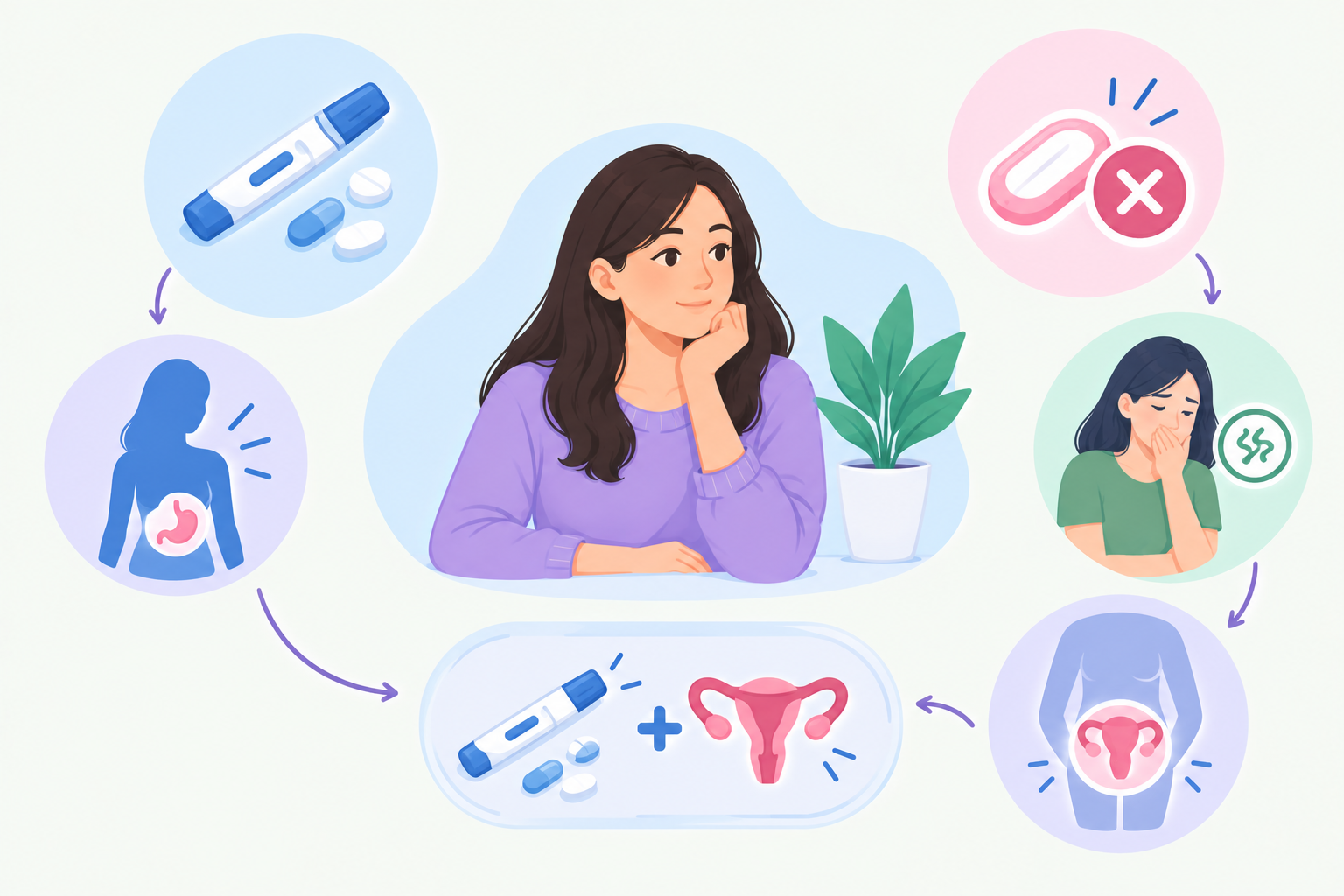
Can GLP-1 Side Effects Make an Abortion Feel Different?
Possibly.
Medication abortion itself can cause cramping, bleeding, nausea, vomiting, diarrhea, headache, dizziness, chills, and other temporary symptoms.
GLP-1 medications can also cause gastrointestinal symptoms, including nausea, vomiting, diarrhea, constipation, and abdominal discomfort.
Because the symptoms can overlap, it may sometimes be difficult to know which medication is responsible for a particular symptom.
This is one reason it is useful to tell your abortion provider about your GLP-1 medication before beginning treatment.
You should also know the warning signs that require medical attention rather than assuming they are ordinary medication side effects. For example, severe abdominal pain, prolonged heavy bleeding, fainting, or concerning symptoms that persist after treatment warrant prompt medical evaluation.
You can learn more about warning symptoms in this guide to when an abortion pill may not be working as expected.
What Should You Tell Your Abortion Provider?

When arranging a medication-abortion consultation, give the provider a complete and accurate medication list.
Tell them if you use:
- Ozempic
- Wegovy
- Mounjaro
- Zepbound
- Rybelsus
- Another GLP-1 or incretin-based medication
- Prescription medications for diabetes
- Insulin or other glucose-lowering medications
- Prescription or nonprescription pain medications
- Supplements or other regular medications
Also mention any significant medical conditions and whether you have experienced severe nausea, vomiting, abdominal pain, or other gastrointestinal symptoms.
Your provider may also ask about the first day of your last menstrual period, pregnancy symptoms, previous pregnancies, and other information needed to determine whether medication abortion is appropriate.
ACOG guidance recommends confirming pregnancy and estimating gestational age before medication abortion. For patients with a reliable menstrual history and no signs or risk factors for ectopic pregnancy, routine ultrasound is not always required.
Does Taking a GLP-1 Drug Mean You Cannot Have a Medication Abortion?
Not necessarily.
Taking a GLP-1 medication by itself does not appear in current mifepristone guidance as a general contraindication to medication abortion. Mifepristone has specific contraindications and drug-interaction considerations that providers review when determining eligibility.
The more appropriate question is whether medication abortion is suitable for you, considering your pregnancy, medical history, current medications, symptoms, and clinical circumstances.
That distinction matters because medication safety cannot always be determined from the name of one medication alone.
When Should You Contact a Healthcare Provider?
Contact your abortion provider before taking medication abortion if you use Ozempic, Wegovy, Mounjaro, Zepbound, or another GLP-1 medication and are unsure whether anything about your treatment should change.
Seek prompt medical attention for symptoms such as:
- Severe or worsening abdominal pain
- Fainting or significant weakness
- Prolonged or unusually heavy bleeding
- Persistent fever
- Severe illness or concerning symptoms
- Symptoms that your provider has specifically told you require urgent evaluation
The FDA’s current mifepristone information emphasizes follow-up and prompt evaluation of serious symptoms after medication abortion.
If you have sudden severe symptoms or believe you may have an emergency, seek emergency medical care rather than waiting for an online response.
How Serenity Choice Health Can Help
If you are considering abortion pills while taking a GLP-1 medication, a medical consultation can help you understand how your current medications fit into your abortion-care plan.
At Serenity Choice Health, you can discuss your current medications, pregnancy information, questions about medication abortion, and concerns about side effects with a healthcare professional.
For people who are considering remote care, you can also learn about telehealth abortion options and how remote care works.
If cost is a concern, you can review options for paying for abortion care without insurance.
The most important step is to provide your abortion provider with an accurate list of medications, including the name and dose of any GLP-1 drug you use. This gives the clinician the information needed to provide individualized guidance.
Key Takeaway
If you are taking Ozempic, Wegovy, Mounjaro, Zepbound, or another GLP-1 medication, you may still be able to receive medication abortion, but your provider should know about the medication before prescribing abortion pills.
Current labeling shows that GLP-1 medications can delay gastric emptying and commonly cause gastrointestinal symptoms, while current mifepristone guidance does not identify GLP-1 medications as a general contraindication.
Because the available information does not establish a simple one-size-fits-all answer, do not independently stop or change your GLP-1 medication or repeat an abortion-pill dose after vomiting. Discuss your medications, symptoms, pregnancy duration, and treatment plan with a qualified healthcare professional.
FAQ Section
Can I take abortion pills while taking Ozempic?
There is no established direct interaction showing that Ozempic makes mifepristone or misoprostol ineffective. However, Ozempic can delay gastric emptying and can cause nausea or vomiting, so your abortion provider should know that you use it before prescribing medication abortion.
Can I take abortion pills while using Wegovy?
Wegovy contains semaglutide, so similar considerations apply. Its FDA labeling notes delayed gastric emptying and pregnancy-related precautions. Tell your abortion provider that you use Wegovy and follow individualized medical guidance about your medications.
Should I stop Ozempic before taking abortion pills?
Do not independently stop or change your Ozempic schedule because you are having a medication abortion. Your clinician can determine whether any change is appropriate based on why you take the medication, your current dose, pregnancy status, and overall health.
Can GLP-1 medications make abortion-pill nausea worse?
They may contribute to overlapping gastrointestinal symptoms. GLP-1 medications commonly cause nausea and vomiting, while medication abortion can also cause nausea, vomiting, diarrhea, and cramping.
What if I vomit after taking mifepristone?
Contact the provider who prescribed the medication and tell them when you took mifepristone and when you vomited. Do not automatically take another dose unless your healthcare provider specifically instructs you to.
Can I take Mounjaro or Zepbound during a medication abortion?
Tirzepatide products such as Mounjaro and Zepbound can delay gastric emptying and may affect the absorption of some oral medications. This does not establish that they directly interfere with medication abortion, but your provider should know that you take them.

Dr. James Carter is a board-certified physician and lead clinician at Serenity Choice Health, specializing in reproductive health access and medication abortion protocols. With over 20+ years of experience, he combines clinical expertise with patient-centered care to ensure safe, compassionate, and confidential reproductive healthcare.