
A low-grade fever in the hours after taking misoprostol, the second medication in the abortion pill process is a recognized and common side effect, not automatically a sign that something is wrong. However, a fever that is too high, lasts too long, or appears at the wrong time in your recovery can signal a complication that needs medical attention.
Understanding the difference between a normal medication response and a warning sign is one of the most important things you can do to protect your health after a medication abortion.
How the Abortion Pill Causes Fever
The Role of Misoprostol
The abortion pill process typically involves two medications: mifepristone, which is taken first, and misoprostol, which is taken one to two days later. Fever is not typically associated with mifepristone. It is misoprostol that commonly triggers a fever-like response.
Misoprostol is a prostaglandin medication. Prostaglandins are compounds the body uses to regulate inflammation, temperature, and uterine activity. When misoprostol is introduced in the doses used for medication abortion, it can activate the body’s thermoregulatory system in a way that produces a temporary rise in body temperature alongside chills, cramping, and bleeding.
Why This Happens
This is a pharmacological effect of the medication, not a sign of infection. The same mechanism that makes misoprostol effective at causing uterine contractions also briefly raises body temperature in many people who take it. Understanding this helps distinguish a normal drug response from an infection developing days later.
What Is a Normal Fever After the Abortion Pill?
Expected Temperature Range
A mild temperature elevation following misoprostol typically between 99°F and 101°F (37.2°C to 38.3°C) is considered within the range of a normal medication response. This kind of low-grade fever is common and usually resolves on its own within a few hours.
Normal Timing
Fever associated with misoprostol typically appears within one to four hours of taking the medication and follows the same general timeline as the other side effects chills, cramping, and heavy bleeding. As the medication’s most intense effects subside, so does the temperature elevation.
How Long It Should Last
A fever caused by misoprostol generally resolves within four to eight hours. By the time heavy bleeding begins to taper and cramping eases, most people find that their temperature returns to normal as well.
When Fever Becomes a Warning Sign
This is where the distinction becomes critical. Not all fever after the abortion pill is a normal side effect. Certain patterns of fever indicate that something more serious may be developing.
The 24-Hour Rule
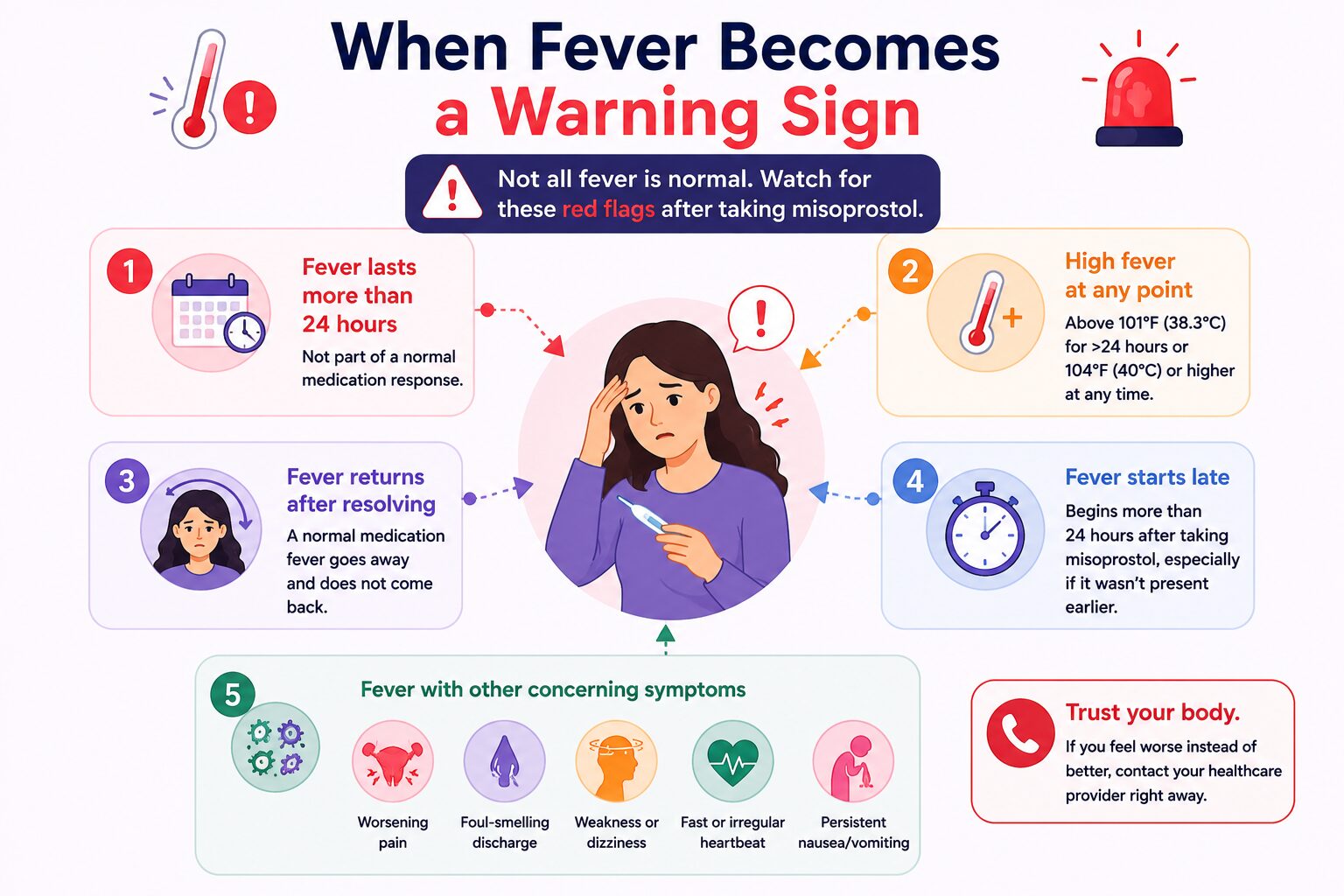
Fever that persists beyond twenty-four hours after taking misoprostol is not a normal part of the medication’s side effect profile. At this point, fever is more likely to indicate an infection developing in the uterus rather than the prostaglandin response of the medication itself.
Fever That Returns After Resolving
If your fever went away and then came back, this is a pattern associated with infection rather than a medication side effect. A normal misoprostol fever resolves and does not return.
High Fever at Any Point
A fever above 101°F (38.3°C) that lasts more than twenty-four hours, or any fever reaching 104°F (40°C) or higher at any time, requires immediate medical evaluation. Do not wait to see if it resolves on its own at these temperatures.
Fever That Starts Late
Fever that begins more than twenty-four hours after taking misoprostol, especially if it was not present in the initial hours is more likely to be infection-related than drug-related. A fever starting on day two, three, or later in your recovery should prompt a call to your provider.
Signs of Infection to Watch For Alongside Fever
Fever alone can sometimes be misleading. When fever appears together with other symptoms, the picture becomes clearer. Contact your healthcare provider if you have fever accompanied by any of the following:
- Foul-smelling vaginal discharge
- Increasing abdominal pain or pelvic tenderness rather than improving pain
- Abdomen that feels tender to the touch
- Feeling significantly worse rather than gradually better over time
- Rapid or irregular heartbeat
- Chills that begin more than twenty-four hours after taking misoprostol
- Persistent nausea or vomiting beyond the first day
- Weakness or dizziness that is worsening
The combination of fever with worsening pain and foul discharge is particularly concerning and warrants same-day evaluation.
Normal vs Concerning Fever: A Clear Comparison
| Feature | Normal After Misoprostol | Possible Infection |
| When it starts | Within 1 to 4 hours of medication | 24+ hours after medication |
| Temperature | Below 101°F | Above 101°F persisting over 24 hours |
| Duration | Resolves within 4 to 8 hours | Persists or worsens over time |
| Pattern | Appears once, then resolves | Returns after resolving, or does not resolve |
| Other symptoms | Cramping, chills, bleeding | Worsening pain, foul discharge, weakness |
| Overall trajectory | Gradual improvement | Feeling increasingly unwell |
Infection After Medication Abortion: What You Should Know
How Common Is It?
Serious infection following medication abortion is uncommon. Estimates from clinical studies place the rate of serious infection at less than one percent of procedures. However, rare does not mean impossible, and when infection does occur, early treatment makes a significant difference in outcomes.
What Type of Infection Can Occur?
The most common infection following medication abortion is endometritis, an infection of the uterine lining. In very rare cases, a more serious systemic infection called sepsis can develop. Sepsis progresses quickly and is a medical emergency requiring immediate care.
Why Early Detection Matters
Endometritis caught early responds well to antibiotic treatment. The same infection left untreated for several days can escalate into a more serious condition. This is why the guidance around fever timing is not overly cautious; it exists because the treatment window matters.
Practical Steps: What to Do If You Have Fever After the Abortion Pill
In the First Few Hours
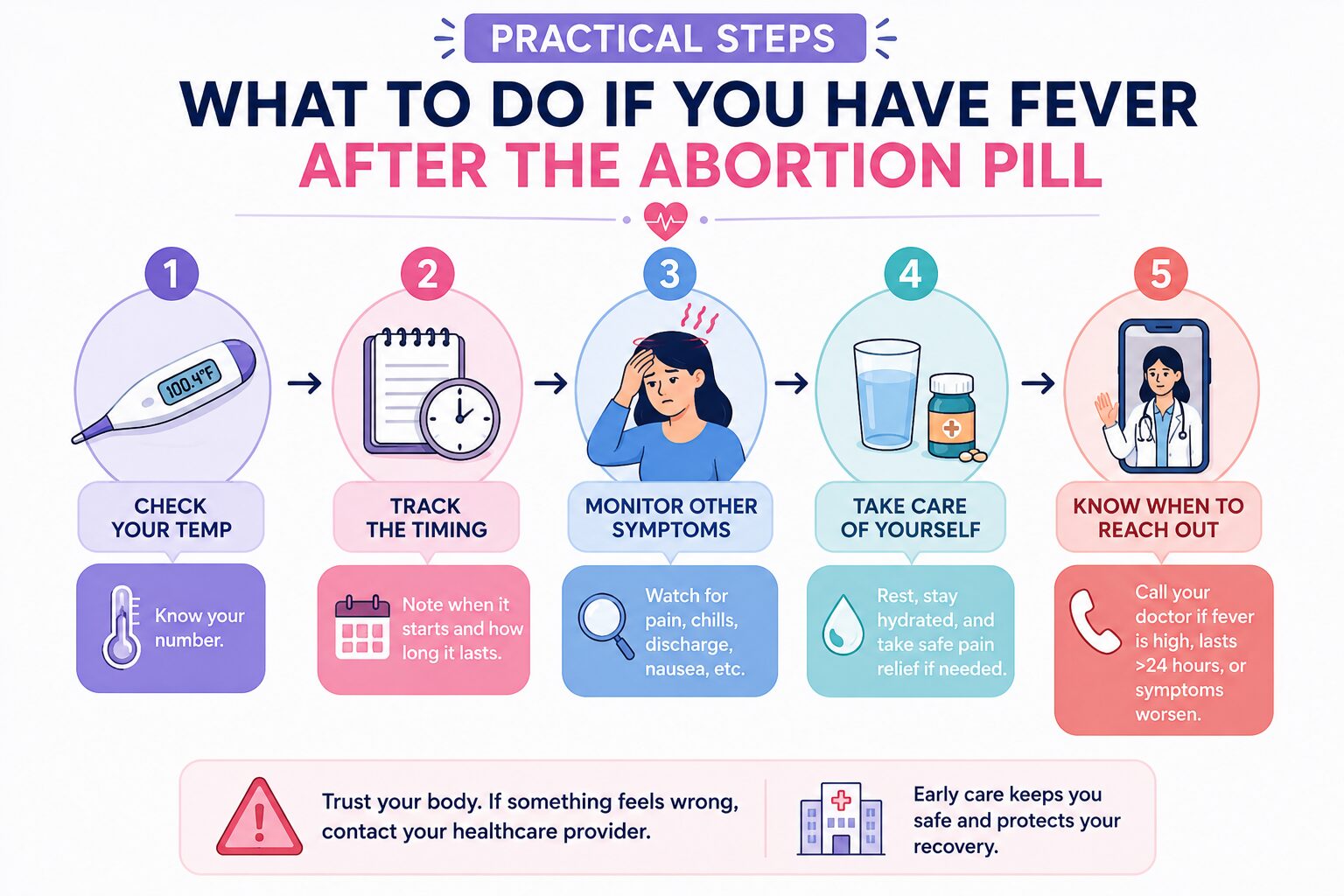
Take note of when the fever started in relation to when you took misoprostol. A low-grade fever appearing within the first few hours alongside chills, cramping, and bleeding is expected. Rest, stay hydrated, and monitor your temperature with a thermometer rather than guessing.
After the First 24 Hours
If your temperature has not returned to normal within twenty-four hours of taking misoprostol, contact your healthcare provider. Do not wait to see if it resolves on its own beyond this point.
Taking Your Temperature Correctly
Use an oral or axillary thermometer and check your temperature at regular intervals if you are concerned. Note the readings and the times so you can give your provider an accurate picture of what has been happening.
Over-the-Counter Fever Management
Some providers recommend ibuprofen or acetaminophen for managing discomfort and mild fever during the medication abortion process. Always follow your specific provider’s instructions on this, and do not assume it is appropriate to take without guidance.
When to Go to the Emergency Room
Some situations require emergency care rather than a scheduled appointment or telehealth call:
- Fever at or above 104°F (40°C) at any point
- Signs of sepsis: rapid heart rate, confusion or disorientation, extreme weakness, very low blood pressure, difficulty breathing
- Severe worsening abdominal pain that is not responding to pain management
- Heavy bleeding soaking more than two thick pads per hour for two or more consecutive hours
- Fainting or near-fainting
If any of these apply, go directly to an emergency room or call emergency services. Do not wait for a provider callback in these circumstances.
Checklist: Monitoring Your Recovery After the Abortion Pill
Use this checklist to track your recovery in the days following the abortion pill:
- Have a thermometer available before you take misoprostol
- Check and record your temperature at the onset of symptoms and every few hours during the peak phase
- Note the time misoprostol was taken and when fever began
- Monitor whether fever is trending down or persisting
- Watch for any new symptoms appearing after the first twenty-four hours
- Contact your provider if fever persists beyond twenty-four hours
- Attend your scheduled follow-up appointment to confirm the abortion was complete
- Know the address of your nearest emergency room before you begin the process
Common Mistakes to Avoid
Treating all fever the same. A low-grade fever in the first few hours is expected. A fever above 101°F lasting more than a day is not. The distinction matters and affects what action to take.
Not using a thermometer. Guessing whether you have a fever based on how you feel is unreliable. Having a thermometer on hand gives you objective information to share with your provider.
Assuming fever after day one is still the medication. The medication’s direct effect on temperature resolves within hours. Fever appearing or continuing beyond twenty-four hours deserves evaluation, not reassurance.
Waiting too long to call. Many people hesitate to contact their provider out of concern about being an inconvenience or uncertainty about whether symptoms are serious enough. When in doubt, call. Providers expect follow-up questions after medication abortion.
Not attending follow-up care. Follow-up after medication abortion whether via telehealth or in person is how providers confirm the abortion was complete and catch any early signs of complication. Skipping it because you feel fine is not advisable.
Frequently Asked Questions
Is it normal to have a fever after the abortion pill?
A low-grade fever generally below 101°F in the first few hours after taking misoprostol is a recognized and common side effect caused by the medication’s prostaglandin activity. It typically resolves on its own within four to eight hours as the initial effects of the medication pass.
What temperature should I be worried about after the abortion pill?
A fever above 101°F (38.3°C) that lasts more than twenty-four hours after taking misoprostol is a warning sign that warrants contact with your healthcare provider. Any fever reaching 104°F (40°C) or higher at any point requires immediate emergency evaluation.
How long does fever last after misoprostol?
Fever caused by misoprostol as a medication side effect typically lasts between one and eight hours, peaking during the most intense phase of cramping and bleeding. If fever persists beyond twenty-four hours, it is no longer likely to be the medication’s direct effect.
Can fever after the abortion pill mean infection?
Yes, fever that appears or continues more than twenty-four hours after taking misoprostol, especially when accompanied by worsening pain, foul-smelling discharge, or a general feeling of getting worse rather than better, may indicate a uterine infection and should be evaluated promptly.
What does infection feel like after a medication abortion?
Infection after medication abortion typically presents as persistent fever above 101°F, increasing or worsening abdominal pain rather than improving pain, foul-smelling vaginal discharge, and a general sense of feeling worse as the days progress rather than recovering. These signs differ clearly from the brief, acute discomfort of the medication itself.
Should I take ibuprofen or acetaminophen for fever after the abortion pill?
Some providers recommend over-the-counter pain and fever relievers to help manage discomfort during the medication abortion process. Always follow the specific instructions your provider gave you rather than assuming it is safe to take additional medications without guidance.
Can I manage fever at home or do I need to go to a clinic?
A low-grade fever in the first few hours can generally be monitored at home. If fever persists beyond twenty-four hours, reaches above 101°F and is not improving, or is accompanied by other concerning symptoms, contact your provider rather than continuing to manage it at home.
When should I go to the emergency room for fever after the abortion pill?
Go to the emergency room immediately if your fever reaches 104°F or higher, if you show signs of sepsis such as rapid heartbeat, confusion, or extreme weakness, if you experience severe worsening abdominal pain, or if you are soaking through more than two thick pads per hour for two consecutive hours.
Final Takeaway
Fever after the abortion pill is something many people experience, and in the first few hours following misoprostol, a mild temperature elevation is an expected part of the medication’s effect on the body. It is not a sign of infection on its own.
What changes the picture is timing, persistence, and what else is happening alongside the fever. A fever that lasts beyond twenty-four hours, appears late in recovery, climbs above 101°F, or comes with worsening pain and unusual discharge is the version that requires medical evaluation not because complications are common, but because catching them early matters.
Understanding your own recovery is easier with the right information and follow-up support. Telehealth abortion care includes follow-up consultations specifically designed to answer questions about your recovery and assess any symptoms of concern. If you need in-person evaluation of fever or other post-abortion symptoms, in-clinic abortion services are available for hands-on assessment and treatment.
For more on what to expect during recovery, the guide on bleeding after the abortion pill covers what normal and abnormal bleeding patterns look like. The misoprostol guide explains the full side effect timeline in detail. And if you are uncertain whether the abortion pill worked, this resource on how to know if the abortion pill worked walks through the signs of a complete medication abortion.
Suggested External Sources
- Planned Parenthood
- American College of Obstetricians and Gynecologists (ACOG)
- World Health Organization (WHO)
- Mayo Clinic
- National Health Service (NHS)
Here are working links for each suggested source:
| Source | Page | URL |
|---|---|---|
| Planned Parenthood | What to expect after the abortion pill (side effects, warning signs) | https://www.plannedparenthood.org/learn/abortion/the-abortion-pill/what-can-i-expect-after-i-take-the-abortion-pill Planned Parenthood |
| Planned Parenthood | The Abortion Pill overview | https://www.plannedparenthood.org/learn/abortion/the-abortion-pill |
| ACOG | Medication Abortion (patient FAQ) | https://www.acog.org/womens-health/faqs/medication-for-achieving-an-abortion |
| WHO | Abortion care guideline | https://www.who.int/publications/i/item/9789240039483 |
| Mayo Clinic | Medical (drug-induced) abortion overview | https://www.mayoclinic.org/tests-procedures/medical-abortion/about/pac-20394687 |
| NHS | Abortion care / what happens | https://www.nhs.uk/conditions/abortion/ |

Dr. James Carter is a board-certified physician and lead clinician at Serenity Choice Health, specializing in reproductive health access and medication abortion protocols. With over 20+ years of experience, he combines clinical expertise with patient-centered care to ensure safe, compassionate, and confidential reproductive healthcare.