
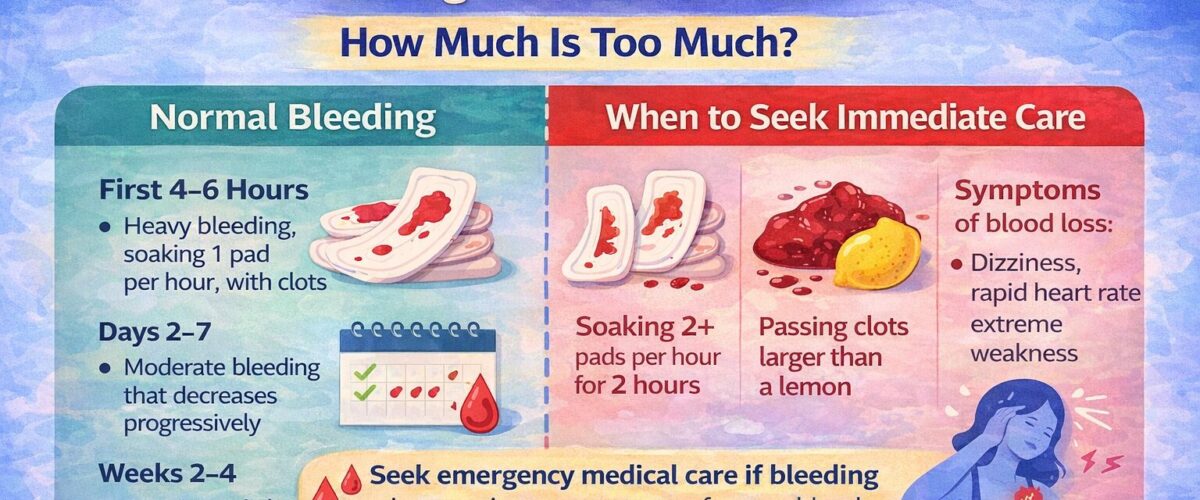
Heavy bleeding is a normal part of a medical abortion, especially in the first 4-6 hours after taking misoprostol. However, knowing the thresholds for concern can help you recognize when to seek immediate care:
- Normal Bleeding:
- First 4-6 hours: Heavy bleeding soaking 1 pad per hour, with clots.
- Days 2-7: Moderate bleeding that decreases progressively.
- Weeks 2-4: Spotting or light bleeding.
- When to Seek Immediate Care:
- Soaking 2+ pads per hour for 2 hours: Indicates hemorrhagic bleeding.
- Passing clots larger than a lemon.
- Symptoms of blood loss: Dizziness, rapid heart rate, or extreme weakness.
Critical Action: If bleeding becomes excessively heavy, or if symptoms of severe blood loss or complications arise, seek emergency medical care immediately.
Why Medical Abortion Causes Bleeding?
The abortion pill regimen uses two medications in sequence. Mifepristone, taken first, blocks progesterone receptors throughout the body. Progesterone is the hormone that maintains the uterine lining and sustains early pregnancy. When progesterone signaling is disrupted by mifepristone, the uterine lining begins to destabilize and the pregnancy loses its hormonal support system.
Misoprostol, taken 24 to 48 hours later, acts on smooth muscle throughout the uterus triggering powerful contractions that physically expel the pregnancy tissue. The combination of uterine lining breakdown and active muscular expulsion is what produces the heavy bleeding and passage of clots that characterizes medical abortion.
This is a physiologically significant process. Describing medication abortion bleeding as similar to a heavy period is a clinical understatement that leaves patients unprepared for what they actually experience particularly at gestational ages beyond six weeks. The bleeding after misoprostol is typically heavier than any period most patients have experienced, and understanding that is part of being genuinely informed before you begin.
How Much Bleeding After the Abortion Pill Is Normal?
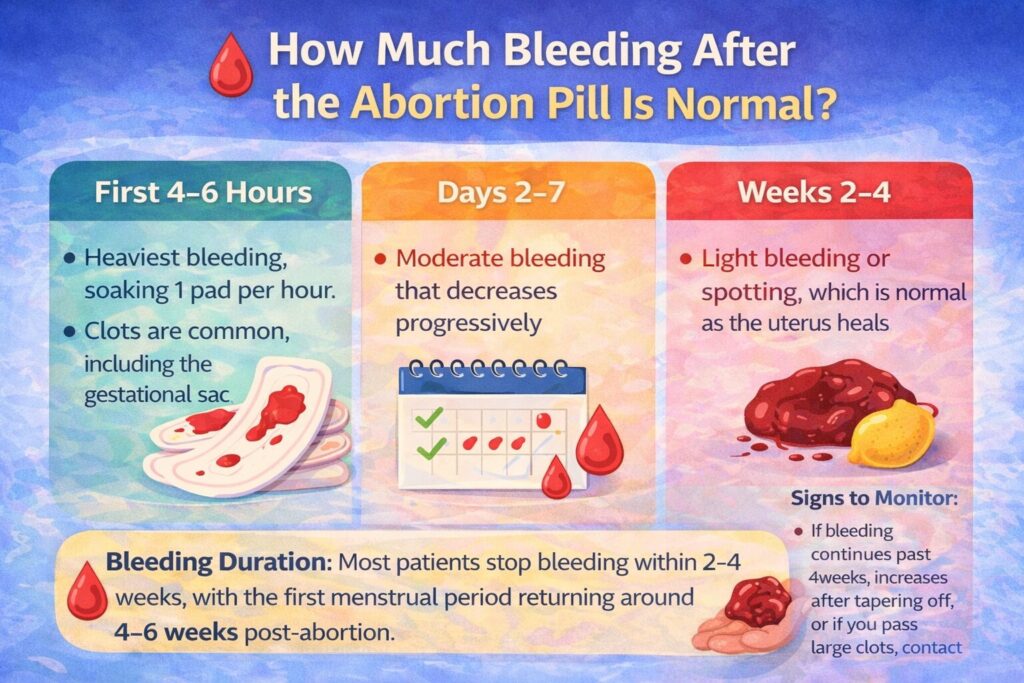
Normal post-abortion bleeding follows a recognizable clinical pattern across the recovery timeline. Understanding this pattern helps you identify when something has deviated from expected.
The First Four to Six Hours After Misoprostol
This is the period of heaviest bleeding for most patients. Bleeding typically begins within one to four hours of misoprostol administration and intensifies progressively over the following hours. Soaking through a pad every hour during this peak phase is expected. Passing clots during this window is also expected including clots that may be larger than what you associate with a typical menstrual period. The gestational sac and pregnancy tissue are typically passed during this phase, often accompanied by the most intense cramping of the entire process.
Days Two Through Seven
After the initial heavy phase, bleeding after the abortion pill should begin decreasing not necessarily to light flow immediately, but trending progressively downward. Moderate bleeding with occasional smaller clots during this period remains within the expected range. The key word is trending: the overall direction of bleeding should be toward less, not more, as the days progress.
Weeks Two Through Four
Spotting or light bleeding continuing for one to three weeks after medication abortion is clinically normal as the uterine lining fully resolves. This late-phase bleeding is typically light comparable to the end of a normal menstrual period. Spotting that continues for up to four weeks post-procedure, while often alarming to patients, is not uncommon and does not automatically indicate a complication.
When Does Bleeding After Abortion Stop?
Most patients experience complete cessation of bleeding within two to four weeks of medication abortion. The first post-abortion menstrual period typically returns four to six weeks after the procedure as the hormonal cycle resets. Bleeding that resumes or increases after initially decreasing, or that extends beyond four weeks without improvement, warrants clinical evaluation.
How Much Bleeding Is Too Much: The Clinical Thresholds
This is the information patients most need and most struggle to find stated clearly. Here are the specific clinical thresholds that distinguish heavy-but-expected from dangerous-and-emergent:
The Two-Pad Rule The Primary Emergency Threshold
The most widely used and clinically reliable threshold for identifying hemorrhagic bleeding after abortion is soaking through two or more thick full-size menstrual pads per hour for two consecutive hours. This rate of blood loss indicates a level of hemorrhage that requires emergency evaluation not monitoring at home, not calling a provider to ask what to think, but going to an emergency room.
This threshold applies to the entire post-abortion period, not just the first few hours. Heavy bleeding that meets this criterion three days after taking misoprostol is just as urgent as heavy bleeding that meets it in the first four hours.
Large Blood Clots After Abortion
Blood clots after the abortion pill are expected during the initial heavy bleeding phase. The size of clots that crosses into concerning territory is clots larger than a lemon approximately the size of a clenched fist or larger. Passing one very large blood clot after abortion alongside normal-range bleeding warrants a provider call. Passing multiple huge blood clots after abortion, or passing them accompanied by the symptoms below, warrants emergency evaluation.
Physical Symptoms of Blood Loss
The physical response your body has to significant blood loss is often more telling than pad counts alone. Lightheadedness, dizziness, or feeling faint during or after heavy bleeding indicates that blood loss has reached a level affecting systemic circulation. A rapid or pounding heart rate, unusual pallor or clamminess, confusion, or extreme weakness are signs of hemodynamic compromise your body struggling to compensate for blood volume loss. Any of these symptoms accompanying heavy bleeding constitute an emergency regardless of whether the two-pad threshold has been met.
What Causes Excessive Bleeding After Medical Abortion?
Understanding the clinical mechanisms behind abnormal post-abortion bleeding helps explain why certain situations produce more blood loss than the expected range and why some require different interventions.
Incomplete Abortion and Retained Tissue
The most common cause of prolonged or excessive bleeding after the abortion pill is incomplete abortion a situation in which the pregnancy has been terminated but some pregnancy tissue remains inside the uterus rather than being fully expelled. When retained tissue is present, the uterus cannot contract down effectively around an empty cavity, and bleeding continues at a higher level than expected because the normal physiological trigger for uterine toning an empty, contracted uterus has not been fully achieved.
Incomplete abortion is more common at later gestational stages particularly beyond nine weeks reflecting the increased complexity of the expulsion process at more advanced gestational ages. This is one of the clinical reasons why medication abortion within the optimal early window, particularly before seven weeks, consistently produces fewer complications and more complete outcomes.
Treatment for incomplete abortion depends on clinical severity. In many cases, an additional dose of misoprostol is sufficient to complete expulsion of retained tissue. In more significant cases where tissue volume is substantial or infection has developed, a vacuum aspiration procedure provides definitive uterine evacuation safely and with minimal discomfort.
Uterine Atony
Uterine atony occurs when the uterus does not contract adequately following pregnancy expulsion. Rather than toning down to control bleeding through muscular contraction, an atonic uterus remains relaxed, allowing blood vessels to continue bleeding without the physiological tamponade that uterine muscle contraction normally provides. Uterine atony is treated with uterotonic medications drugs that stimulate uterine contraction and responds well to early treatment.
Gestational Age and Bleeding Volume
The volume of bleeding after misoprostol is directly correlated with gestational age at the time of the abortion. A patient at five weeks will experience meaningfully different bleeding than a patient at nine weeks not because anything is wrong in either case, but because the volume of pregnancy tissue being expelled and the degree of uterine work required to expel it are both larger at more advanced gestational stages. Setting appropriate expectations for bleeding volume based on gestational age is an important component of pre-procedure patient education.
Blood Clots After Medical Abortion: What Is Expected vs. What Is Not
Clotting is a natural physiological response to bleeding, and passage of clots during medication abortion is expected and normal during the initial heavy bleeding phase. The clinical distinction that matters is size and timing.
Clots the size of a grape or smaller during the first four to six hours after misoprostol are within the expected range. Clots the size of a lemon or larger large blood clots after abortion particularly if multiple, are concerning. Blood clots after abortion pill use that appear on day three, four, or five when initial heavy bleeding has already begun to subside may indicate incomplete abortion with retained tissue requiring clinical evaluation. Passing large blood clots several days after the heaviest initial phase has passed is not a normal trajectory and warrants provider contact.
How Long Do You Bleed After the Abortion Pill?
One of the most frequently searched questions about medication abortion recovery is how long bleeding lasts and the honest clinical answer involves a range rather than a single number, because individual variation is real and significant.
The heaviest bleeding phase typically lasts four to six hours after misoprostol. Moderate to light bleeding typically continues for one to two weeks. Light spotting can persist for up to four weeks in some patients. The first return of a normal menstrual period typically occurs four to six weeks after the abortion as the hormonal cycle reestablishes itself.
Still bleeding three weeks after abortion, or still bleeding five weeks after abortion, can fall within the outer range of normal but only if the bleeding is light spotting rather than active flow, and only if it is consistently decreasing rather than increasing or fluctuating. Bleeding that is still moderate or heavy at three weeks post-procedure, or that increases after having decreased, is not within the normal range and requires clinical evaluation.
How to Stop Bleeding After Abortion Pill: What You Can and Cannot Do at Home
Ibuprofen helps manage cramping during medication abortion and has mild effects on prostaglandin-mediated bleeding, but it is not a reliable mechanism for stopping heavy bleeding after the abortion pill. Resting and avoiding strenuous activity in the days following medication abortion is appropriate supportive care. Staying well hydrated supports recovery.
What you cannot do at home is treat the causes of abnormal bleeding incomplete abortion, uterine atony, or retained tissue. These require clinical intervention. The most important thing you can do if bleeding feels excessive is contact a provider or go to an emergency room rather than trying to manage it independently.
Serenity Choice Health: Expert Medication Abortion Care with Full Clinical Support
At Serenity Choice Health, we specialize exclusively in medication abortion, telehealth abortion, and in-person abortion services and we believe that truly comprehensive abortion care means patients are never left alone to figure out whether what they are experiencing is normal.
Before your procedure, our clinical team provides personalized, gestational-age-specific guidance on what to expect from bleeding and cramping not generic descriptions, but realistic preparation based on where you actually are in your pregnancy. After your procedure, our structured follow-up protocol confirms complete abortion and provides a direct clinical contact point for any recovery concerns that arise.
Whether you are in the research phase and want to understand the full medication abortion process before making a decision, are currently recovering and want to discuss whether your bleeding pattern is within the expected range, or had a procedure elsewhere and are concerned about your post-abortion bleeding our clinical team is accessible, experienced, and committed to your health through every stage of the process.
The Clinical Bottom Line on Bleeding After Medical Abortion
Heavy bleeding is expected. Hemorrhagic bleeding is emergent. The threshold between them is soaking two pads per hour for two consecutive hours and if you meet that threshold at any point during your recovery, the right move is immediate emergency care, not waiting to see if it improves.
Every other question about your bleeding is this too much, should this still be happening, is this normal for my gestational age has a clinical answer that your provider can give you accurately and quickly. You do not have to manage uncertainty alone.
Concerned about your bleeding? Get clinical answers today. Book your confidential consultation at Serenity Choice Health. Telehealth and in-person appointments are available so you can access expert clinical guidance on medication abortion recovery quickly, privately, and from a team that prioritizes your health at every stage of the process.

Dr. James Carter is a board-certified physician and lead clinician at Serenity Choice Health, specializing in reproductive health access and medication abortion protocols. With over 20+ years of experience, he combines clinical expertise with patient-centered care to ensure safe, compassionate, and confidential reproductive healthcare.