
Telehealth abortion access changed dramatically again in 2026, leaving many patients unsure about what is legal, what is safe, and what options still exist online. The landscape of virtual reproductive healthcare has shifted faster in the last four years than in the previous four decades driven by a combination of Supreme Court decisions, state-level legislation, federal regulatory updates, and a rapid expansion in telehealth technology that has made remote medical consultations genuinely routine.
If you are trying to understand what online abortion care looks like right now, what is available in your state, and how to access it safely and privately, this guide gives you a clear, current picture.
What Changed for Telehealth Abortion in 2026?
The biggest shift in 2026 is not a single law or ruling; it is the consolidation of two diverging tracks that have been developing since 2022. States with abortion protections have moved aggressively to expand and formalize telehealth abortion access, passing shield laws, extending prescription allowances, and in several cases creating explicit legal protections for providers serving patients across state lines. At the same time, states with abortion restrictions have moved to extend those restrictions into the telehealth space, attempting to limit online consultations and block the shipment of abortion medications.
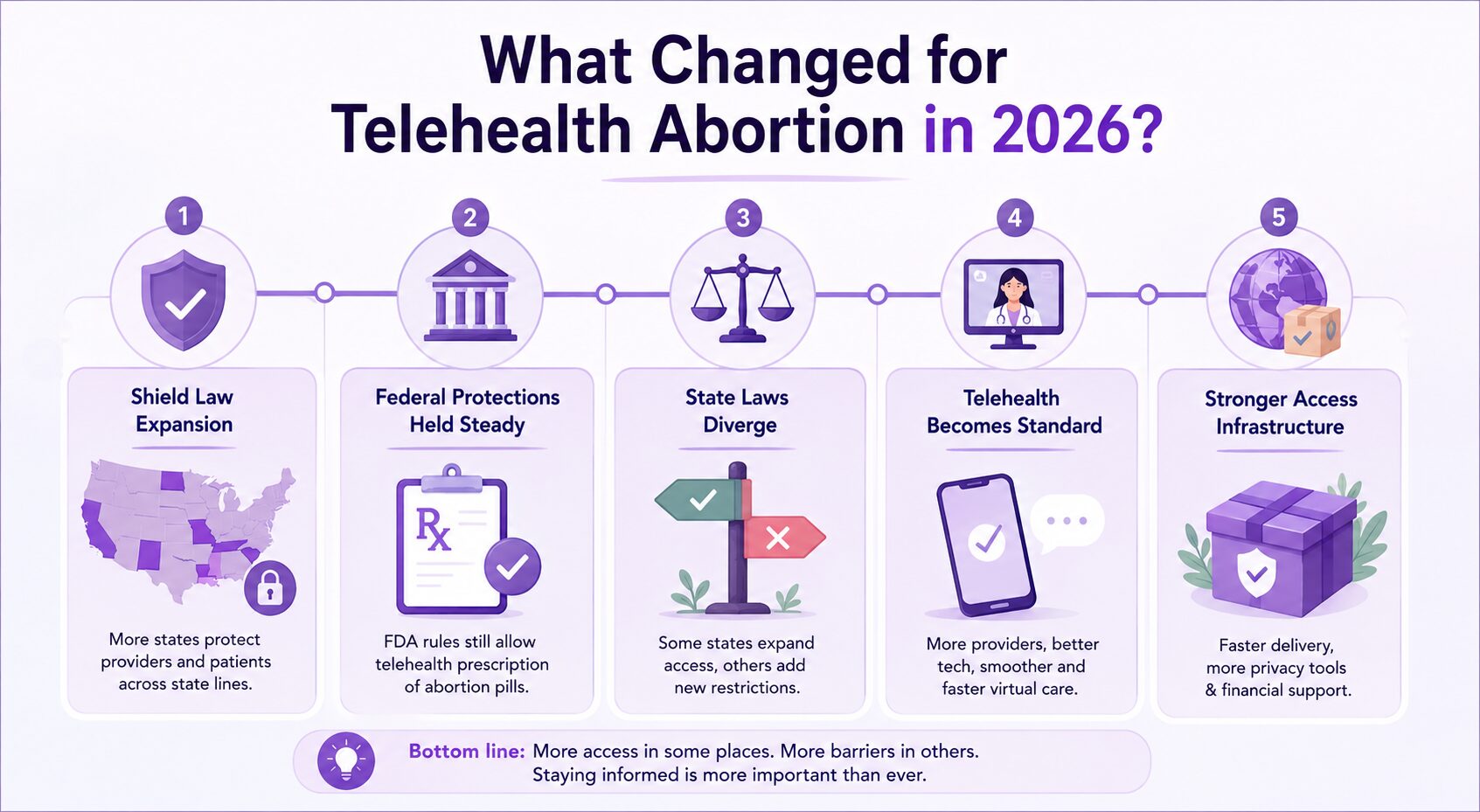
Shield law expansion is the most significant legal development affecting online abortion care this year. These laws protect providers in states like Illinois from legal liability when they prescribe abortion medications to patients located in states where abortion is restricted. Several states added or strengthened shield protections in 2025 and 2026, meaningfully expanding the pool of providers who can serve patients in restricted states through telehealth. For a detailed breakdown of how these laws work and which states have them, our complete shield laws guide covers the current landscape.
On the federal side, FDA regulations governing mifepristone, the first medication in the abortion pill regimen, have remained a site of ongoing legal challenge. The core prescription access that was expanded during the COVID-19 public health emergency has largely held, meaning certified providers can still prescribe mifepristone via telehealth without requiring an in-person visit first. This was not guaranteed heading into 2026 and represents a meaningful protection for patients who rely on remote care.
State-level changes have been the most variable and most consequential part of the 2026 picture. Several states tightened restrictions on receiving abortion medications by mail, while others explicitly codified the legality of telehealth abortion within their borders. Understanding what applies in your specific state is essential before beginning the process.
Is Telehealth Abortion Still Legal in 2026?
The answer is yes in a significant number of states but the answer varies meaningfully depending on where you are located and where your provider is based.
In states with abortion protections including Illinois, California, New York, Colorado, Washington, and others, telehealth abortion is fully legal and actively supported by state law. Providers in these states can consult with patients, issue prescriptions, and have medications delivered without in-person visits required at any stage of the process.
In states with abortion restrictions, the legal picture is more complex. Some states have attempted to prohibit the receipt of abortion medications regardless of where they were prescribed, while others have focused restrictions on providers rather than patients. The practical effect is that in heavily restricted states, accessing telehealth abortion typically requires working with an out-of-state provider operating under shield law, a legal model that has survived early legal challenges but remains subject to ongoing litigation.
For patients in restricted states, the most important question is not whether telehealth abortion is theoretically available but whether it is practically accessible in your circumstances. Our guide on whether telemedicine abortion is legal breaks down the state-by-state picture with current information on where providers can and cannot serve patients remotely.
One of the most common misunderstandings about online abortion care is that mailing medications across state lines is automatically illegal. The current legal framework is more nuanced; the legality depends on where the provider is licensed, what shield protections apply, and how the specific state’s restrictions are written. Working with a licensed, reputable provider who is operating within a clearly defined legal framework is the most important protection a patient can have.
How Telehealth Abortion Works in 2026
The process for accessing abortion care online has become more streamlined in 2026 than it was even two years ago, largely because providers have developed clearer protocols and more efficient systems for remote consultation and follow-up.
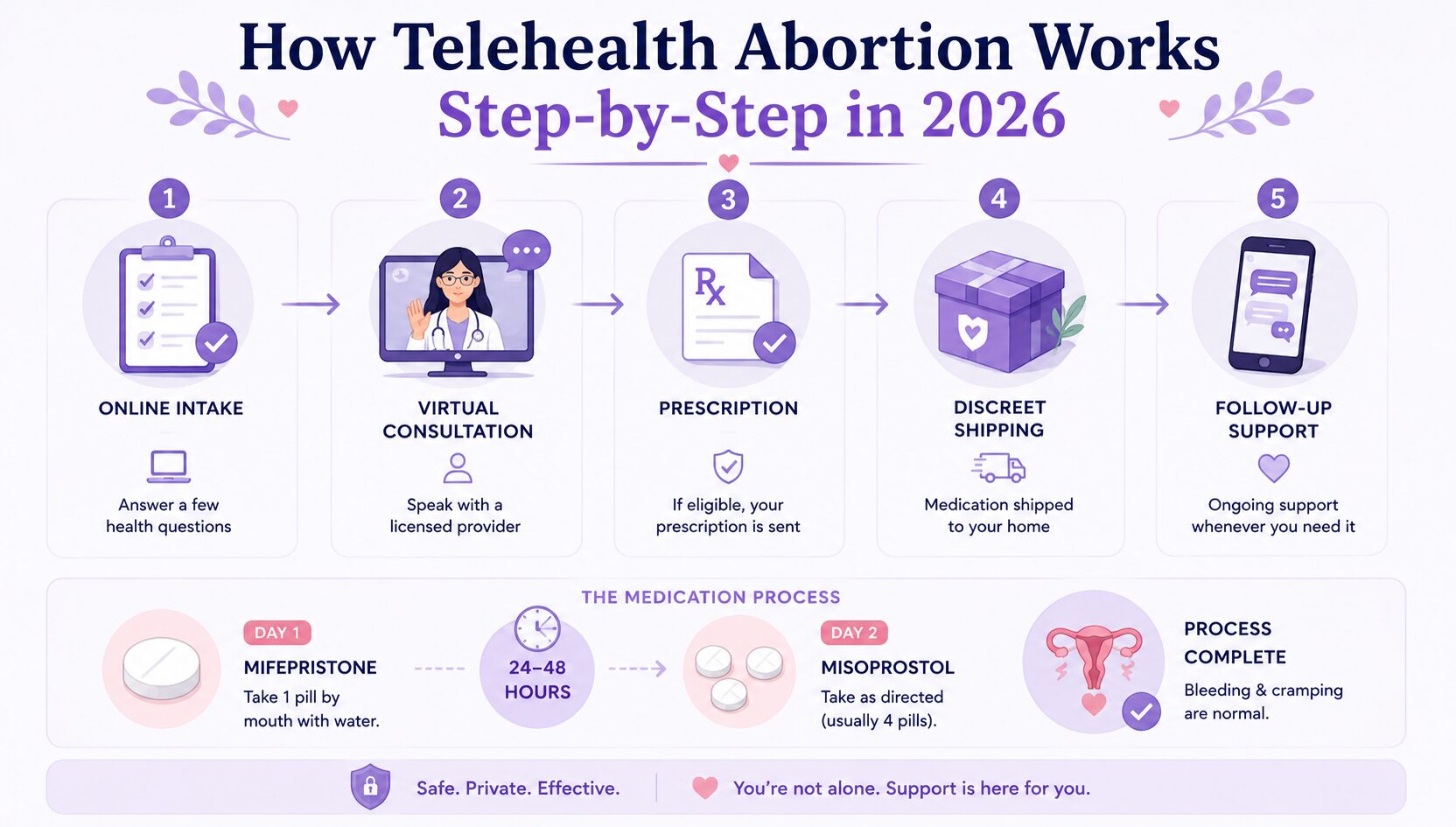
The process typically begins with an online intake form and a consultation either via video call or an asynchronous messaging exchange with a licensed clinician. During this consultation, the provider reviews your medical history, confirms gestational age (typically through a combination of your last menstrual period date and, in some cases, remote review of ultrasound images), screens for any medical contraindications, and determines eligibility.
If eligible, the provider issues a prescription for mifepristone and misoprostol. The medications are dispensed through a certified pharmacy and shipped discreetly packaging does not identify the contents as related to abortion. Delivery timelines in 2026 are generally two to five days for standard shipping, with expedited options available through some providers.
What you take and when: Mifepristone is taken first, followed by misoprostol 24 to 48 hours later. Our guides on how the abortion pill works, mifepristone explained, and what to expect from misoprostol cover each stage of the process in clinical detail. For effectiveness data by gestational age, our abortion pill effectiveness chart provides a clear breakdown.
Follow-up care after a telehealth medication abortion is managed remotely. Most providers schedule a check-in call or message exchange, and confirmation of a complete abortion is typically done through an at-home pregnancy test taken four weeks after the procedure, or through remote review of lab work in some cases.
For a full breakdown of whether telehealth abortion is the right choice for your specific situation, our guide is telehealth abortion right for you covers the eligibility considerations in detail. And for the practical and clinical benefits of this model of care, our telehealth benefits guide explains what makes remote care a genuinely effective option for many patients.
Privacy and Safety in Online Abortion Care
For patients in states with abortion restrictions, privacy is not an abstract concern it is a practical and sometimes urgent one. Understanding what data telehealth providers collect, how it is stored, and what legal protections apply is an important part of choosing a provider and using their services safely.
Reputable telehealth abortion providers operate under HIPAA protections, which govern how medical information can be stored, shared, and disclosed. However, HIPAA is a floor, not a ceiling. Providers vary in how much additional privacy protection they build into their systems. Patients in restrictive states should look for providers who use end-to-end encrypted messaging, do not store unnecessary identifying data, and have clear policies about how they respond to law enforcement requests.
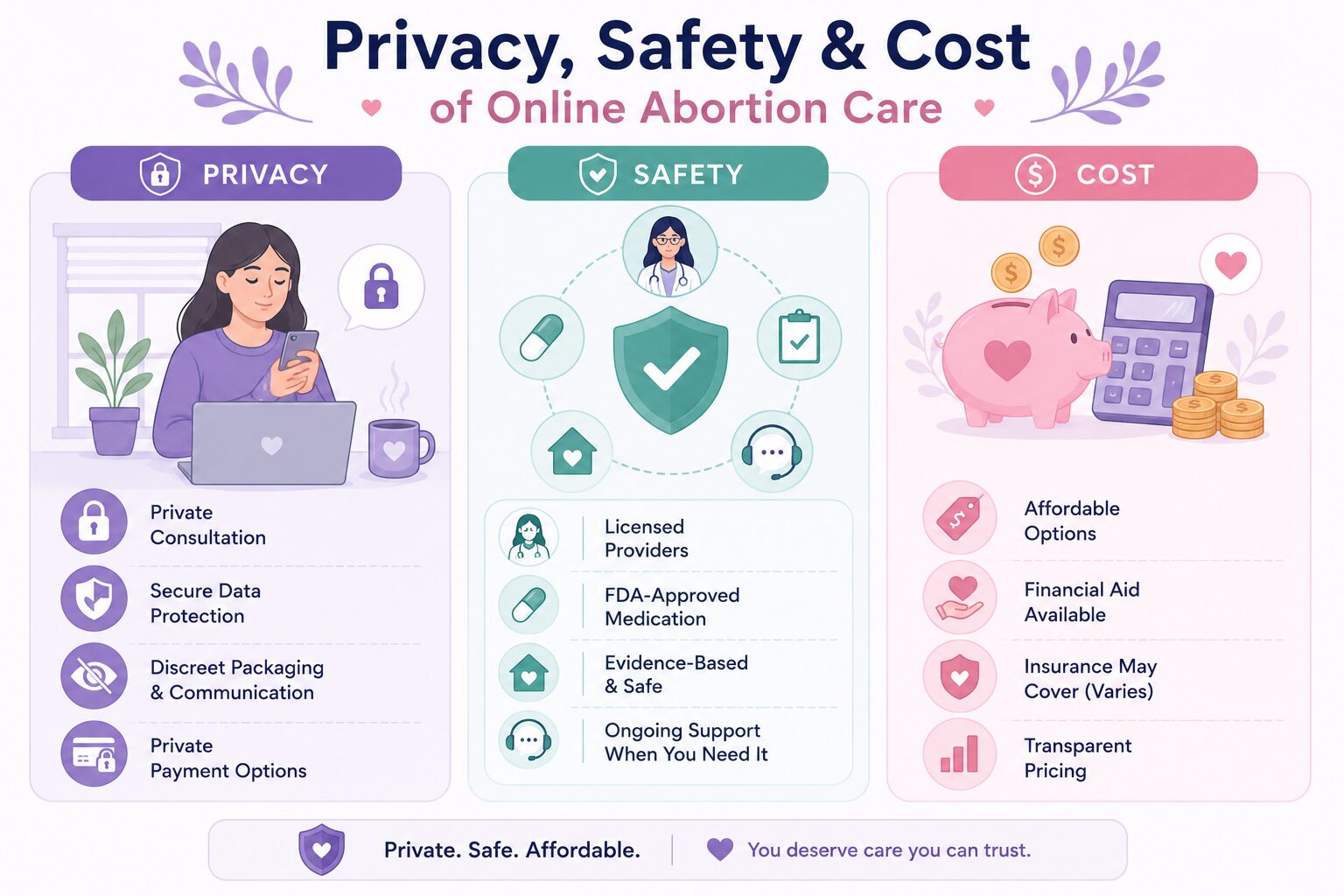
Payment privacy is also worth considering. Credit card transactions are associated with your identity by default. Some providers accept payment methods that provide greater privacy cash, prepaid cards, or specific privacy-focused payment options. Using a personal email address or device connected to your home network creates a data trail that some patients in restrictive states prefer to minimize.
For comprehensive guidance on protecting your privacy throughout the process from initial research through follow-up care our abortion privacy guide, online privacy and abortion access guide, and how to keep your abortion private cover both digital and practical privacy steps in detail.
On the question of medical safety: telehealth medication abortion is as safe as in-person medication abortion when appropriate screening has been completed. The medications involved mifepristone and misoprostol have been in use for decades and have extensive safety data. Our abortion safety and medical facts guide addresses common safety questions with reference to peer-reviewed evidence.
The primary safety risk in the telehealth space is not the medication itself it is unverified providers and counterfeit medications. Our guide on how to get safe, verified abortion pills online and buying abortion pills online safely explain what to look for in a legitimate provider and what red flags indicate an unsafe source.
Cost of Telehealth Abortion in 2026
Telehealth medication abortion is generally the most affordable form of abortion care available, and in 2026 that affordability advantage has become more pronounced as provider competition has increased and more financial assistance programs have developed specifically for remote care.
The cost of a telehealth abortion consultation and medication typically ranges from under one hundred dollars to several hundred dollars depending on the provider, the state, and whether insurance coverage applies. Several telehealth providers operate on sliding scale or income-based pricing models.
Insurance coverage for telehealth abortion has expanded in states with abortion protections, where insurers are required to cover abortion care. In restrictive states, insurance coverage is frequently excluded by state law, meaning patients often pay out of pocket. For a detailed breakdown of what insurance covers and what it does not, our insurance coverage for abortion guide and abortion pill cost guide provide current information on both coverage and pricing.
Financial assistance is available for patients who cannot afford the cost of care. Abortion funds, mutual aid networks, and provider-specific financial assistance programs exist specifically to reduce or eliminate cost as a barrier to access. Our team can connect you with relevant assistance programs scheduling a confidential consultation is the fastest way to understand what financial support is available for your specific situation.
Telehealth Abortion vs In-Clinic Care Which Is Right for You?
Telehealth medication abortion and in-clinic care are both legitimate options, and the right choice depends on your gestational age, medical history, location, and personal preferences, not on which is inherently superior.
Telehealth abortion offers privacy, convenience, and accessibility particularly for patients in areas without local providers or in states where traveling to a clinic would require significant distance. It is appropriate for pregnancies up to approximately 10 to 12 weeks and for patients without medical contraindications.
In-clinic care offers direct medical supervision, access to anesthesia options, and the ability to manage complications in real time. It is the appropriate option for patients further along in pregnancy, those with certain medical histories, and those who prefer or require face-to-face care. Our in-clinic abortion services page describes what to expect from an in-person procedure. For a direct comparison of the two approaches across multiple dimensions, our abortion pills vs surgical abortion guide covers the key differences in detail.
If you are unsure which option is appropriate for your circumstances, our telehealth abortion care team can discuss your specific situation and help you understand your options without pressure or judgment.
The Future of Telehealth Abortion Access
The trajectory of telehealth abortion access beyond 2026 depends heavily on legal battles that are still actively developing. Shield law challenges are working through state and federal courts. Mifepristone prescription regulations remain subject to litigation. Several states are actively considering both expansions and restrictions of online abortion access.
What is clear is that telehealth has become structurally central to abortion access in the United States in a way that would have been difficult to predict even five years ago. For the millions of people who live in states with restricted or no local abortion access, remote care is not an alternative to in-person care, it is the primary pathway to care that exists. The legal and clinical frameworks supporting that care have proven more durable than many observers expected after 2022, and the provider ecosystem has continued to develop in ways that make access more reliable, more affordable, and more private.
Conclusion
Telehealth abortion in 2026 is a functioning, legal, and clinically sound option for millions of people but navigating it requires understanding a legal landscape that varies by state and continues to evolve. Shield laws have expanded the reach of out-of-state providers. FDA protections for mifepristone have held. Privacy tools and financial assistance programs have matured alongside the clinical infrastructure.
If you are considering telehealth abortion care or have questions about what is available in your state, the clearest next step is speaking directly with a licensed provider. Schedule a confidential consultation with our team. We provide discreet, judgment-free reproductive healthcare and can help you understand exactly what options exist for your specific situation.
Frequently Asked Questions
Is telehealth abortion still legal in 2026?
Yes, telehealth abortion will remain legal in many U.S. states in 2026, but laws vary significantly depending on where you live. Some states protect online medication abortion access through shield laws, while others restrict or ban telehealth abortion services entirely.
What changed for telehealth abortion in 2026?
Several states introduced new regulations affecting online abortion consultations, prescription rules, and interstate telehealth access. At the same time, more providers expanded virtual care services and shield-law protections increased in certain states.
Can doctors still prescribe abortion pills online?
In many states, licensed healthcare providers can still prescribe abortion pills through telehealth consultations. Patients may complete an online screening, virtual appointment, and receive medications by mail without visiting a clinic in person.
Which states allow telehealth abortion services?
States with stronger reproductive healthcare protections generally allow telehealth abortion access, including mail delivery of medication abortion pills. However, restrictions continue to evolve, so users should always check the latest state-specific laws.
Can abortion pills still be mailed across state lines?
Mailing abortion pills across state lines remains legally complex in 2026. Some providers operate under shield laws that protect telehealth prescribing, while certain states attempt to restrict access. Legal interpretations continue to change through ongoing court cases.
Do you need to visit a clinic for telehealth abortion?
In many cases, no in-person visit is required. Depending on state laws, gestational age, and medical history, patients may complete the entire medication abortion process remotely.
How long does it take to receive abortion pills by mail?
Delivery times vary by provider and location. Some telehealth services offer expedited shipping within 1–3 days, while others may take longer due to state restrictions or pharmacy processing.

Dr. James Carter is a board-certified physician and lead clinician at Serenity Choice Health, specializing in reproductive health access and medication abortion protocols. With over 20+ years of experience, he combines clinical expertise with patient-centered care to ensure safe, compassionate, and confidential reproductive healthcare.