
You took misoprostol expecting bleeding and cramps, but several hours have passed without any bleeding. Maybe you have cramps but no blood, or perhaps you took four misoprostol tablets and haven’t noticed any changes.
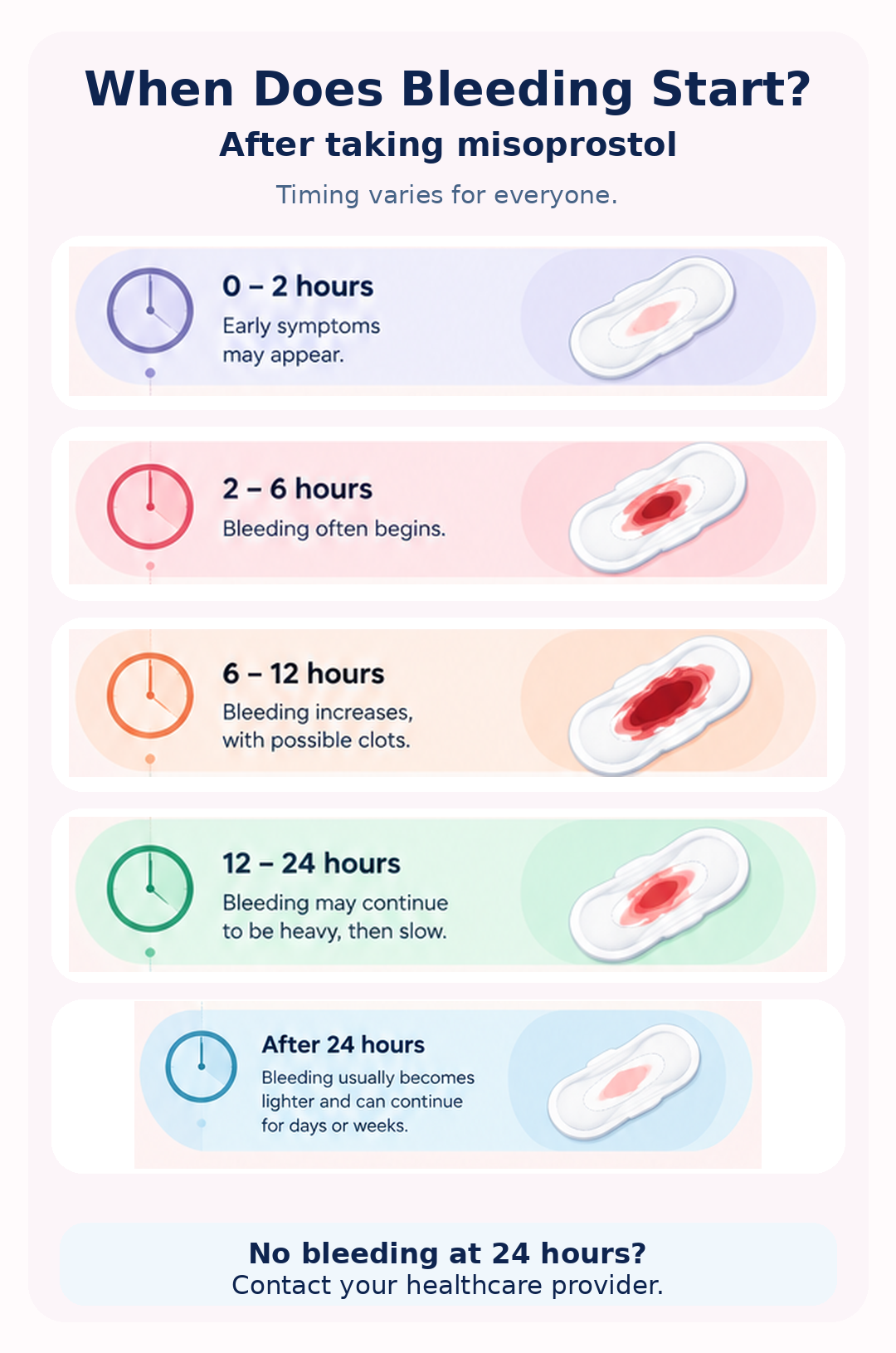
No bleeding after misoprostol does not automatically mean the abortion pills failed. Bleeding commonly begins within one to four hours, although some people experience a delayed response. However, if you have no bleeding at all within 24 hours after taking misoprostol for a medication abortion, contact your abortion provider or another qualified healthcare professional promptly.
The amount of bleeding, whether you pass clots, and how strongly you cramp can vary. None of these symptoms alone can confirm whether a medication abortion is complete.
The important questions are how long it has been since you took misoprostol, which medication regimen you used, and whether you’re experiencing any warning signs.
Seek emergency care immediately if you have severe or one-sided abdominal pain, shoulder-tip pain, fainting, or severe dizziness. These can be warning signs of an ectopic pregnancy or another serious complication. Do not wait for bleeding to begin.
No Bleeding After Misoprostol: What Should You Do Right Now?
Start by checking which medication you took and how much time has passed.
| Your situation | What it may mean | Recommended next step |
|---|---|---|
| You took mifepristone but haven’t taken misoprostol | Many people have little or no bleeding after mifepristone alone. | Follow your prescribed medication schedule. |
| Less than 4 hours after misoprostol | Bleeding may not have started yet. | Follow your treatment instructions and monitor symptoms. |
| 4–12 hours after misoprostol | A delayed response is possible. | Review your instructions and contact your provider if concerned. |
| 12–24 hours with no bleeding | The absence of bleeding deserves attention, but it doesn’t establish treatment failure. | Contact your provider for individualized guidance. |
| 24 hours or longer with no bleeding | The expected response may not have occurred. | Contact a qualified healthcare professional promptly for assessment. |
| Severe one-sided pain, fainting, or shoulder-tip pain at any time | A serious complication, including ectopic pregnancy, may be possible. | Seek emergency medical care immediately. |
These recommendations are general information for medication abortion. Your individual treatment instructions may include scheduled medication steps that differ from another person’s regimen.
How Long After Misoprostol Does Bleeding Usually Start?
Misoprostol causes the uterus to contract and expel pregnancy tissue. For many people, cramping and bleeding begin within approximately one to four hours.
Bleeding may start as spotting before becoming heavier. It can be accompanied by clots, and the heaviest bleeding often lasts several hours before gradually decreasing.
Light bleeding or spotting may continue for days or weeks afterward.
However, the timing and amount vary. A later start is possible, but prolonged absence of bleeding should not be assumed to mean that the abortion has completed without any visible signs.
For information about usual bleeding patterns and duration, see our guide to bleeding after the abortion pill.
What If There Is No Bleeding 12 Hours After Misoprostol?
If you’re not bleeding 12 hours after taking misoprostol, the medication may still produce a response.
Some people experience cramping before bleeding begins. Others may have little noticeable activity during the first several hours.
Still, you cannot determine from the delay alone whether the medication worked.
If you haven’t had any bleeding by 12 hours, contacting your provider is sensible, especially if you’re uncertain about the medication instructions or have symptoms that concern you.
What If There Is No Bleeding After 24 Hours?
Having no bleeding at all 24 hours after misoprostol is a reason to seek professional guidance promptly.
Possible explanations include an ongoing pregnancy, an ineffective medication response, or another condition that needs evaluation.
Your provider may recommend testing or an examination to determine what happened.
Do not assume the abortion was successful simply because you experienced little discomfort or no bleeding.
Why Am I Not Bleeding After Taking Misoprostol?
There is no single reason why bleeding may not begin as expected.
Understanding the possible explanations is useful, but determining the actual cause may require clinical assessment.
The Medication May Be Taking Longer to Work
Misoprostol stimulates uterine contractions, but responses vary between individuals.
Cramping may start before bleeding, and some people notice changes later than expected.
A delay during the first few hours does not automatically indicate failure.
However, a delay and a confirmed successful abortion are not the same thing. If the expected bleeding never occurs, follow-up is important.
You May Have Taken Mifepristone Without Misoprostol
A medication abortion commonly uses two medications:
Mifepristone blocks progesterone, a hormone needed to maintain pregnancy.
Misoprostol stimulates uterine contractions that help empty the uterus.
Some people experience spotting after mifepristone, while others have no bleeding until misoprostol is taken.
If you’ve only taken mifepristone, the absence of bleeding may be expected at that stage.
Follow the medication instructions supplied with your treatment.
You can learn more about mifepristone and its role in medication abortion.
The Medication Regimen May Not Have Been Completed as Intended
Medication abortion regimens vary depending on factors such as pregnancy duration and whether mifepristone is used.
Misoprostol may be administered inside the cheeks, under the tongue, or vaginally, according to the specific instructions.
Using tablets differently from the prescribed method may affect absorption or treatment effectiveness.
If you’re uncertain about your dose, medication timing, or administration method, contact your abortion provider for guidance.
The Pregnancy May Still Be Ongoing
Medication abortion is effective for most people, but it doesn’t work in every case.
An ongoing pregnancy means the pregnancy continues after medication was taken.
An incomplete abortion means the pregnancy has ended, but some pregnancy tissue remains in the uterus.
These outcomes require different clinical considerations.
No bleeding may raise concern about an ongoing pregnancy, but symptoms alone cannot establish whether a pregnancy has continued or ended.
Your clinician may recommend pregnancy hormone testing, ultrasound, or another appropriate assessment.
For more information, read our guide on when abortion pills don’t work.
An Ectopic Pregnancy May Need to Be Considered
An ectopic pregnancy develops outside the uterus, usually in a fallopian tube.
Abortion medications do not treat ectopic pregnancy.
No bleeding alone does not mean you have an ectopic pregnancy. However, if the pregnancy’s location is uncertain, a clinician may need to consider this possibility.
Severe one-sided abdominal pain, shoulder-tip pain, fainting, or significant dizziness can indicate internal bleeding and require emergency care.
Cramps but No Bleeding After Misoprostol: Is the Medication Working?
Cramping and bleeding do not always begin simultaneously.
Misoprostol stimulates uterine contractions, which may cause cramps before any blood becomes visible.
But cramps without bleeding do not confirm that pregnancy tissue has passed or that the abortion is complete.
If you have mild cramps within the first several hours, bleeding may still begin later.
A heating pad or appropriate pain medication may provide relief. Ibuprofen is commonly used when medically suitable, but follow your provider’s instructions and check that it is safe for you.
More severe symptoms require a different response.
What If You Have Strong Cramps but No Bleeding?
Severe or worsening pain, particularly on one side, should not be assumed to be an expected medication effect.
If pain is intense or accompanied by fainting, shoulder-tip pain, or severe dizziness, seek emergency care immediately.
What If Your Cramps Stop Without Any Bleeding?
Cramping that stops without bleeding doesn’t prove that the medication failed, but it also doesn’t confirm success.
If there has been no bleeding at all within 24 hours, contact your healthcare provider for appropriate evaluation.
After Taking Four Misoprostol Tablets, Why Is There No Bleeding?
If you’ve taken four misoprostol tablets without bleeding, you may wonder whether the dose was enough or whether you need additional medication.
The number of tablets alone cannot establish whether the correct treatment regimen was completed.
The strength of the tablets, administration method, pregnancy duration, and whether mifepristone was also taken are important.
Some misoprostol-only protocols involve several scheduled doses. Other protocols use mifepristone followed by misoprostol.
That is why advice intended for one treatment schedule should not automatically be applied to another.
If you took four tablets and haven’t started bleeding:
- Check the time you took the medication and record any symptoms.
- Review your prescribed instructions, including any already scheduled doses.
- Contact your provider if you are unsure whether the medication was taken correctly.
- Seek prompt medical guidance if no bleeding occurs within 24 hours.
If your treatment plan includes additional scheduled medication, follow those instructions unless your healthcare professional advises otherwise.
Do not independently switch to a different dosing schedule or use unprescribed medicines to induce bleeding.
Can Misoprostol Work Without Heavy Bleeding or Blood Clots?
Not everyone experiences heavy bleeding or sees identifiable pregnancy tissue.
In very early pregnancies, visible tissue may be difficult to distinguish from blood or the uterine lining.
Some people have lighter bleeding than others.
However, having only light bleeding is different from having no bleeding at all, and neither pattern is sufficient on its own to confirm the treatment outcome.
Bleeding but No Clots After Misoprostol
If you’re bleeding but haven’t noticed clots, this does not automatically mean that the abortion was unsuccessful.
Visible clots are common but are not required for every person.
If bleeding is minimal or your pregnancy symptoms continue, your provider can help determine whether follow-up testing is appropriate.
White Discharge Without Bleeding After Misoprostol
White discharge after misoprostol can have different explanations.
If the tablets were inserted vaginally, some whitish material may be medication residue.
Ordinary vaginal discharge may also continue.
Discharge cannot confirm whether the abortion worked.
If you notice discharge with an unpleasant odor, fever, increasing pelvic pain, or other concerning symptoms, contact a healthcare professional.
If there has been no bleeding within 24 hours, seek guidance about the lack of bleeding even if the discharge itself seems normal.
How to Know if Misoprostol Worked When You Didn’t Bleed
The most reliable way to resolve uncertainty is through an appropriate follow-up assessment.
Bleeding, cramps, clots, or changes in pregnancy symptoms may provide clues, but none of them independently proves that a pregnancy has ended.
There are several ways to evaluate the outcome.
Home Pregnancy Tests
A home pregnancy test detects human chorionic gonadotropin (hCG), a hormone associated with pregnancy.
Even after a successful abortion, hCG can remain detectable for several weeks.
This means a standard home pregnancy test may still show a positive result despite the pregnancy having ended.
Testing the next day cannot reliably confirm whether misoprostol worked.
Some abortion services provide special follow-up pregnancy tests designed to be used at a specific time. Others advise using a standard home test later, often around four weeks after the medication abortion.
The correct timing depends on the test and the follow-up protocol.
Blood hCG Tests
Quantitative blood hCG tests measure pregnancy hormone levels.
A healthcare professional may compare results collected at appropriate intervals to determine whether the level is declining as expected.
This can provide valuable information about whether the pregnancy has ended.
However, a single hormone result may not be enough to determine the outcome, particularly if an ectopic pregnancy is a concern.
Ultrasound Examination
Ultrasound can help determine whether a pregnancy is continuing and assess other findings that may require care.
It may be recommended when there has been no bleeding, symptoms are concerning, or the treatment outcome remains uncertain.
Ultrasound is not routinely necessary for everyone after an uncomplicated medication abortion.
Also, an ultrasound finding of a thickened uterine lining does not automatically mean additional treatment is required. A clinician must interpret imaging in the context of symptoms and the overall clinical situation.
Which Method Can Confirm the Outcome?
| Method | Useful for | Main limitation |
|---|---|---|
| Symptom changes | Understanding whether pregnancy symptoms are improving | Cannot independently confirm completion |
| Standard home pregnancy test | Detecting pregnancy hormone at the recommended follow-up time | May remain positive for weeks |
| Specialized follow-up urine test | Assessing the outcome according to a specific protocol | Requires the correct test and timing |
| Serial quantitative blood hCG | Measuring changes in pregnancy hormone levels | Requires professional interpretation |
| Ultrasound | Assessing an ongoing pregnancy or clinical concerns | Not always necessary or definitive on its own |
Learn more about how to know if the abortion pill worked.
When Should You Seek Medical Attention?
A delayed response and an emergency complication are not the same thing.
Knowing which symptoms require immediate attention is important.
Contact Your Healthcare Provider Promptly If:
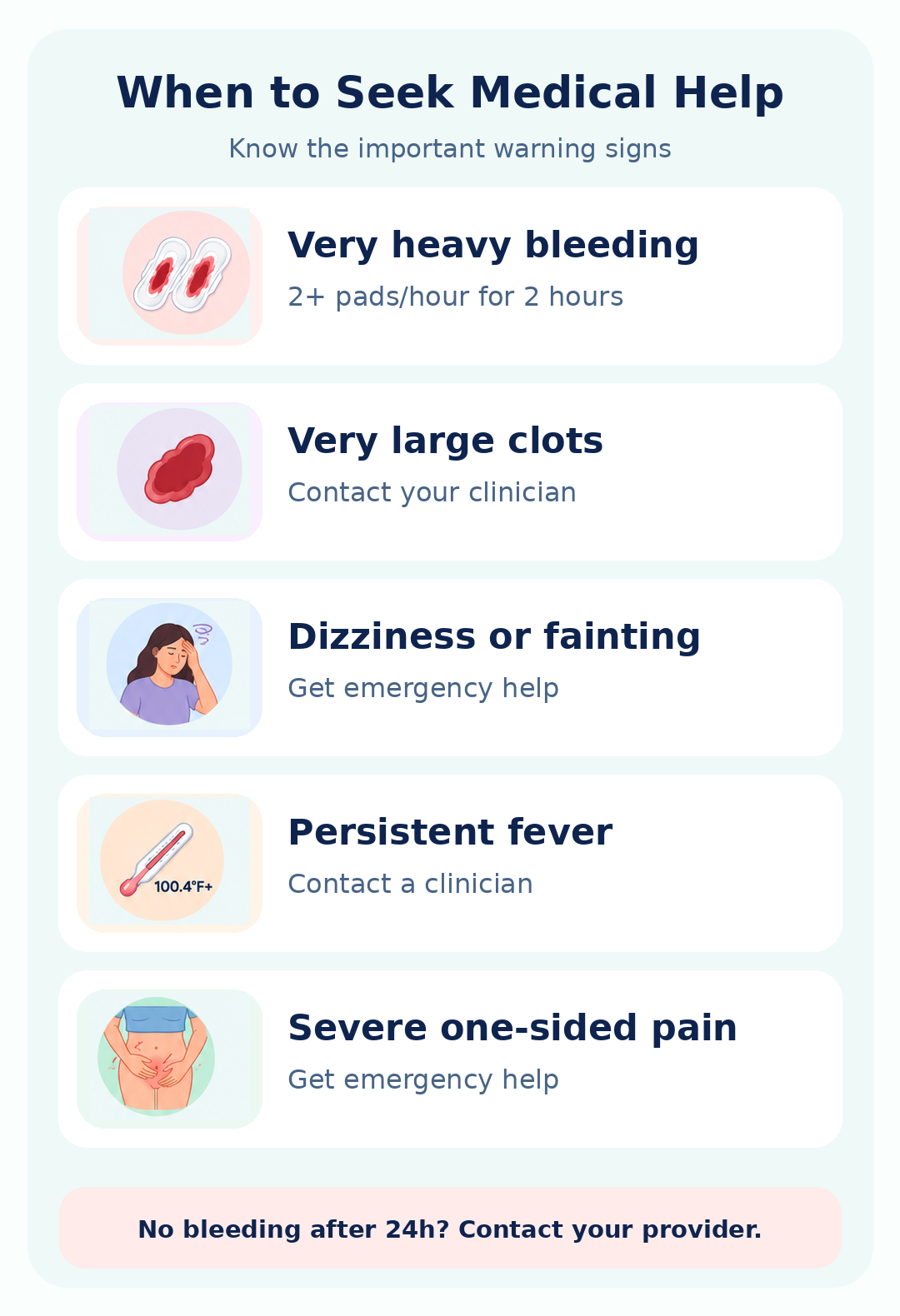
- You have no bleeding at all 24 hours after misoprostol.
- You have very little bleeding and are concerned about the treatment outcome.
- You are unsure whether your medication regimen was completed correctly.
- Pregnancy symptoms persist or you suspect the pregnancy is continuing.
- You develop a fever, unusual discharge, or other symptoms that may suggest infection.
Seek Emergency Care Immediately If:
- You experience severe or one-sided abdominal pain.
- You develop shoulder-tip pain, fainting, or severe dizziness.
- You soak through two full-size maxi pads per hour for two consecutive hours.
- You have signs of significant blood loss, such as severe weakness or faintness.
- You develop severe or rapidly worsening symptoms suggesting a serious infection.
A fever of 100.4°F (38°C) or higher that lasts more than 24 hours after taking misoprostol, or a fever that begins later, warrants prompt medical evaluation. Severe illness requires emergency assessment regardless of the temperature reading.
Do not wait for a particular bleeding timeframe if you develop emergency symptoms.
What to Tell Your Healthcare Provider if Bleeding Hasn’t Started
If you’re contacting a clinic or telehealth service, gathering a few details beforehand can make the conversation more useful.
Be prepared to explain:
- When you took mifepristone, if you used it.
- When and how you took misoprostol.
- The tablet strength and prescribed medication schedule, if known.
- Approximately how many weeks pregnant you were.
- Whether you experienced spotting, cramps, fever, or other symptoms.
- Whether an ultrasound previously confirmed the pregnancy was inside the uterus.
You can ask whether your response is expected for your particular regimen, whether an ongoing or ectopic pregnancy needs to be ruled out, and which follow-up test would be appropriate.
A qualified clinician may recommend additional medication, diagnostic testing, or an in-person procedure if the initial treatment was unsuccessful or incomplete.
Can You Get a Telehealth Consultation?
Telehealth can sometimes be used to review your medication history, discuss symptoms, and arrange follow-up testing.
However, an online consultation cannot replace emergency evaluation for symptoms that may indicate internal bleeding, ectopic pregnancy, or another serious complication.
If you received your medication from a telehealth provider, the service may have specific follow-up instructions and contact options.
Read more about telehealth abortion care.
Frequently Asked Questions
Is it normal not to bleed after taking mifepristone and misoprostol?
Not bleeding after mifepristone alone can be expected. Bleeding usually begins after misoprostol. If you have no bleeding at all within 24 hours of taking misoprostol, contact your provider promptly.
Does no bleeding after misoprostol mean I’m still pregnant?
Not necessarily. The medication response may be delayed, but an ongoing pregnancy is possible. Appropriate testing or clinical assessment is needed to determine the outcome.
Is there any over-the-counter medication that can make bleeding start?
There is no established over-the-counter treatment that can safely and reliably resolve an unsuccessful medication abortion. Consult a qualified healthcare professional rather than using supplements, herbal products, or unprescribed medication.
Which pregnancy test is best after taking misoprostol?
Use the test recommended by your abortion-care provider at the specified follow-up time. Ordinary high-sensitivity tests may remain positive for several weeks after a successful abortion.
Do I need an ultrasound if I haven’t bled after misoprostol?
You may need an ultrasound, serial blood hCG tests, or another assessment depending on your circumstances. Not every person requires ultrasound, but complete absence of bleeding warrants professional guidance.
What if I haven’t had my next period after taking misoprostol?
The absence of bleeding immediately after misoprostol is different from waiting for your first menstrual period after a completed abortion.
Menstruation often returns within approximately four to eight weeks, although the timing varies.
If you never experienced bleeding following misoprostol, do not wait until your next expected period to seek guidance about whether the medication worked.
Final Takeaway
No bleeding after misoprostol can be the result of a delayed response, but it can also mean the medication abortion has not had the expected effect.
Bleeding commonly begins within a few hours. If no bleeding occurs at all within 24 hours, contact a qualified healthcare professional promptly.
Cramps, light spotting, white discharge, and the absence of visible blood clots cannot independently confirm whether the pregnancy has ended.
If the outcome remains uncertain, appropriate follow-up testing can help determine whether further care is needed.
You do not have to rely on bleeding patterns alone to know what happened.
Medical disclaimer: This content is provided for general educational purposes and is not a substitute for individualized medical advice, diagnosis, or emergency care. Medication abortion regimens and follow-up requirements vary according to clinical circumstances.

Dr. James Carter is a board-certified physician and lead clinician at Serenity Choice Health, specializing in reproductive health access and medication abortion protocols. With over 20+ years of experience, he combines clinical expertise with patient-centered care to ensure safe, compassionate, and confidential reproductive healthcare.