
For most women, the hardest part of a medication abortion isn’t the physical process, it’s the uncertainty leading up to it. What will the pain feel like? What if something goes wrong? Will anyone find out? How do I even know this is safe?
These questions before taking abortion pills are completely normal. They don’t signal weakness or indecision. They signal that you’re a thoughtful person trying to make an informed choice about your own body and you deserve clear, honest answers rather than vague reassurances or medical jargon that leaves you more confused than when you started.
This article covers the questions women ask most often before a medication abortion, including the ones that are hard to say out loud. Whether you’re weighing your options, preparing for the process, or simply trying to understand what to expect, the goal here is to give you the information you actually need.
How Do Abortion Pills Actually Work?
Before anything else, it helps to understand the mechanics because knowing what’s happening in your body makes the entire experience less frightening.
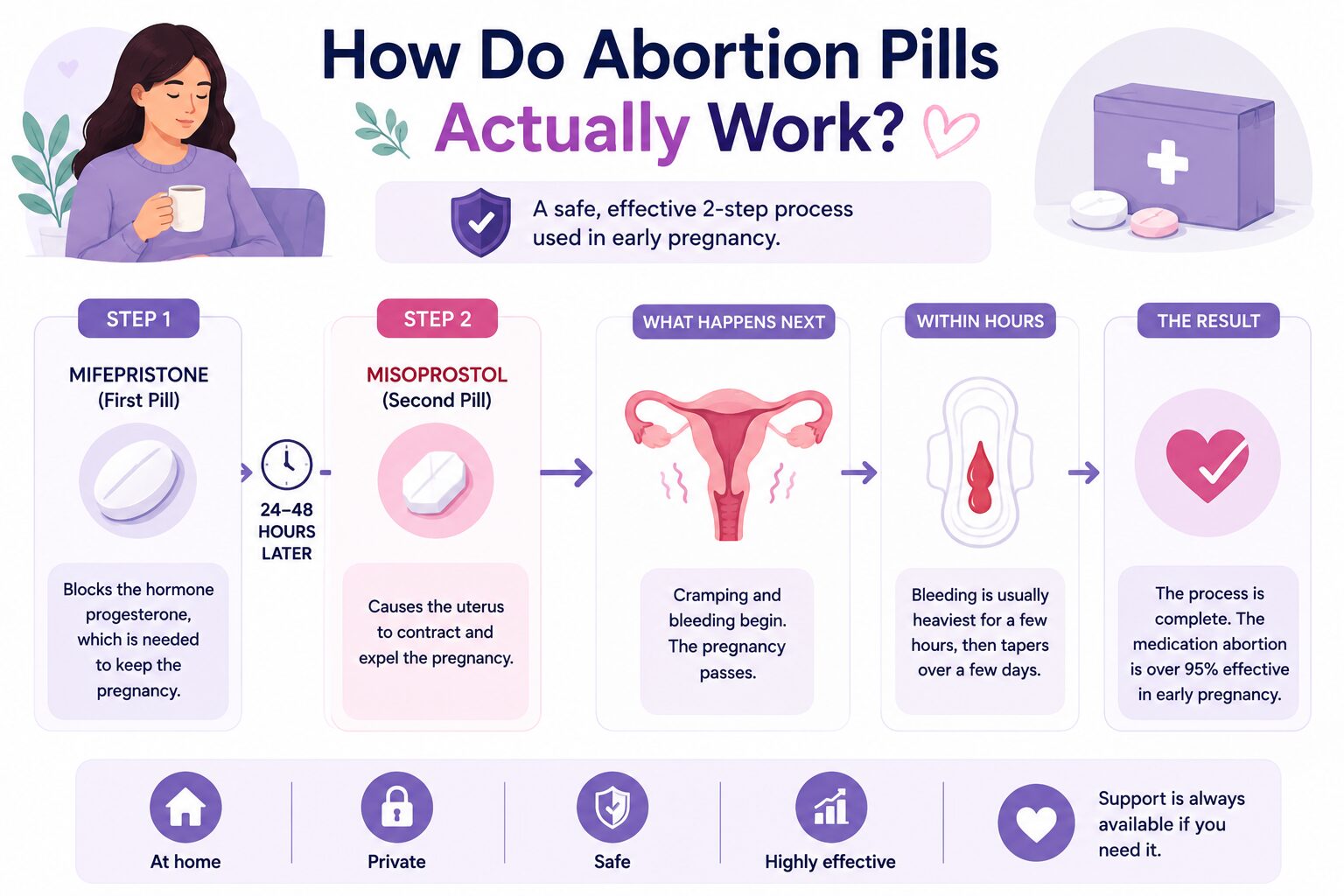
Medication abortion uses a two-drug protocol. The first medication, mifepristone, works by blocking progesterone, the hormone that supports a pregnancy. Without it, the uterine lining begins to break down. The second medication, misoprostol, is taken 24 to 48 hours later. It causes the uterus to contract and expel the pregnancy, similar to how the body responds during a miscarriage.
The full process from taking the first pill to the end of significant bleeding typically spans one to two weeks, though the most intense phase usually happens within the first 24 hours of taking misoprostol. Cramping and bleeding generally begin within one to four hours of that second medication.
Timing matters quite a bit here. The abortion pill is most effective when used within the first 10 to 11 weeks of pregnancy. The earlier in the pregnancy, the higher the success rate which is why understanding your gestational age before starting is an important part of any responsible consultation.
Is the Abortion Pill Safe?
This is the most important question women ask before taking abortion pills, and the answer is well-supported by decades of research.
Yes, medication abortion using FDA-approved mifepristone and misoprostol is safe and medically sound. It has been studied extensively, used by millions of people in over 60 countries, and endorsed by the World Health Organization, the American College of Obstetricians and Gynecologists, and numerous other major medical bodies. Serious complications occur in fewer than 1% of cases.
That said, not everyone is an ideal candidate. People with certain conditions including confirmed or suspected ectopic pregnancy, certain bleeding disorders, or those taking specific medications may need a different approach. This is precisely why a real medical consultation with a licensed provider matters before you take anything. A qualified provider will screen for these contraindications and ensure the medication is appropriate for your specific situation.
Common side effects include cramping, heavy bleeding, nausea, and sometimes chills or a low-grade fever. These are expected and normal. What’s not normal and what should prompt immediate medical attention includes sustained heavy bleeding (soaking more than two pads per hour for two or more hours), high fever lasting longer than 24 hours, or severe abdominal pain that doesn’t respond to pain medication. Knowing the difference between expected and concerning symptoms before you begin is one of the most important ways to feel prepared.
How Painful Are Abortion Pills Really?
This question deserves an honest answer rather than minimization and the honest answer is: it varies significantly from person to person.
Most women describe the cramping from misoprostol as similar to heavy menstrual cramps or an early miscarriage. For some, it’s manageable with ibuprofen and a heating pad. For others particularly those whose bodies respond more intensely to misoprostol the cramping can be quite strong for one to three hours before easing off.
What seems to be consistently true is that the physical intensity is often front-loaded. The most significant cramping typically occurs in the first two to four hours after the second medication. After that window, most women report that symptoms become much more manageable, settling into something closer to a heavier-than-usual period over the following days.
Pain management preparation matters. Before the medication, it’s worth stocking up on: ibuprofen (800mg taken about an hour before misoprostol is commonly recommended), a heating pad, light snacks, fluids, and something to keep you comfortable a warm blanket, a show you’ve been meaning to watch, a person you trust nearby.
One thing that often catches women off guard isn’t the physical pain, it’s the emotional weight. Some people feel profound relief. Some feel grief. Many feel both at the same time, and feel confused by that. All of it is completely valid, and it’s worth giving yourself space for the emotional experience, not just the physical one. Emotional recovery after an abortion is a real part of the process and deserves as much care as the physical side.
How Much Bleeding Is Normal After Taking Abortion Pills?
Bleeding is one of the most common sources of anxiety and one of the areas where clear information makes the biggest difference.
After taking misoprostol, most women experience bleeding that is heavier than a normal period, often with clots and tissue. This is expected. The bleeding is how your body expels the pregnancy, and seeing blood clots, even large ones, is a normal part of that process for many people.
Typical bleeding patterns include: heavier flow in the first 24 to 72 hours, gradually tapering to something lighter over the following one to two weeks. Some spotting or irregular bleeding can continue for up to four weeks as the uterine lining fully sheds.
What you’re watching for as a potential problem is bleeding that is significantly heavier than what’s described above. The general clinical guideline is to contact a provider if you’re soaking more than two thick maxi pads per hour for two consecutive hours. That level of bleeding along with dizziness, weakness, or fainting warrants prompt medical attention.
It’s also worth knowing that bleeding that is very light, or that stops quickly and doesn’t restart, can occasionally indicate that the medication hasn’t fully worked. That’s a reason to follow up with your provider, not a reason to panic. It’s something that can be addressed with additional medication or, in rare cases, a follow-up procedure.
Can the Abortion Pill Fail?
Yes, rarely and knowing what to watch for removes a lot of the anxiety around this possibility.
The effectiveness of the abortion pill using the mifepristone-misoprostol combination is approximately 95–98% when used within the recommended window. The small percentage of cases where it doesn’t work fully can involve an incomplete abortion (where some tissue remains) or, even more rarely, a continuing pregnancy.
Several factors influence effectiveness: gestational age at the time of taking the medication, how consistently the protocol is followed, and individual physiological differences. This is why accurate pregnancy dating before starting is so important.
Signs that suggest the process may not have completed fully include: continued pregnancy symptoms (persistent nausea, breast tenderness) after two weeks, very minimal bleeding, or an ultrasound showing retained tissue. None of these are emergencies on their own, but they do mean you should connect with a provider for follow-up.
Most reputable telehealth abortion services include follow-up support as a standard part of care so if something feels off, there’s someone to contact. That ongoing access to a licensed provider is one of the most important things to look for when choosing where to get safe, verified abortion pills.
Will Anyone Know I Took Abortion Pills?
Among all the questions women have before taking abortion pills, this one carries the most emotional weight particularly for people who live with family members, are in complicated relationships, or simply value keeping their medical decisions private.
The good news is that telehealth abortion care is highly discreet by design. Medications are shipped in plain, unmarked packaging; there is nothing on the outside to indicate what’s inside. Virtual consultations are HIPAA-protected, meaning your medical provider is legally prohibited from disclosing your information without your consent.
Abortion pills do not show up on a drug test and don’t leave any detectable trace in your system after the process is complete. From a purely physical standpoint, there is no way for someone to know you took them.
That said, digital privacy deserves real attention. How you search for information, who you communicate with, and what apps you use can create a trail that has nothing to do with the medication itself. Using a private browser, being thoughtful about your messaging apps, and understanding how to keep your abortion private are all things worth considering especially if you’re in a state where the legal climate is more hostile.
A full abortion privacy guide can walk you through the specific steps that matter most.
What Should I Do Before Taking Abortion Pills?
Preparation physically and emotionally genuinely makes a difference in how the experience unfolds. Here’s what’s worth doing before you take anything.
Get a real consultation. Before taking any medication, a licensed provider should confirm your gestational age, screen for contraindications, and walk you through the full protocol. This isn’t bureaucratic box-checking; it’s what makes the process safe. A telehealth abortion consultation can accomplish all of this remotely, often within a few days.
Stock up on supplies. Ibuprofen, a heating pad, maxi pads (not tampons), light snacks, ginger tea or anti-nausea medication if you’re prone to nausea, and comfortable clothing. Having these things ready before your misoprostol day means you don’t have to manage logistics while you’re also managing symptoms.
Plan for rest. Most people take misoprostol on a day when they can be home, horizontal, and undisturbed for several hours. If you have children, childcare, or work obligations, it’s worth planning around that window specifically.
Have someone nearby if possible. Not everyone has the luxury of support, but if you can have a trusted friend or partner present or at least reachable by phone it helps. Not because anything is likely to go wrong, but because emotional and physical comfort during a hard physical experience matters.
Write down your provider’s contact information so you know exactly who to call if you have a question or concern during the process. You shouldn’t have to search for it at 2am.
What Symptoms Mean I Should Contact a Medical Provider?
This is the section that can genuinely help keep you safe, so it’s worth reading carefully.
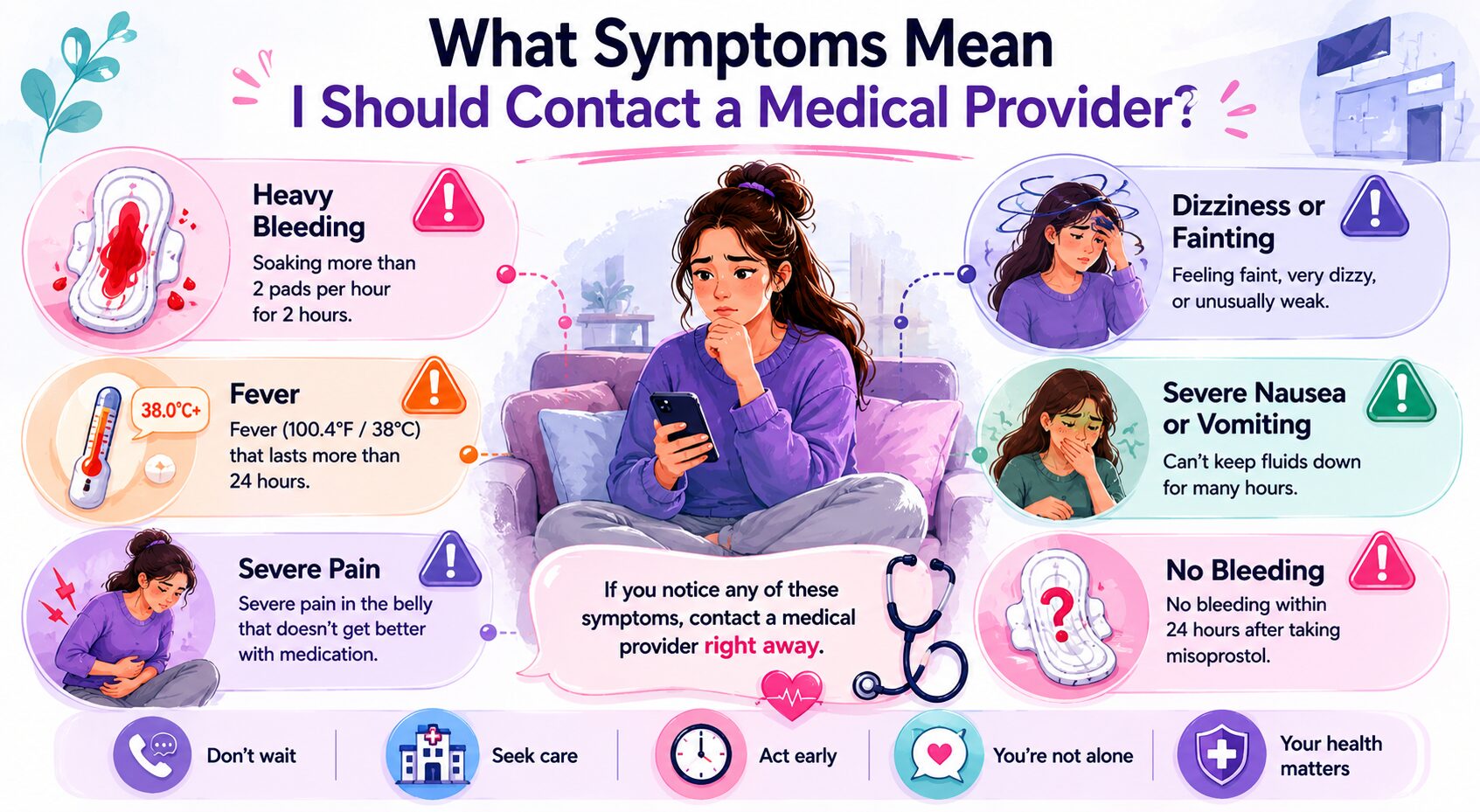
Most of what you experience during a medication abortion is expected and manageable at home. But certain symptoms warrant prompt medical attention:
Fever. A mild fever in the first few hours after misoprostol is normal. A fever above 101°F (38.3°C) that persists for more than 24 hours can indicate infection and needs to be evaluated.
Heavy bleeding. As noted earlier: soaking more than two thick maxi pads per hour for two consecutive hours is the threshold for calling a provider or going to an emergency room.
Severe, unrelenting pain. Cramping that doesn’t ease with ibuprofen, or pain that intensifies rather than diminishes after the first few hours, should be evaluated.
Foul-smelling discharge. This can be a sign of infection, particularly in the days following the medication.
Continued pregnancy symptoms after two weeks. If you still feel pregnant persistent nausea, breast tenderness, no significant bleeding contact your provider for a follow-up assessment.
These symptoms are uncommon, but knowing them in advance means you won’t be trying to figure out whether something is normal in the middle of the night when you’re scared and already uncomfortable.
How Telehealth Abortion Care Answers These Questions Faster
One of the underappreciated benefits of virtual abortion care is how much better it is at actually answering your questions, not just processing your case.
In a traditional clinic model, you might have a few minutes with a provider, surrounded by other patients, in an environment that doesn’t always feel conducive to honest conversation. With a telehealth consultation, you’re typically in your own home, speaking one-on-one with a licensed provider who has time to actually address your concerns.
Women who choose online abortion care consistently report that the ability to ask questions privately without judgment, without rushing made a meaningful difference in how prepared and supported they felt going into the process.
Beyond the consultation itself, good telehealth providers offer ongoing support during and after the medication process. That means if you’re lying on your couch four hours after taking misoprostol and something feels off, there’s someone you can actually reach.
If you’re weighing your options, you might also find it useful to understand how medication abortion compares to surgical abortion including the situations where one approach may be more appropriate than the other.
You Deserve Answers Before You Begin
Having questions before taking abortion pills doesn’t mean you’re unprepared it means you’re paying attention. The more you understand about what to expect, the more control you’ll feel throughout the process, and the better equipped you’ll be to recognize what’s normal and what needs attention.
If you’re ready to talk through your specific situation with a licensed provider, you can schedule a confidential consultation or explore the abortion pill and telehealth care options available to you. If you’d prefer to be seen in person, in-clinic abortion services are also available. You can also review what abortion costs and whether insurance may cover it before you commit to anything.
Whatever path you choose, you deserve care that is safe, honest, and built around your needs.
Frequently Asked Questions
How painful are abortion pills?
Most women describe cramping similar to a heavy period or early miscarriage, most intense in the first two to four hours after misoprostol. It varies by person.
How much bleeding is normal?
Heavier than a normal period, often with clots, for the first few days tapering over one to two weeks. Contact a provider if you’re soaking two pads per hour for two consecutive hours.
Can abortion pills fail?
The mifepristone-misoprostol combination is 95–98% effective. In rare cases of incomplete abortion, a provider can advise on next steps.
How long does the process take?
The most intense phase is usually 4–8 hours. Bleeding may continue for one to two weeks. Full recovery is typically within a few weeks.
Will anyone know I took abortion pills?
The medication leaves no detectable trace. Telehealth consultations are HIPAA-protected and medications arrive in discreet packaging.
Can I take abortion pills alone?
Medically, yes. Having someone available even by phone is recommended for emotional and practical support, but it’s not a medical requirement.
What symptoms are an emergency?
Fever above 101°F lasts more than 24 hours, soaking two pads per hour for two hours, severe unrelenting pain, or foul-smelling discharge.
Do I need a follow-up appointment?
A follow-up is strongly recommended to confirm the abortion is complete. Many telehealth providers include this as part of their care.

Dr. James Carter is a board-certified physician and lead clinician at Serenity Choice Health, specializing in reproductive health access and medication abortion protocols. With over 20+ years of experience, he combines clinical expertise with patient-centered care to ensure safe, compassionate, and confidential reproductive healthcare.