
Every year, millions of people have abortions. And yet, detailed, honest, week-by-week information about what recovery actually looks and feels like remains surprisingly hard to find. Most aftercare sheets are one page long. Most online searches return either overly clinical medical papers or deeply judgmental content that tells you how you should feel instead of what your body is actually doing.
THE FIRST 24–48 HOURS: WHAT YOUR BODY BEGINS DOING IMMEDIATELY
The moment an abortion is complete, your body initiates a complex hormonal and physiological reset. Understanding what to expect in these first hours makes a meaningful difference in how you experience recovery — and helps you distinguish normal symptoms from ones that need attention.
What happens physically in the first hours:
If you had a medication abortion (mifepristone followed by misoprostol), cramping and bleeding typically begin within 1–4 hours of taking the second medication. The cramping can be intense — similar to strong period pain or early labor contractions. This is your uterus contracting to expel its contents. This is normal and expected. If you are considering this option, you can learn more about our abortion pill services.
With a surgical abortion (MVA or D&C), the procedure itself removes uterine contents directly. Cramping afterward is usually milder and shorter-lived, and bleeding begins almost immediately but tends to be lighter than with the pill method. You can explore our in-clinic abortion services to understand what to expect during and after the procedure.
Symptom comparison in the first 0–48 hours:
Medication abortion — Cramping: Intense, wave-like, peaks at 1–3 hours. Bleeding: Heavy with clots, can be significant. Nausea: Common from misoprostol. Fatigue: High — rest is essential. Chills/low fever: Mild, temporary (misoprostol side effect).
Surgical abortion — Cramping: Mild to moderate, subsides quickly. Bleeding: Moderate, similar to a normal period. Nausea: Possible from sedation or anesthesia. Fatigue: Moderate procedure-related. Chills/low fever: Not a typical flag if present.
Emotional state in the first hours:
It is entirely common to feel emotionally numb immediately after, or to feel an unexpected rush of relief, or to cry without fully understanding why. All of these responses are valid. Progesterone levels drop sharply after an abortion, and this hormonal shift alone can trigger emotional vulnerability regardless of how certain you felt about your decision. Give yourself permission to simply rest and feel whatever arises.
Rest, warmth, and a trusted person nearby make the first 24 hours significantly more manageable. Avoid strenuous activity, alcohol, and tampons for the first few days.
WEEK 1 RECOVERY — BLEEDING, CRAMPING, AND HORMONAL SHIFTS
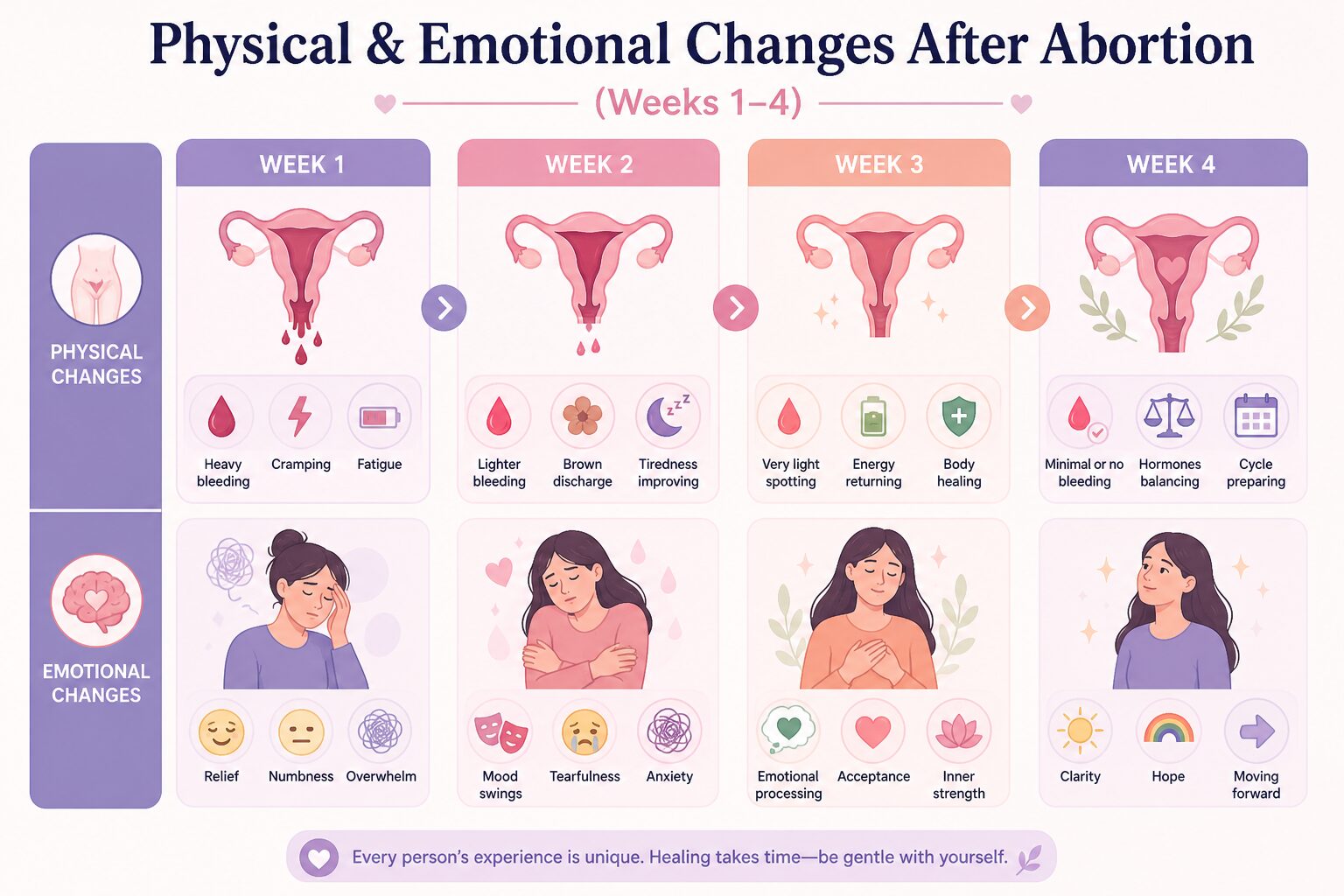
The first week is typically the most physically intense phase of recovery. Your uterus is returning to its pre-pregnancy size, your hormone levels are actively declining, and your body is doing the hard work of resetting itself.
How much bleeding is normal in week 1:
Bleeding in week 1 can range from light spotting to flow heavier than a typical period, depending on how far along the pregnancy was and the type of procedure. Passing small-to-medium clots after a medication abortion is normal. Bright red bleeding that soaks more than two thick pads per hour for two or more consecutive hours is not normal and warrants immediate medical attention.
Why you may still feel pregnant in week 1:
Human chorionic gonadotropin (hCG) the hormone pregnancy tests detect does not disappear the moment an abortion is complete. Your hCG levels decline gradually over the following weeks. This means you may still experience pregnancy symptoms during week 1: breast tenderness, nausea, bloating, or fatigue. These are hormonal echoes, not signs that something went wrong.
Signs of incomplete abortion to watch for:
An incomplete abortion where some tissue remains in the uterus occurs in roughly 2–5% of medication abortion cases. Signs include continued strong pregnancy symptoms beyond week 2, unusually prolonged heavy bleeding, or persistent pelvic pain that worsens rather than improves. A follow-up appointment or home pregnancy test at the 4-week mark can confirm that the process is complete.
WEEK 2 — IS THIS STILL NORMAL? WHAT’S CHANGING INSIDE YOUR BODY
By week 2, most people notice a meaningful shift. The physical intensity of week 1 eases, though the body is still very much in recovery mode. This is also often when emotional processing begins in earnest — the busyness of week 1 gives way to more space for feelings to surface.
Brown discharge at week 2 — what it means:
If your bright red bleeding has shifted to brown or pinkish spotting by week 2, this is actually a positive sign. Brown discharge simply indicates older blood leaving the uterus slowly it is not a sign of infection. It is your body completing the clearing process. Light spotting can continue intermittently for up to four weeks and still fall within the normal range.
The hormonal crash and emotional swings:
Week 2 is when the hormonal crash often becomes most noticeable. Progesterone and estrogen elevated during pregnancy have now significantly declined. This mirrors what happens after childbirth, and the emotional effects can be similarly disorienting: mood swings, tearfulness, heightened anxiety, or a general sense of flatness. These are biological responses, not signs of psychological weakness or regret.
When pregnancy symptoms should fully fade:
By the end of week 2, hCG levels should be declining significantly. For most people, all pregnancy symptoms resolve within 2–3 weeks post-procedure. If you still feel clearly pregnant at the end of week 2 persistent nausea, noticeable breast changes, contact your provider, as this may indicate incomplete abortion.
WEEKS 3–4 — YOUR BODY RESETTING AND REBUILDING
By weeks 3 and 4, most of the acute physical recovery is behind you. But important internal processes are still underway, and this phase deserves just as much attention as the first two weeks.
Uterine lining rebuilding:
Your endometrium (uterine lining) begins rebuilding itself during this phase in preparation for your next menstrual cycle. This is a quiet but significant process driven by rising estrogen levels. Most people experience minimal bleeding or none at all by week 3, though light spotting remains possible and is not a cause for alarm.
When ovulation can return — earlier than most people expect:
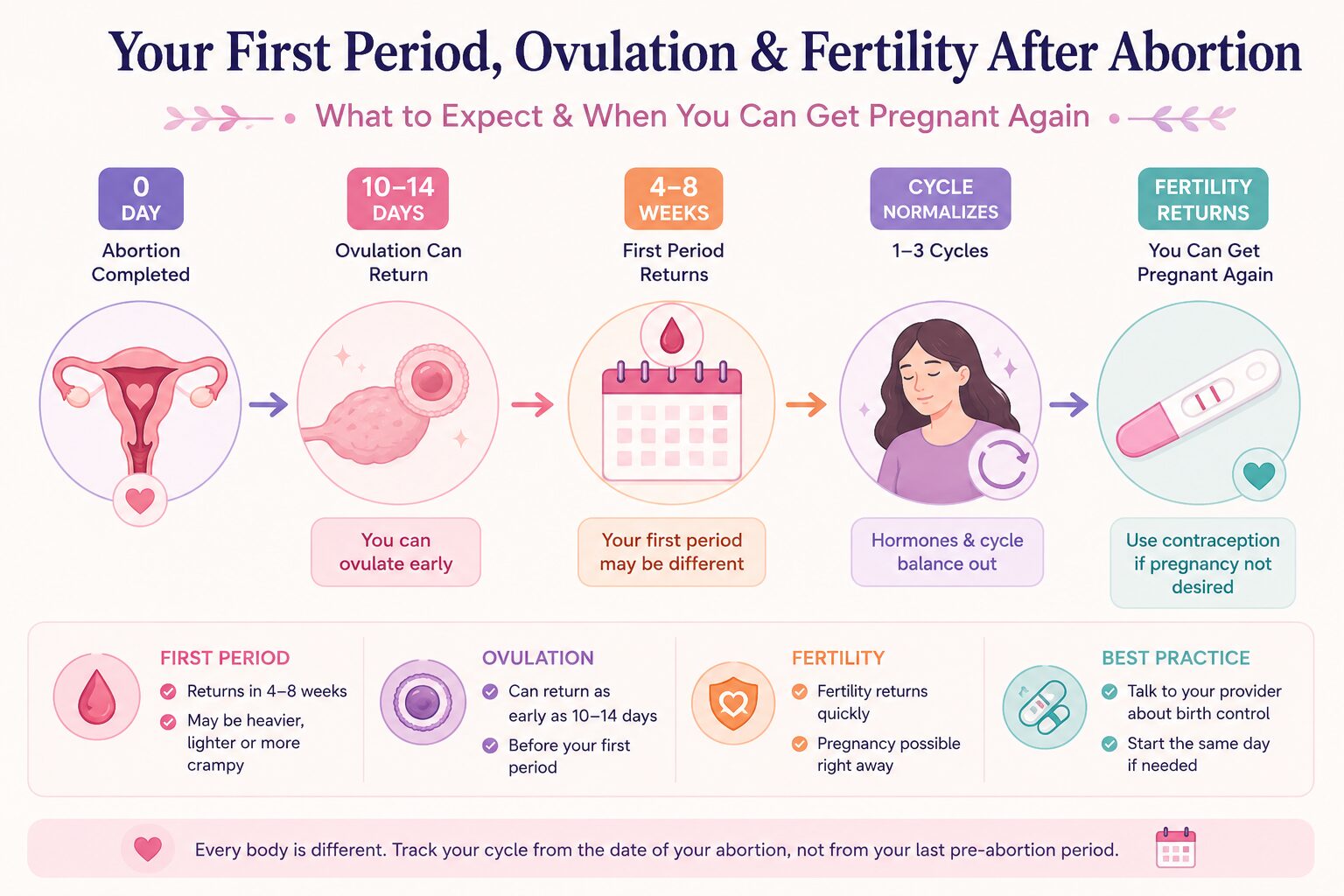
This is one of the most clinically important facts about abortion recovery: ovulation can return as early as 10–14 days after the procedure often before your first period arrives. This means you can become pregnant again before you have had a single post-abortion period. If pregnancy prevention is a priority, discuss contraception with your provider at or immediately after your follow-up appointment.
Sex after abortion — when it is physically safe:
Most providers recommend waiting at least 1–2 weeks before resuming penetrative sex. The primary concern is infection risk: while the cervix is still partially open and the uterine lining is healing, bacteria can more easily enter and cause infection. Emotionally, there is no set timeline, readiness varies enormously from person to person, and that is completely valid.
Start tracking your cycle from the date of your abortion, not from your last pre-abortion period. This helps you and your provider monitor recovery and the return of ovulation accurately.
YOUR FIRST PERIOD AFTER ABORTION — WHAT TO EXPECT AND WHEN
Your first post-abortion period is one of the clearest signals that your hormonal system has fully reset but its arrival is not always predictable, and its character may surprise you.
Most people get their first period between 4 and 8 weeks after the procedure. The timing depends largely on how far along the pregnancy was: the further along, the longer it may take for the cycle to restart. If you have not had a period by 8 weeks post-procedure, take a pregnancy test (since ovulation may have returned) and contact your provider.
Why your first period may feel different:
Your first post-abortion period may be heavier than usual, with stronger cramping than you are used to; this is because the uterine lining has had extra time to build up. Alternatively, some people experience a lighter-than-normal first period. Both are normal variations. By the second or third cycle, most people return to their usual pattern.
EMOTIONAL RECOVERY — THE TIMELINE NOBODY TALKS ABOUT
Physical recovery follows a more predictable timeline than emotional recovery. The emotional experience after an abortion is not linear, not universal, and often not what people expect. Some people feel immediate relief that persists for weeks. Others feel grief that arrives suddenly, weeks later. Many feel both simultaneously and that ambivalence is real, valid, and far more common than is publicly acknowledged.
The hormonal basis of post-abortion emotions:
The emotional turbulence that many people experience has a direct hormonal foundation. The sudden drop in progesterone and estrogen affects the same neurological pathways involved in mood regulation; this is why post-abortion emotional difficulty often feels similar to premenstrual or postpartum mood changes. Understanding biology does not diminish the emotional experience. It simply adds important context.
Common emotional responses and when they tend to peak:
Relief is often immediate; sometimes accompanied by guilt about feeling relieved. Grief may not surface until weeks later, sometimes triggered by unrelated events. Anxiety common in weeks 1–2, often linked to physical recovery uncertainty. Numbness is a common protective initial response; feelings often arrive later. Anger at circumstances, partners, the healthcare system, or society.
Research consistently shows that the most commonly reported emotion after abortion is relief. However, more difficult emotions can and do coexist with relief — one does not cancel out the other. If emotional difficulty persists beyond 4–6 weeks or significantly affects daily functioning, speaking with a therapist experienced in reproductive health can make a meaningful difference. Our team is here to support you. You can schedule an appointment to speak with a compassionate provider at any stage of your recovery.
WARNING SIGNS — WHEN TO CALL YOUR DOCTOR IMMEDIATELY
Most abortions have no serious complications. But when complications do arise, early recognition and prompt treatment are what prevent them from becoming serious. Know these signs and do not wait them out.
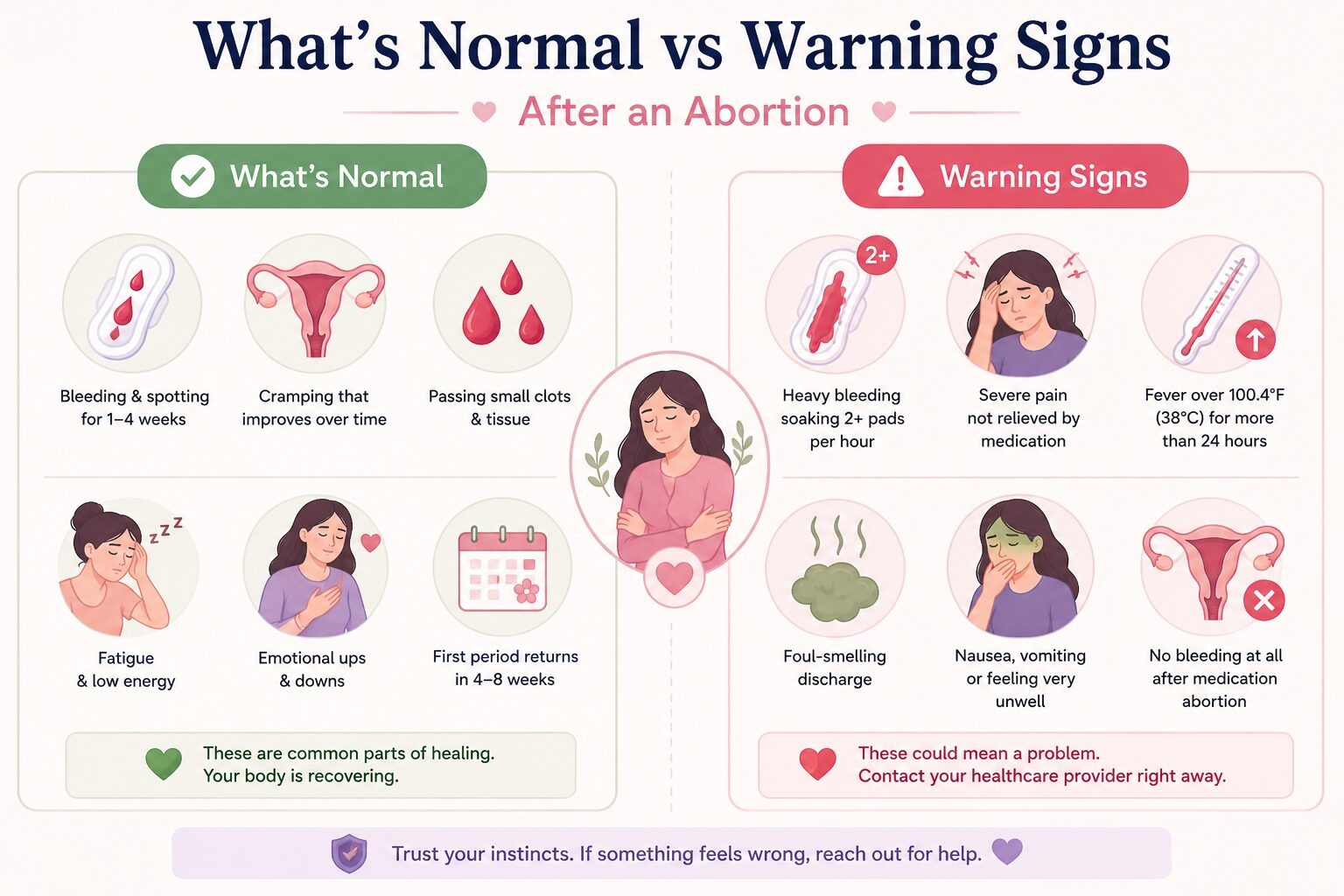
Seek medical care immediately if you experience any of the following:
Fever above 38°C (100.4°F) that lasts more than 24 hours. Foul-smelling vaginal discharge is a key indicator of infection. Soaking more than 2 thick pads per hour for 2 or more consecutive hours. Severe abdominal pain that is not relieved by ibuprofen or prescribed pain relief. No bleeding at all after a medication abortion (may mean the medications did not work). Continued strong pregnancy symptoms more than 3 weeks after the procedure. Chills, vomiting, or feeling systemically unwell beyond the first 24 hours.
Trust your instincts. If something feels wrong, it is always appropriate to contact your provider or go to an emergency department. You do not need to justify seeking care
FERTILITY AND FUTURE PREGNANCIES — WHAT THE RESEARCH ACTUALLY SAYS
One of the most persistent misconceptions about abortion is that it negatively affects future fertility. The evidence does not support this. Multiple large-scale studies and reviews by the American College of Obstetricians and Gynecologists (ACOG) and the World Health Organization confirm that uncomplicated abortions both medication and surgical, do not affect a person’s ability to conceive or carry future pregnancies.
Rare complications, such as significant untreated uterine infection, can in some cases have an impact which is precisely why attending your follow-up appointment and treating any warning signs promptly matters so much.
Contraception after abortion:
Because ovulation can resume within two weeks of an abortion, contraception should be discussed proactively ideally before or at the time of the procedure. Most methods, including hormonal contraception, IUDs, and the implant, can be started immediately after an abortion. Your provider can help you choose what fits your health needs, timeline, and future plans. If you prefer to discuss this from the comfort of your home, our telehealth abortion care service allows you to connect with a provider privately and conveniently.
FREQUENTLY ASKED QUESTIONS
How long does bleeding last after an abortion?
Bleeding typically lasts 1–2 weeks, with light spotting possible for up to 4 weeks. If you are soaking more than two thick pads per hour for two or more consecutive hours, contact your provider immediately.
Is it normal to feel no symptoms after an abortion?
Yes, especially after a surgical abortion. The exception: if you had a medication abortion and had no bleeding at all, contact your provider as the medications may not have worked.
Why do I still feel pregnant two weeks after my abortion?
The hCG hormone can remain in your system for 4–6 weeks post-abortion, causing lingering symptoms. If you still feel strongly pregnant at week 3 or beyond, contact your provider to rule out incomplete abortion.
When will my period come back after an abortion?
Most people get their first period 4–8 weeks after the procedure. If it has not returned by 8 weeks, take a home pregnancy test and contact your provider.
Can I get pregnant immediately after an abortion?
Yes. Ovulation can return within 10–14 days, even before your first period arrives. Discuss contraception with your provider right away — most methods can begin the same day as the procedure.
What are the signs of infection after an abortion?
Watch for fever above 38°C lasting more than 24 hours, foul-smelling discharge, worsening pelvic pain, or feeling systemically unwell beyond the first day. Seek care promptly as infection is treatable when caught early.
Is it normal to feel emotional weeks after an abortion?
Absolutely. Hormonal shifts continue for several weeks, and emotional processing is not linear. Delayed feelings are normal. If emotional difficulty becomes persistent or overwhelming, speaking with a reproductive health counselor can help.

Dr. James Carter is a board-certified physician and lead clinician at Serenity Choice Health, specializing in reproductive health access and medication abortion protocols. With over 20+ years of experience, he combines clinical expertise with patient-centered care to ensure safe, compassionate, and confidential reproductive healthcare.