
Many women assume that a routine STI test checks for every sexually transmitted infection but that is often not the case. Standard screening panels vary by clinic, provider, and patient history. Without knowing what questions to ask, it is easy to leave an appointment believing you have been fully tested when important infections may not have been included.
Understanding which STI tests you actually need and why puts you in control of your own reproductive health. This guide breaks down the most important screenings by infection, age, and risk level, so you can walk into any appointment prepared and informed.
What STIs Should Women Be Tested For?
There is no single universal STI panel that applies to every woman. Testing recommendations are shaped by several factors, including your age, sexual history, number of partners, whether you are pregnant, and whether you have experienced any symptoms.
Why There Is No One-Size-Fits-All Screening Panel
Different healthcare organizations including the CDC, the U.S. Preventive Services Task Force, and the American College of Obstetricians and Gynecologists each publish slightly different guidelines. What they agree on is that risk-based, individualized screening catches more infections than a blanket approach.
A woman in a long-term monogamous relationship has different testing needs than someone who has recently had a new partner or who has a history of prior infections. Your provider uses these factors to decide which tests to order.
Factors That Determine Which Tests You Need
The key variables that shape your screening plan include your age (women under 25 face higher chlamydia and gonorrhea rates), how many sexual partners you have had, whether you use barrier contraception consistently, any previous STI diagnoses, and whether you are currently pregnant or planning to become pregnant.
Why Symptoms Are Not Always a Reliable Guide
This is one of the most important points in sexual health: most STIs cause no noticeable symptoms, especially in the early stages. Chlamydia, gonorrhea, syphilis, and HIV can all be present in your body for months or years without any signs. Waiting until something feels wrong means infections go untreated longer and the health consequences can be serious.
The Most Important STI Tests Every Woman Should Know About
The following infections are most commonly included in or recommended alongside standard screening panels.
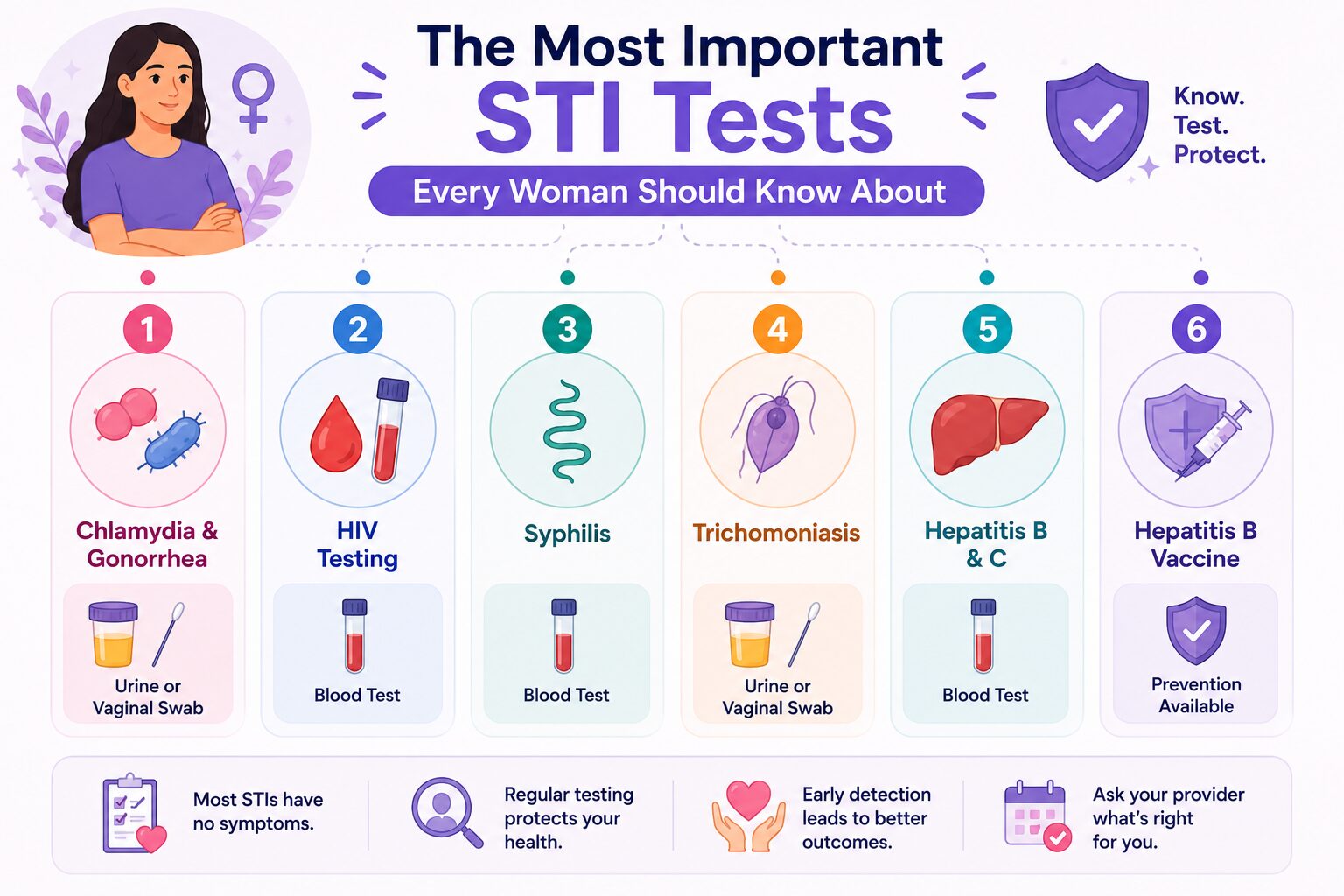
Chlamydia and Gonorrhea
These two bacterial infections are the most commonly reported STIs in the United States. They frequently occur together, which is why they are typically tested at the same time. Both are detected through a urine sample or vaginal swab. The CDC recommends annual screening for chlamydia and gonorrhea in all sexually active women under 25, and for older women with new or multiple partners.
HIV Testing
HIV testing is recommended at least once for all adults ages 15 to 65 as part of routine healthcare, and more frequently for anyone at higher risk. The standard test detects HIV antibodies and antigens through a blood draw. Early detection is essential and effective treatment today means people living with HIV can maintain excellent long-term health.
Syphilis
Syphilis has been increasing in the United States in recent years, including among women of reproductive age. It is detected through a blood test and is highly treatable with antibiotics in its early stages. Left undetected, syphilis can cause serious long-term complications affecting the heart and nervous system. Pregnant women are routinely screened because syphilis can be passed to the baby during pregnancy.
Trichomoniasis
Trichomoniasis or ‘trich’ is one of the most common but least discussed STIs. It is caused by a parasite and is detected through a vaginal swab or urine test. While it often causes no symptoms, it can increase the risk of contracting other STIs if left untreated.
Hepatitis B and C
Hepatitis B can be sexually transmitted and can also be passed from mother to baby during birth. Hepatitis C is transmitted primarily through blood contact, though sexual transmission is possible. Both are detected through blood tests. Hepatitis B has a vaccine, making it especially important to know your status.
Should Women Be Tested for HPV?
HPV (human papillomavirus) is the most common sexually transmitted infection in the world. However, HPV screening is not part of a standard STI panel; it is handled through cervical cancer screening.
HPV Testing vs. Pap Smears
A Pap smear checks cervical cells for abnormal changes that could indicate cancer. An HPV test checks whether high-risk HPV strains are present on those cells. The two tests are sometimes done together in what is called co-testing. Neither test requires a separate STI appointment; they are performed during a routine pelvic exam.
Age-Based HPV Screening Recommendations
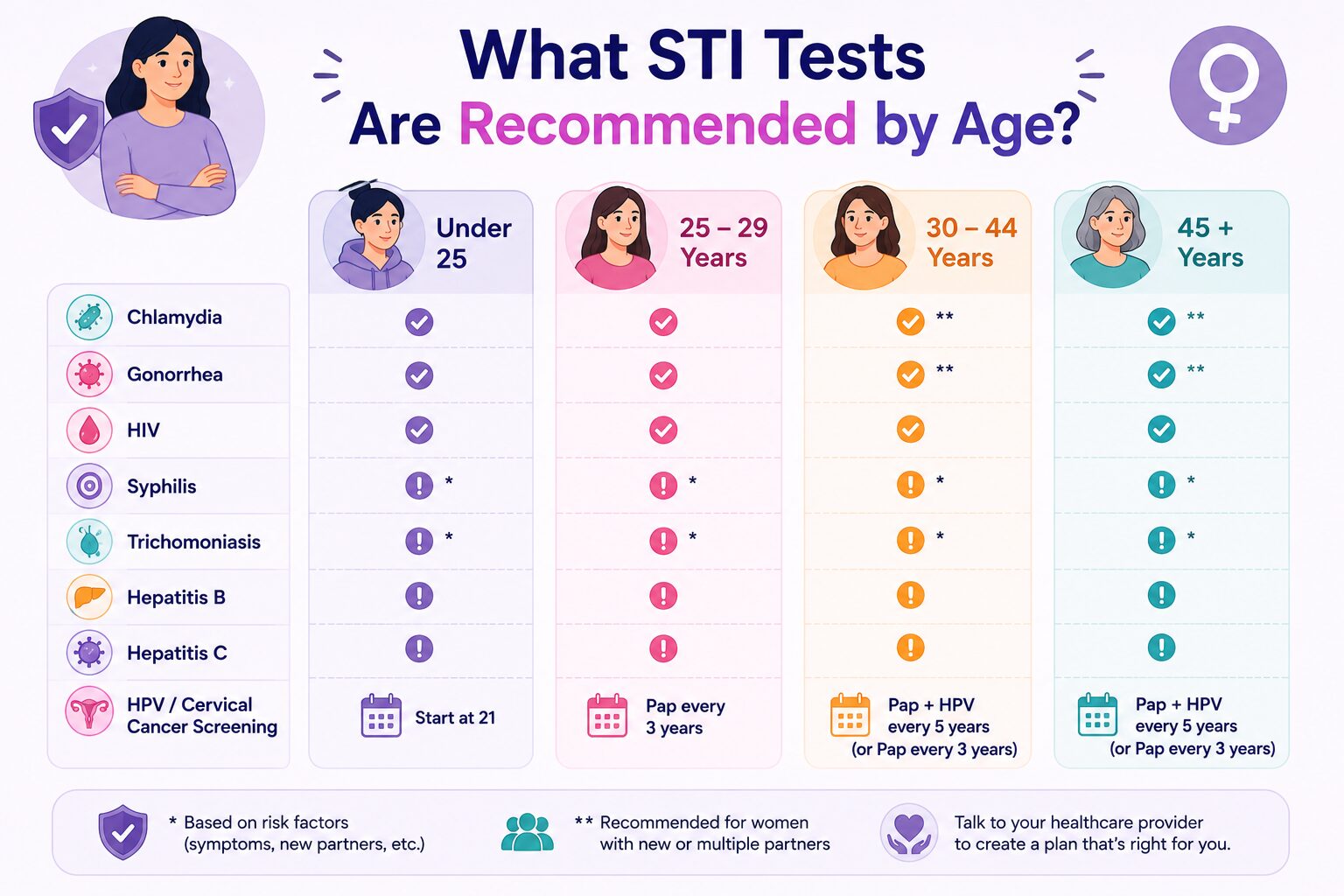
Pap smears are recommended starting at age 21, regardless of sexual history. Women ages 21 to 29 typically receive a Pap smear alone every three years. From age 30 onward, co-testing with both Pap and HPV is recommended every five years, or a Pap alone every three years.
There is currently no approved HPV test for people with penises, and most HPV infections clear on their own. However, certain high-risk strains can cause cervical abnormalities, making routine cervical screening one of the most effective cancer prevention tools available.
What Does a Standard STI Panel Include?
Most standard STI panels include chlamydia and gonorrhea, and sometimes HIV and syphilis. What they do not automatically include unless you specifically request it is herpes, hepatitis, or trichomoniasis.
What May Not Be Included Automatically
Herpes (HSV) is one of the most common examples of a test that is rarely included in standard panels unless you have visible symptoms or specifically request it. This is partly because blood tests for herpes can have high rates of false positives, and positive results can cause anxiety without always changing clinical management.
If you want a complete picture of your sexual health, the best approach is to have an open conversation with your provider and ask directly which infections are being tested. Do not assume a panel is comprehensive without asking. Our STI and STD testing services are designed to give you full clarity on exactly what is being screened.
How Often Should Women Get Tested for STIs?
Testing frequency depends on your personal risk profile. Here is a practical breakdown:
Annual testing is recommended for all sexually active women under 25 for chlamydia and gonorrhea. After a new partner, testing is generally advised within two to four weeks for most bacterial infections, though HIV and syphilis may have longer window periods before a test can detect them accurately. During pregnancy, testing is recommended at the first prenatal visit and again in the third trimester for higher-risk patients. Women with multiple partners or a history of prior infections may benefit from more frequent screening every three to six months.
Can Women Have an STI Without Symptoms?
Yes and this is more common than most people realize. Chlamydia is often called a ‘silent infection’ because roughly 70% of women who have it experience no symptoms at all. Gonorrhea, syphilis, trichomoniasis, hepatitis, and HIV can all be asymptomatic in the early stages.
Why Delayed Detection Matters
When STIs go undetected, they have time to cause damage that is not always reversible. Untreated chlamydia and gonorrhea are leading causes of pelvic inflammatory disease (PID), which can affect the fallopian tubes and reduce fertility. Untreated syphilis can cause cardiovascular and neurological complications over years. Routine screening is precisely what catches infections before they reach this stage.
What STI Tests Are Recommended by Age?
Women Ages 18–24
Annual chlamydia and gonorrhea testing is strongly recommended for all sexually active women in this age group. HIV testing should also be completed at least once, with repeat testing based on risk. Cervical screening (Pap smear) begins at age 21.
Women Ages 25–39
Chlamydia and gonorrhea testing continues annually for those with new or multiple partners. HIV, syphilis, and hepatitis testing are recommended based on risk factors. Pap smears continue every three years, or co-testing with HPV every five years from age 30.
Women Ages 40 and Beyond
Routine STI screening continues based on risk factors and is not something to stop simply because of age. Cervical screening may be reduced or stopped after age 65 if prior tests have been consistently normal, per current guidelines.
Pregnancy-Specific Screening
Pregnant women are typically tested for chlamydia, gonorrhea, syphilis, HIV, and hepatitis B at the first prenatal visit. Some providers also test for hepatitis C and bacterial vaginosis. These tests protect both mother and baby, as several infections can be passed during pregnancy or delivery.
What Happens During an STI Screening Appointment?
An STI screening appointment is straightforward. Your provider will typically ask about your sexual history, number of partners, contraception use, and any symptoms you may have noticed. This information helps them decide which tests to run.
Testing methods vary by infection. Chlamydia and gonorrhea are typically detected through a urine sample or a self-collected vaginal swab. HIV and syphilis require a blood draw. Hepatitis is also diagnosed through blood testing. Some providers may perform a physical examination if symptoms are present. Most results come back within a few days.
At Home STI Testing vs. Clinic Testing
At-home STI testing kits have become widely available and offer a convenient option for people who prefer privacy. Most kits require a urine sample, swab, or finger-prick blood sample collected at home and mailed to a lab. Learn more about the benefits of telehealth and how virtual care supports your sexual health needs.
The accuracy of at-home tests for chlamydia, gonorrhea, HIV, and syphilis is generally comparable to clinic testing when samples are collected correctly. The limitations are that at-home kits may not include every infection, follow-up care requires contacting a provider separately, and some positive results need confirmation testing.
In-person clinic testing remains the best choice when you need a comprehensive panel, have symptoms, require treatment, or want to discuss your results with a provider directly. For first-time patients especially, an in-person visit offers the added benefit of counseling and a complete health evaluation. Our women’s primary care services provide exactly this kind of comprehensive, in-person support.
Common STI Testing Mistakes Women Make
Waiting for symptoms. As covered above, most STIs have no symptoms early on. Waiting until something feels wrong means missing the window for the easiest treatment.
Assuming one test covers everything. A standard panel is not a complete panel. Always ask your provider which specific infections are being tested.
Skipping follow-up testing. Some infections have window periods between exposure and when a test can detect the infection. If you were recently exposed, your provider may recommend retesting after a few weeks.
Not discussing risk factors openly. Your provider cannot tailor your screening without accurate information. Being honest about your sexual history, number of partners, and contraception use helps them recommend the right tests.
Creating a Personal STI Screening Plan
Building a screening routine does not have to be complicated. Start by assessing your risk level honestly, consider how often you have new partners, whether you use condoms consistently, and whether you have ever had an STI in the past.
From there, talk to your provider at your next appointment and ask specifically which infections they are testing for and why. If you are due for cervical screening, ask whether HPV co-testing is appropriate for your age. If you have had a new partner recently, mention it.
Staying consistent is the most important part. Annual screening, combined with prompt testing after any new sexual contact, catches infections early when they are easiest to treat and least likely to cause long-term complications. Our birth control and contraceptive services can also be part of a complete, ongoing reproductive health plan. Consider booking a confidential STI screening to get a plan tailored to your health history.
Frequently Asked Questions
What STIs should women be tested for routinely?
At a minimum, sexually active women under 25 should be tested annually for chlamydia and gonorrhea. HIV testing is recommended at least once for all adults. Additional tests for syphilis, hepatitis, and trichomoniasis are recommended based on individual risk factors and sexual history.
What is included in a standard STI screening panel?
Most standard panels include chlamydia and gonorrhea, and sometimes HIV and syphilis. Herpes, hepatitis, and trichomoniasis are often not included automatically; it is always worth asking your provider exactly which tests are being ordered.
How often should women get tested for STIs?
Women under 25 who are sexually active should be tested annually at minimum. After a new partner, testing within a few weeks is advisable. Women with higher risk factors such as multiple partners or a history of STIs may benefit from testing every three to six months.
Should women get tested even without symptoms?
Yes. Most STIs produce no symptoms, especially in the early stages. Routine screening is the primary way asymptomatic infections are caught before they cause serious health complications like pelvic inflammatory disease or fertility problems.
Does an STI test automatically include HPV testing?
No. HPV is screened through cervical cancer screening, specifically the Pap smear and HPV co-test not through a standard STI panel. These tests are performed separately during a routine gynecological exam.
Which STI is most commonly missed without screening?
Chlamydia is the most frequently missed infection because approximately 70% of women with it have no symptoms. It is also one of the most treatable which makes regular screening especially important for catching it early.

Dr. James Carter is a board-certified physician and lead clinician at Serenity Choice Health, specializing in reproductive health access and medication abortion protocols. With over 20+ years of experience, he combines clinical expertise with patient-centered care to ensure safe, compassionate, and confidential reproductive healthcare.