
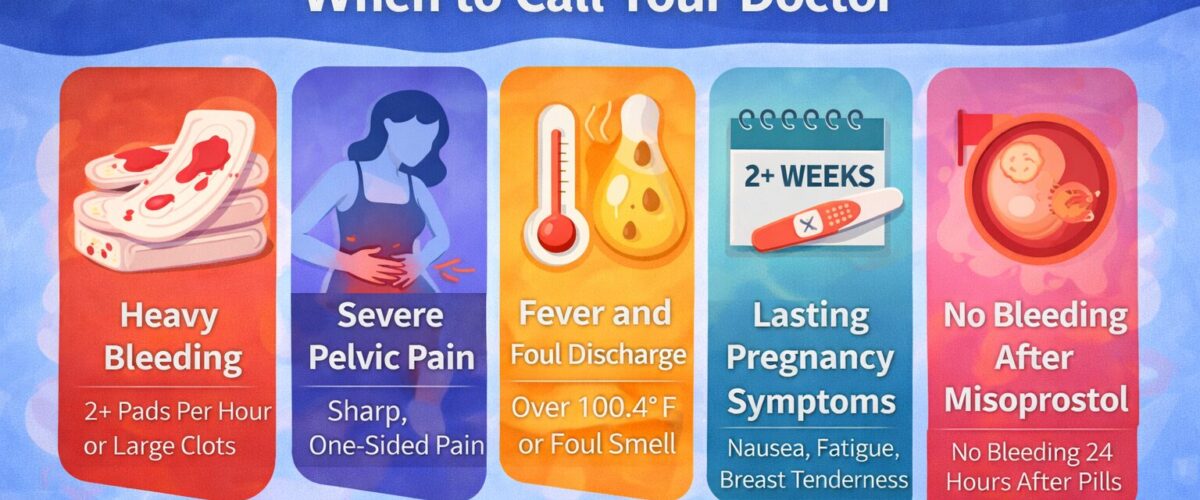
After an abortion, some symptoms are normal, but others can be a sign of complications that need urgent care. Here are key warning signs to watch for:
- Heavy bleeding: Soaking 2+ pads per hour for 2 hours or passing clots larger than a lemon requires immediate medical attention.
- Severe pelvic pain: Pain that worsens or is sharp and one-sided could signal a ruptured ectopic pregnancy.
- Fever over 100.4°F lasting more than 4 hours or severe abdominal pain with foul-smelling discharge may indicate an infection.
- Continued pregnancy symptoms: Nausea, fatigue, or breast tenderness that persists beyond 2 weeks suggests the abortion may not have been complete.
- No bleeding after Misoprostol: If bleeding doesn’t occur within 24 hours of taking misoprostol, it may indicate an ectopic pregnancy.
When to Seek Immediate Medical Attention:
- Heavy bleeding, sharp pain, or fever should be evaluated in an emergency room without delay.
- Unexplained dizziness or fainting after heavy bleeding requires immediate care.
What Is Normal After an Abortion?
Before identifying warning signs, understanding the expected recovery baseline matters. Normal post-abortion symptoms include light to moderate cramping for several days, spotting or light bleeding for up to two weeks, mild nausea, fatigue, and breast tenderness persisting for one to two weeks as pregnancy hormones leave the body, and a positive home pregnancy test for up to four to six weeks after the procedure. That positive test does not mean the abortion failed, it simply reflects lingering hCG levels that decline gradually.
After medication abortion specifically, the heaviest bleeding and strongest cramping typically occur within the first four to six hours following misoprostol. This phase is intense but temporary. What follows over the subsequent one to three weeks is progressively lighter bleeding transitioning to spotting and eventual resolution.
Everything outside this pattern deserves clinical attention. Several specific presentations require emergency care immediately.
Warning Sign #1: Heavy Bleeding and Large Blood Clots
Heavy bleeding after the abortion pill or surgical abortion is expected. Hemorrhagic bleeding is a medical emergency that requires immediate intervention.
The clinical threshold that separates expected heavy bleeding from dangerous blood loss is soaking through two or more thick full-size sanitary pads per hour for two consecutive hours. Additional danger indicators include passing blood clots larger than a lemon, feeling dizzy or lightheaded, experiencing a rapid or pounding heartbeat, developing pallor or unusual weakness, or feeling faint.
Large blood clots after abortion or huge blood clots after abortion are among the most alarming symptoms patients search for and with good reason. While some clot passage during the first few hours of heavy bleeding is normal, clots the size of a lemon or larger, or continuous passage of multiple large clots over hours, indicates that something requires clinical evaluation rather than home monitoring.
The clinical causes of heavy bleeding after abortion include uterine atony when the uterus relaxes rather than contracting to control bleeding retained pregnancy tissue causing the uterus to contract inadequately, and in rare cases following surgical abortion, uterine perforation. All of these are treatable conditions when addressed promptly. The risk escalates significantly with delayed intervention.
Go to the emergency room immediately if you meet the two-pad-per-hour threshold for two consecutive hours, if you are passing very large clots, or if you feel faint, dizzy, or confused.
Warning Sign #2: Severe or Persistent Pelvic Pain
Cramping after abortion pills or surgical abortion is expected and normal. Severe or worsening pelvic pain that does not respond to standard pain management is not normal and requires same-day clinical evaluation.
The most common cause of significant pain after abortion is uterine infection endometritis which develops when retained pregnancy tissue creates conditions for bacterial growth inside the uterine cavity. Most post-abortion infections are mild and respond well to oral antibiotics when identified early. The danger is in delay: an untreated uterine infection can progress to sepsis, a life-threatening systemic response that requires hospitalization.
Pain can also result from retained tissue or blood clots that have not passed naturally, requiring either oral misoprostol or a minor vacuum aspiration procedure to resolve.
The most urgent pain presentation is sharp, severe, one-sided pelvic pain particularly if accompanied by shoulder pain, dizziness, or fainting. This combination of symptoms raises immediate concern for ectopic pregnancy rupture, a genuine medical emergency requiring emergency surgical intervention. An ectopic pregnancy implanted in the fallopian tube that ruptures causes severe internal bleeding. If you experience sudden severe one-sided pelvic pain at any point during or after abortion care, do not wait go to an emergency room immediately.
Call your provider or seek emergency care for pelvic pain not relieved by ibuprofen, pain that worsens rather than improves over days, or any sudden severe one-sided pelvic pain.
Warning Sign #3: Fever Understanding What Is Concerning and What Is Not
A low-grade temperature and chills in the immediate hours following misoprostol is a recognized side effect of the prostaglandin medication itself, not a sign of infection. It is temporary, typically resolving within four to six hours of the medication being absorbed, and does not require clinical evaluation in isolation.
What does require clinical evaluation is a fever of 100.4°F or higher that persists beyond four hours, fever that develops or returns in the days following the procedure when you should be feeling better, or any fever accompanied by severe abdominal pain, foul-smelling vaginal discharge, chills and body aches, or a fast heart rate.
These signs of infection after abortion particularly the combination of persistent fever, worsening pain, and abnormal discharge indicate uterine infection requiring antibiotic treatment and potentially uterine evacuation. The warning signs of infection after abortion are most dangerous when dismissed as normal recovery symptoms. When in doubt, contact your provider the same day rather than waiting to see if the fever resolves independently.
Warning Sign #4: Continued Pregnancy Symptoms Beyond Two Weeks
Nausea, breast tenderness, fatigue, and frequent urination are driven by hCG, the pregnancy hormone. Following a successful abortion, these symptoms typically resolve within one to two weeks as hormone levels return to baseline.
Pregnancy symptoms that persist beyond two weeks post-abortion, or that initially improve and then return, are a potential indicator that the abortion was incomplete or unsuccessful. Breast pain three weeks after abortion, ongoing nausea at two weeks post-procedure, or fatigue that worsens rather than improves should be discussed with your provider.
One important clinical nuance: if you started hormonal contraception the pill, patch, or ring immediately after your abortion, some of these same symptoms can occur as a side effect of the hormonal contraception rather than as indicators of ongoing pregnancy. Your provider can help differentiate these scenarios.
Critically, a home pregnancy test is not a reliable tool for confirming complete abortion in the first four to six weeks post-procedure. hCG levels decline gradually and a positive test during this window does not mean the abortion failed. A serum hCG blood test with declining levels, or an ultrasound confirming an empty uterus, are the only clinically reliable confirmation methods.
Warning Sign #5: Signs of Infection Beyond Fever
Uterine infection following abortion presents with a recognizable cluster of symptoms that go beyond fever alone. The full picture of post-abortion infection signs includes foul-smelling or unusual vaginal discharge yellow, green, or malodorous discharge that appears in the days following the procedure chills or body aches developing after the initial misoprostol side effects have resolved, a feeling of general unwellness several days post-procedure when recovery should be progressing, lower abdominal pain that intensifies rather than diminishes over days, and a rapid heart rate.
Any combination of these symptoms warrants same-day clinical contact. Infection after the abortion pill caught early is readily treated. Infection that progresses to sepsis becomes a hospitalization-level emergency with significantly more complex management.
A note on retained tissue: abortion pill side effects and the symptoms of retained pregnancy tissue can overlap in the early days following the procedure. Both involve bleeding and cramping. What distinguishes retained tissue from normal recovery is the persistence and progression of symptoms bleeding that does not gradually decrease, pain that does not follow a pattern of improvement, or fever developing days after the procedure when recovery should be well underway.
Warning Sign #6: No Bleeding After Misoprostol
Not bleeding after the abortion pill specifically, experiencing no significant bleeding within 24 hours of taking misoprostol is a red flag that requires same-day clinical contact rather than monitoring at home.
Misoprostol cramping but no bleeding, or experiencing only light bleeding after misoprostol when heavier bleeding was expected at your gestational stage, raises concern for ectopic pregnancy in which the pregnancy is located outside the uterine cavity and therefore cannot respond to misoprostol in the expected way.
Why am I not bleeding after taking misoprostol is one of the most urgent questions in medication abortion recovery. The answer requires clinical evaluation not reassurance from an internet search. Contact your provider immediately if no meaningful bleeding occurs within 24 hours of misoprostol, or if bleeding is dramatically lighter than expected for your gestational age.
When to Go Directly to the Emergency Room?
Certain symptom combinations bypass the call-your-provider step entirely. Go to the nearest emergency room without delay for any of the following:
Heavy bleeding soaking two or more pads per hour for two consecutive hours, fainting or loss of consciousness, sudden severe abdominal pain that is worsening, high fever accompanied by severe pain and chills, signs of shock including rapid heartbeat, pale or clammy skin, confusion or extreme weakness, sharp one-sided pelvic pain with shoulder pain or dizziness at any point during or after the abortion process, or any symptom that feels medically serious regardless of whether it matches a specific category above.
Post-abortion complications that require emergency care deteriorate faster than most patients anticipate. The decision to go to an emergency room when a symptom feels serious is always the right clinical instinct.
Serenity Choice Health: Care That Continues Through Your Recovery
At Serenity Choice Health, we understand that safe abortion care does not end when the prescription is filled or the procedure is complete. We specialize exclusively in medication abortion, telehealth abortion, and in-person abortion services and comprehensive post-procedure support is a standard component of every patient’s care.
Before your procedure, our clinical team provides personalized guidance on what to expect during recovery, which symptoms fall within the normal range for your specific gestational age and health history, and exactly which signs should prompt you to contact us or seek emergency care. After your procedure, we provide structured follow-up coordination to confirm complete abortion and address any recovery concerns with clinical accuracy rather than generic reassurance.
Whether you are currently in post-abortion recovery and experiencing symptoms you want evaluated, are preparing for medication abortion and want to fully understand the recovery process before you begin, or had a procedure elsewhere and need clinical support our team is accessible, experienced, and genuinely committed to your health through every stage of the process.
Recovery Confidence Starts With Clinical Knowledge
The patients who navigate post-abortion recovery most safely are not the ones who worry least. They are the ones who know exactly what normal looks like, recognize the specific symptoms that cross clinical thresholds, and act quickly when something does not fit the expected pattern.You now have that knowledge. Use it.
Recovery questions or concerns? Book your confidential consultation at Serenity Choice Health today. Telehealth and in-person appointments are available so you can access the clinical support, post-procedure follow-up, and expert guidance you need quickly, privately, and from a team that takes your recovery as seriously as you do.

Dr. James Carter is a board-certified physician and lead clinician at Serenity Choice Health, specializing in reproductive health access and medication abortion protocols. With over 20+ years of experience, he combines clinical expertise with patient-centered care to ensure safe, compassionate, and confidential reproductive healthcare.