
There was a time when getting an abortion meant navigating long drives to a clinic, sitting in waiting rooms, and hoping no one you knew saw your car in the parking lot. For many women in the United States, that reality hasn’t changed, it’s gotten harder. Clinic closures, state restrictions, and the lingering uncertainty after the fall of Roe v. Wade have made in-person abortion care harder to reach for millions of people.
But something else has changed too: telehealth abortion care has quietly become one of the most trusted, accessible, and private ways to end a pregnancy in early stages. And the number of women choosing it is growing every year not just out of necessity, but because it genuinely works well for their lives.
This article breaks down exactly why that shift is happening from safety and convenience to privacy, cost, and legal realities in a post-Roe world.
What Is Telehealth Abortion Care?
Telehealth abortion care is the process of receiving a medication abortion through a virtual consultation with a licensed medical provider, followed by abortion pills delivered directly to your home. The entire process from medical screening to medication delivery happens without ever stepping foot in a clinic.
Here’s how it typically works:
You connect with a licensed provider through a secure online platform or video call. The provider reviews your medical history, confirms how far along the pregnancy is, and determines whether you’re a good candidate for medication abortion. If you qualify, they write a prescription. The pills are then shipped to your address in discreet packaging.
The medication used is a two-drug protocol mifepristone followed by misoprostol both of which are FDA-approved and have been used safely for more than two decades. This combination is highly effective up to 10–11 weeks of pregnancy, with a success rate exceeding 95%.
Most women who choose this path find the process far more straightforward than they expected. A consultation can happen in under an hour. Pills often arrive within a few days. And the entire experience unfolds in the privacy and comfort of your own home.
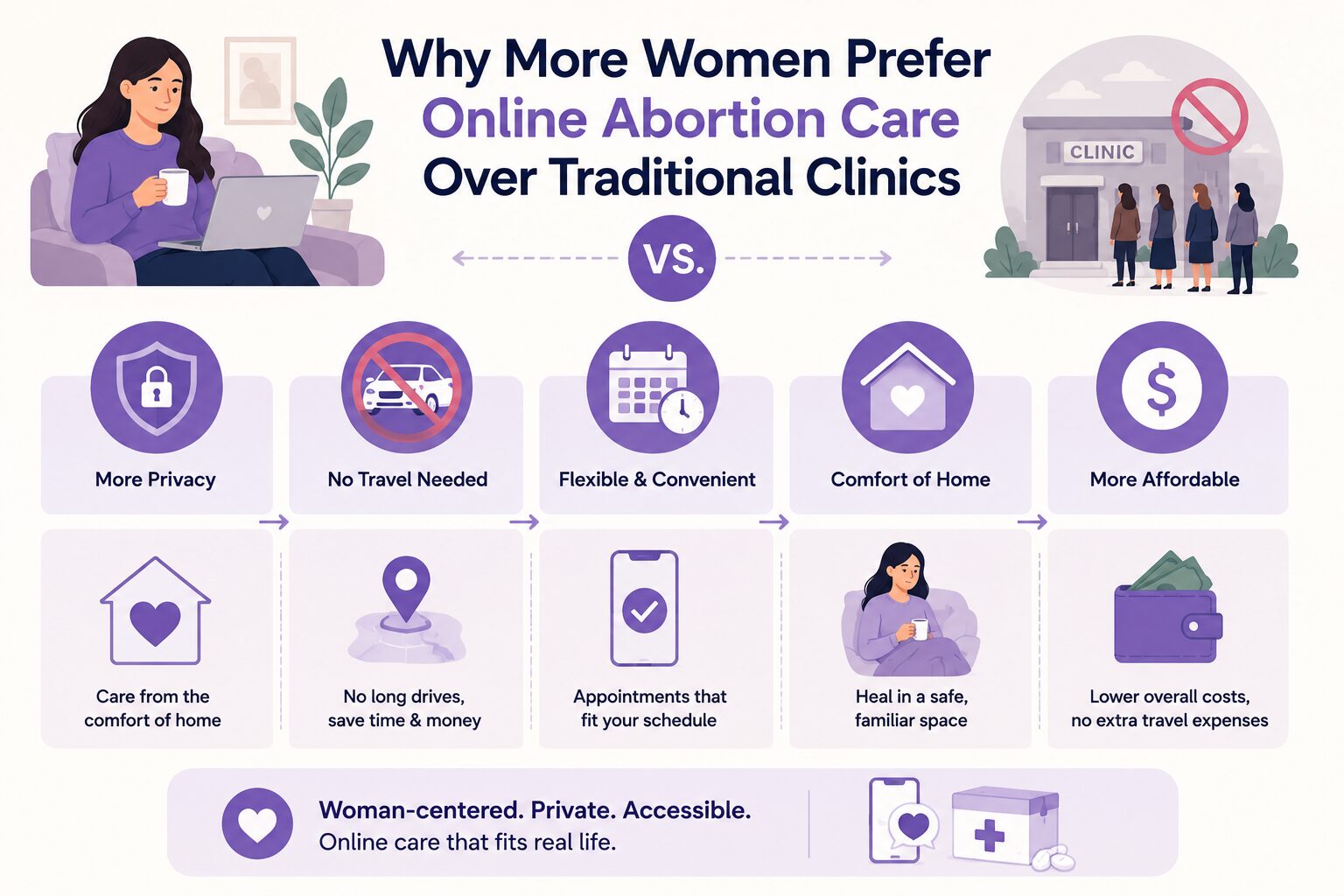
Why More Women Prefer Online Abortion Care Over Traditional Clinics
The reasons women choose remote reproductive healthcare are deeply personal and they’re different for everyone. But a few themes come up again and again.
Privacy and Freedom from Judgment
Walking into an abortion clinic still carries social weight that many women would rather avoid. Whether it’s the fear of being seen by someone you know, the stress of navigating protesters outside a clinic, or simply not wanting anyone else to know your business privacy matters. Telehealth abortion care removes almost all of that exposure.
Your consultation happens from wherever you feel most comfortable. Medications arrive in plain, unmarked packaging. There are no waiting rooms, no parking lots, no strangers. For a lot of women, this level of confidentiality makes the entire experience far less stressful and stress reduction during a medical procedure genuinely matters.
No Travel Required
Access to abortion care in the United States has become increasingly geographic. Depending on where you live, the nearest clinic may be dozens or even hundreds of miles away. Women in rural areas often face a full day of travel each way, plus the challenge of taking time off work, arranging childcare, or affording gas and lodging.
Free abortion access in rural areas is a serious concern, and virtual care directly addresses it. If you have a phone or computer and a reliable mailing address, distance is no longer a barrier.
Flexibility That Fits Real Life
Women don’t stop having jobs, kids, school, or caregiving responsibilities just because they’re facing an unplanned pregnancy. The scheduling flexibility of a virtual consultation often available evenings and weekends makes it possible to get care without blowing up your entire week. That kind of accommodation is rarely available through traditional clinic models.
Feeling More Comfortable at Home
There’s something worth acknowledging here that doesn’t always make it into clinical discussions: many women simply feel better going through a medical procedure at home. Being surrounded by familiar things, having a trusted person nearby, and controlling your own environment can reduce anxiety and make the physical experience easier to manage.
Is Telehealth Abortion Safe?
This is the question most women ask first and it deserves a clear answer.
Yes. When accessed through a licensed, legitimate provider, medication abortion is safe, effective, and well-supported by decades of medical evidence. The World Health Organization, the American College of Obstetricians and Gynecologists (ACOG), and the National Academies of Sciences all recognize medication abortion as a safe and effective standard of care.
The abortion pill, specifically the mifepristone-misoprostol combination, has been used by millions of people worldwide. Serious complications are rare, occurring in less than 1% of cases. The safety profile is comparable to, and in some measures better than, many common prescription medications.
What makes telehealth care safe is the screening process. A licensed provider evaluates your medical history and pregnancy timing before prescribing anything. They check for contraindications, confirm gestational age, and ensure you understand what to expect. Follow-up support is also typically available if you have questions or concerns after taking the medication.
The risk comes from unregulated sources, websites with no medical oversight, providers who skip screening, or counterfeit pills from unknown suppliers. That’s why choosing a verified, licensed telehealth provider matters enormously. Look for providers who are transparent about their licensing, offer real consultations (not just online forms), and provide follow-up care.
Common Reasons Women Seek At-Home Abortion Care
Understanding why someone seeks virtual reproductive care requires getting honest about the barriers that exist in the first place.
Clinic closures and provider shortages have left entire regions with no in-state abortion access. Following the Dobbs decision in 2022, over two dozen states implemented restrictions or near-total bans. Women in those states often face significant travel challenges that virtual care can help circumvent, depending on the legal landscape.
Financial limitations are another major factor. Taking two days off work, paying for travel, childcare, and lodging on top of the cost of the procedure can put in-clinic care out of reach for women living paycheck to paycheck. Abortion pill costs through telehealth services are often lower than in-clinic fees, and some providers offer sliding-scale pricing or financial assistance.
Fear of being recognized is real, especially in smaller communities where everyone knows everyone. The local clinic staff, the pharmacist, the person at the front desk these social dynamics keep some women from seeking care at all. Virtual care eliminates almost all of that.
Busy schedules with competing responsibilities, a demanding job, young children, a partner who doesn’t know make the logistical gymnastics of an in-person visit feel impossible for some women. The asynchronous nature of telehealth removes many of those logistical barriers.
How Much Does Telehealth Abortion Care Cost?
Cost is one of the most searched questions around abortion care and understandably so. The answer varies depending on the provider and your state, but telehealth abortion care is generally more affordable than in-clinic procedures.
On average, medication abortion through a telehealth provider ranges from around $150 to $400, often including the consultation, prescription, and medication delivery. Some providers offer income-based pricing or connect patients with abortion funds to cover costs.
Insurance coverage for abortion is inconsistent across the country. Some plans cover it, others don’t, and it can vary by state law. Telehealth providers typically offer transparent pricing upfront so you know what to expect which is itself a meaningful difference from the financial opacity that sometimes accompanies in-clinic visits.
When comparing costs, keep in mind that in-clinic care often comes with additional out-of-pocket expenses that don’t show up in the headline price: travel, childcare, lodging if you need to stay overnight, and lost wages from missed work.
What the Telehealth Abortion Experience Is Actually Like
One of the most common things women say after their telehealth abortion experience is: “It was more manageable than I expected.” Here’s a realistic picture of what the process involves.
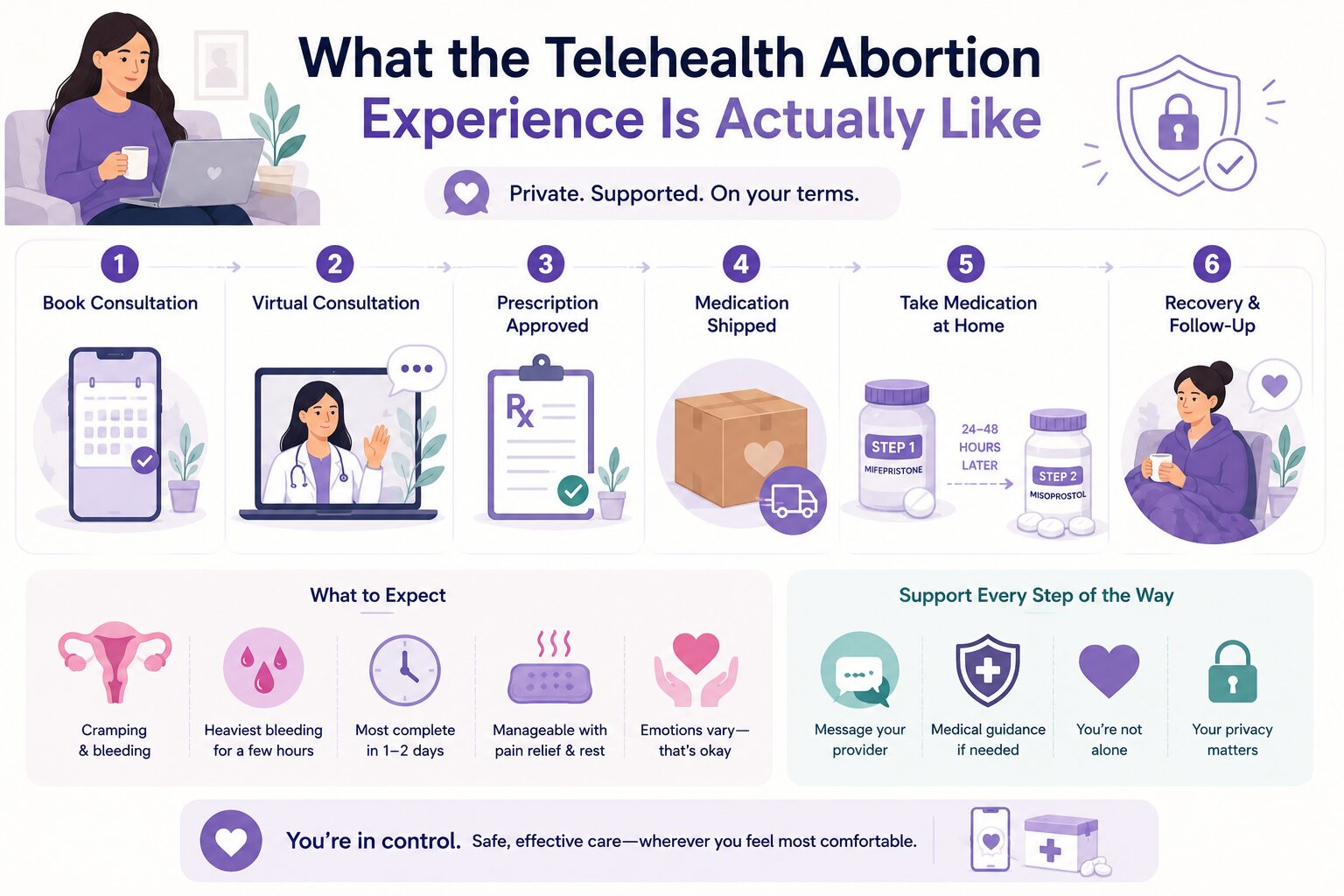
The virtual consultation typically takes 30 minutes to an hour. You’ll discuss your medical history, confirm the pregnancy’s gestational age, and go over what to expect from the medication. The provider answers your questions and ensures you’re comfortable proceeding.
Once the prescription is filled and shipped, delivery usually takes two to five business days depending on your location and the provider’s pharmacy. Packaging is discreet; there’s nothing on the outside to indicate what’s inside.
The medication itself causes cramping and bleeding, usually beginning within a few hours of taking misoprostol. The intensity varies, but most women describe it as similar to a heavy period or early miscarriage. Pain management options are discussed in advance so you can prepare.
Emotionally, recovery looks different for everyone. Some women feel relief, some feel grief, and many feel a complicated mix of both. Having support from someone you trust, whether a friend, partner, or a patient advocate can make a real difference.
Telehealth Abortion Access After Roe v. Wade
The legal landscape for abortion care in the United States shifted dramatically after June 2022. What was once a federally protected right became a patchwork of state laws, some protective, some severely restrictive, and many still evolving through courts.
Telehealth abortion care didn’t disappear after Dobbs but it did get more complicated. Whether telemedicine abortion is legal depends heavily on where you live and which state’s provider you’re accessing.
Several states have passed shield laws that protect providers located in abortion-supportive states from legal liability when they care for patients in restrictive ones. This has made it possible for providers in states like New York, Colorado, and Washington to continue serving patients across state lines within legal limits.
The demand for virtual reproductive care has increased significantly since Dobbs, precisely because it offers a pathway for women in restrictive states who would otherwise have to travel hundreds of miles or go without care entirely.
That said, the legal picture is genuinely complex and changes frequently. If you’re in a restrictive state, it’s worth understanding how to protect your privacy and what your online privacy rights are before seeking care. Digital footprints matter in this environment.
How to Choose a Trusted Telehealth Abortion Provider
Not all online abortion services are created equal. Choosing a legitimate, licensed provider is one of the most important decisions you’ll make in this process.
Here’s what to look for:
Licensed medical professionals. Any legitimate provider will have board-certified physicians, nurse practitioners, or licensed midwives on staff. Don’t proceed with any service that doesn’t clearly identify its medical team.
Real consultations, not just forms. A genuine medical consultation involves a provider actually reviewing your case and communicating with you, not just having you fill out a form and auto-generating a prescription.
Transparent pricing and clear follow-up support. You should know exactly what you’re paying and who to contact if you have questions or complications after taking the medication.
HIPAA-compliant privacy practices. Your medical information should be protected. A trustworthy provider will explain clearly how your data is stored and never shared without your consent.
Red flags to avoid include vague or nonexistent provider credentials, no real consultation process, no follow-up support, and pricing that seems too good to be true.
If you want to understand how to get safe, verified abortion pills online, working with a reputable telehealth service is the clearest path.
A Final Word
Telehealth abortion care isn’t a workaround or a lesser option for many women, it’s simply the better one. It’s private, it’s accessible, it’s evidence-based, and it meets people where they actually are: at home, with real lives and real constraints.
The growth in virtual reproductive healthcare reflects something important: when people are given access to care that respects their autonomy and fits their reality, they use it. And they should be able to.
If you’re considering your options, learn whether telehealth abortion care is right for you, or schedule a confidential appointment with a licensed provider. You can also explore in-clinic services if that’s the path that makes more sense for your situation.
Whatever you decide, you deserve care that is safe, private, and centered around your needs.
Frequently Asked Questions
Is telehealth abortion care safe?
Yes, when provided by a licensed medical professional using FDA-approved medications, it is safe and effective for pregnancies up to 10–11 weeks.
Can you legally get abortion pills online?
It depends on your state. In many states, yes. Check current laws and consider consulting a provider who can explain what’s accessible in your specific situation.
How quickly are abortion pills delivered?
Most providers ship within 1–2 business days of the consultation, with total delivery time typically ranging from 2–5 days.
Do I need to visit a clinic first?
No. The entire process consultation, prescription, and medication delivery can happen remotely with no in-person visit required.
How private is telehealth abortion care? Very. Consultations are HIPAA-protected, and medications arrive in discreet, unmarked packaging. There are additional steps you can take to protect your privacy further.
What if I have complications afterward? Follow-up support is available through most telehealth providers. In the event of a medical concern, you should contact your provider or visit an emergency room.

Dr. James Carter is a board-certified physician and lead clinician at Serenity Choice Health, specializing in reproductive health access and medication abortion protocols. With over 20+ years of experience, he combines clinical expertise with patient-centered care to ensure safe, compassionate, and confidential reproductive healthcare.