
For many women living in states with abortion restrictions, the biggest challenge is not just finding access, it is doing so privately. The moment abortion became a state-level decision, the questions women were asking changed. It was no longer just “how do I get care?” It became: “Who will know? Is this safe? Can this be traced? What happens if someone finds out?”
These are not paranoid questions. They are reasonable, practical concerns that millions of women across the United States are navigating right now. And the answers, while complex, are more reassuring than many people expect.
This guide addresses the real questions women in restricted states are asking about confidential abortion care: what options exist, how telehealth actually works, what privacy protections are in place, and how to identify legitimate care versus dangerous misinformation. Whether you are exploring the abortion pill or trying to understand all available options, our licensed providers prioritize your safety and privacy above everything else.
Why More Women Are Seeking Private Abortion Care
Since the Dobbs decision overturned Roe v. Wade in 2022, the landscape of reproductive healthcare in America has fractured along state lines. More than a dozen states have enacted near-total abortion bans. Others have introduced gestational limits, mandatory waiting periods, or restrictions specifically targeting telehealth prescribing. The result is a patchwork of access that leaves millions of women in genuinely uncertain territory.
But the response to restriction has not been silence. It has been adapted.
The Shift Toward Private, Home-Based Care
In states where clinic access has disappeared or shrunk dramatically, women have moved toward options that do not require a physical clinic visit not because they prefer it that way, but because it is often the only viable path. Telehealth abortion, medication abortion by mail, and interstate travel for care have all increased significantly since 2022.
Privacy concerns are a major driver of this shift. In communities where everyone knows everyone, walking into a local clinic carries social risk. In states where abortion is politically charged, even the act of seeking information can feel fraught. Women are not just seeking discreet abortion care because of legal risk, they are seeking it because privacy is a basic healthcare need that everyone deserves.
Why Clinics Are Not Always an Option
Even in states where abortion remains legal, geographic and logistical barriers create real obstacles. Rural women may live hours from the nearest provider. Women without paid time off or reliable childcare cannot easily take a day for a clinic appointment. Women in abusive relationships may not be able to travel without explanation.
Telehealth removes many of these barriers entirely. A virtual consultation can happen from a phone, in a private space, at a time that works. That accessibility is not a workaround, it is a meaningful improvement in how healthcare can be delivered. Learn more about access considerations in our guide on why abortion access matters.
How Telehealth Abortion Care Works
One of the most persistent misconceptions about online abortion care is that it is somehow less legitimate or less safe than in-person care. It is neither. Telehealth medication abortion is practiced by licensed clinicians, regulated under the same medical standards, and backed by decades of safety data.
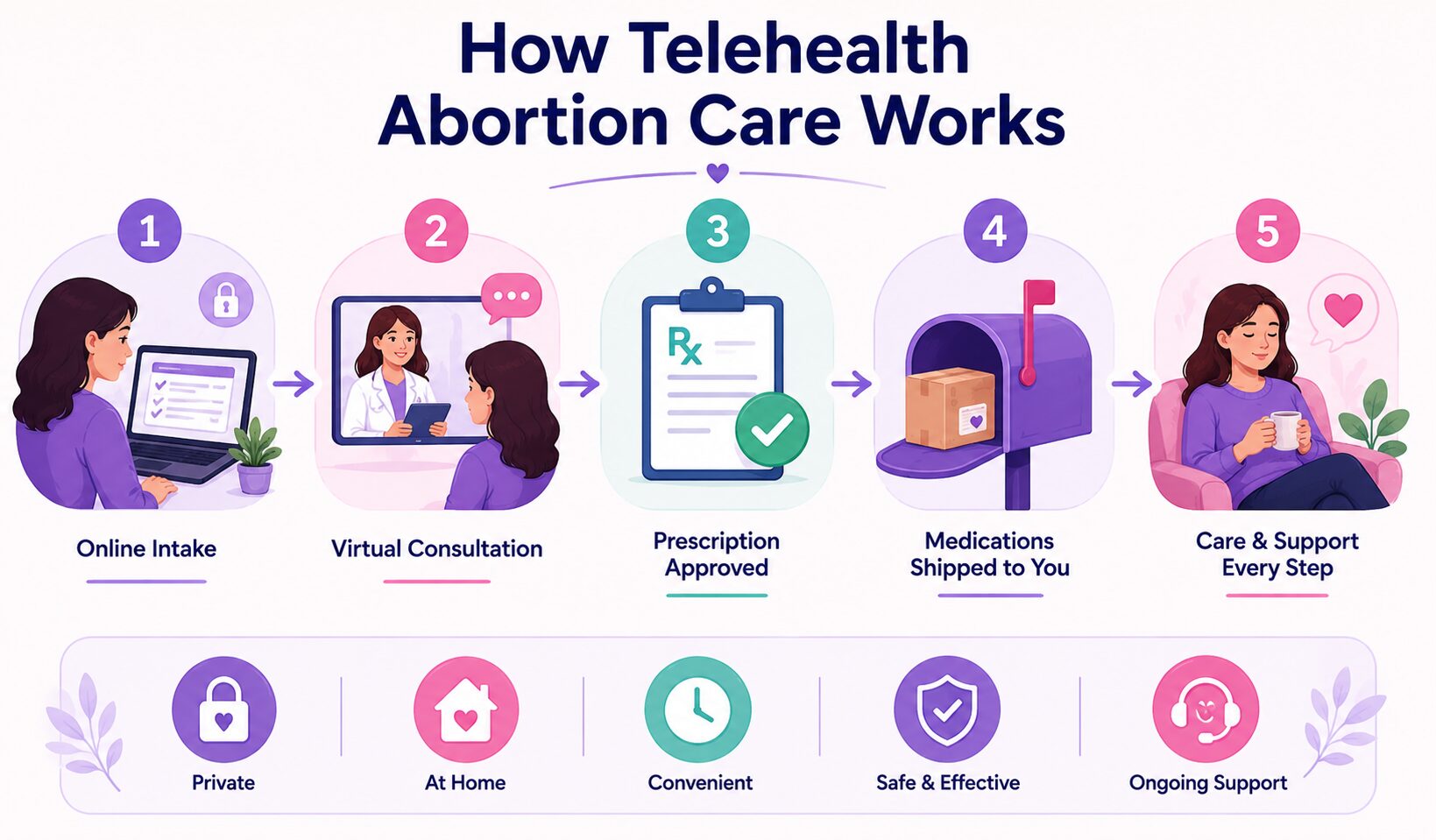
Here is how the process actually works for a woman seeking confidential care from home.
The Virtual Consultation
The process begins with a secure online intake form. You provide information about your last menstrual period, your medical history, any medications you are currently taking, and details about your pregnancy. This is reviewed by a licensed clinician who then meets with you through a secure video call or encrypted messaging platform depending on the provider.
The clinician confirms your eligibility for medication abortion, answers your questions, and addresses any concerns about the process, the medications, or what to expect. The entire consultation typically takes 20 to 40 minutes. You do not need to travel anywhere. You do not need to sit in a waiting room. And the consultation is covered by the same privacy protections as any other medical appointment.
How Medications Are Prescribed
If you are eligible typically up to 10 to 12 weeks of pregnancy and without certain medical contraindications the clinician issues a prescription for mifepristone and misoprostol. Mifepristone is taken first and blocks the hormone progesterone, stopping the pregnancy from developing. Misoprostol is taken 24 to 48 hours later and causes the uterus to contract and expel the pregnancy tissue.
This two-medication regimen has a success rate of over 95% when used correctly. It is safe, effective, and supported by the FDA, the WHO, and the American College of Obstetricians and Gynecologists. For a full explanation of how both medications work, read our guide on how to take mifepristone and misoprostol together.
Follow-Up Care After Treatment
Reputable telehealth providers do not disappear after the prescription is sent. Ongoing support through secure messaging or phone is available throughout the process and recovery. A follow-up pregnancy test at three to four weeks confirms the abortion is complete. If anything feels wrong at any point, the clinical team is reachable. This is what legitimate telehealth abortion care looks like, not a transaction, but a complete healthcare experience. Our before, during and after care guide covers every stage in detail.
Can Abortion Pills Be Mailed Discreetly?
Yes and the packaging is far more discreet than most people expect.
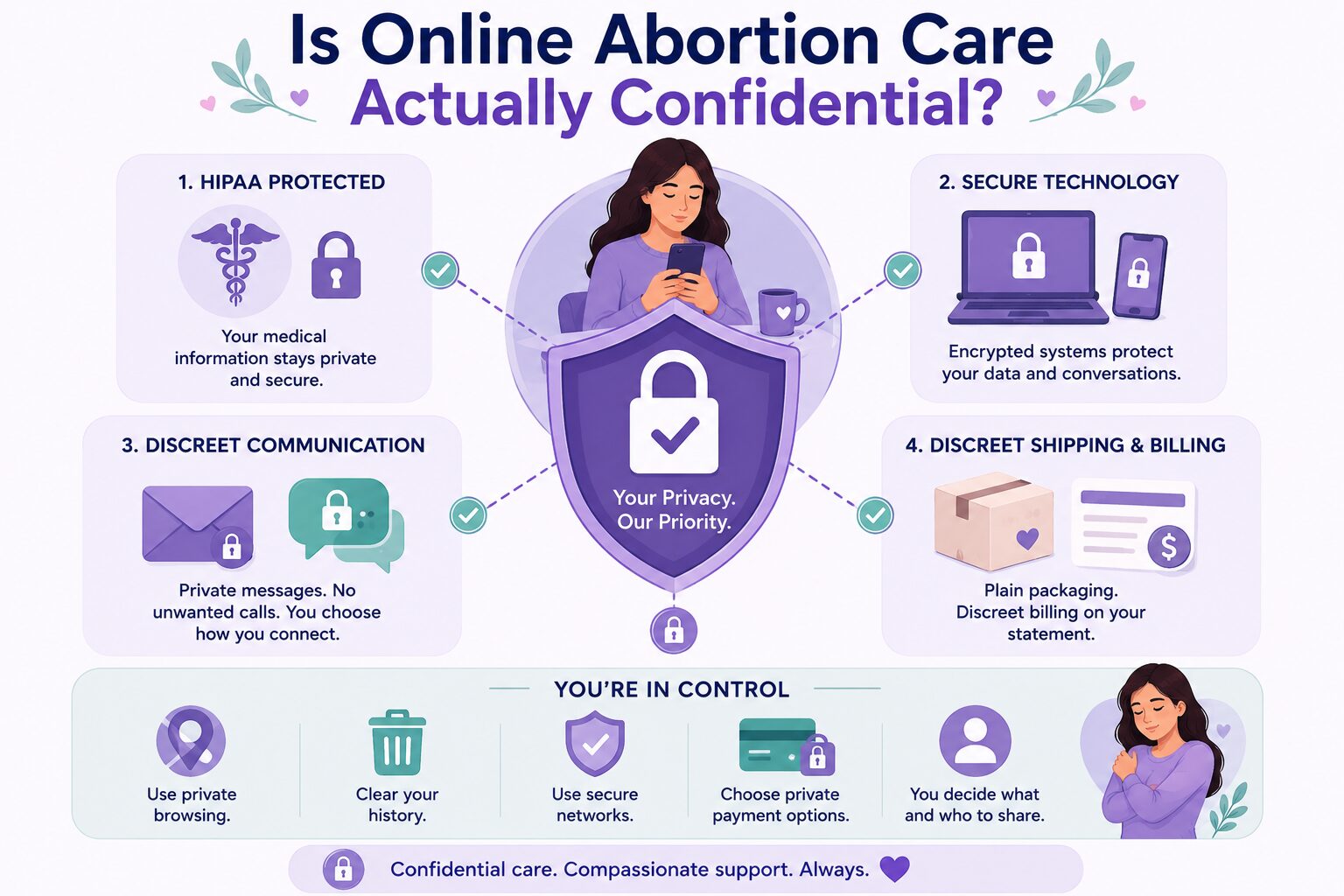
Reputable telehealth providers ship medications in plain envelopes or unmarked boxes with no reference to the contents, the provider, or anything that would identify the package as related to reproductive healthcare. From the outside, it looks like any other piece of mail. There is no branding, no clinic name, and no identifying information beyond your address.
What the Shipping Process Looks Like
After your prescription is issued, medications are typically shipped within one to two business days. Standard delivery takes three to five business days in most areas. Expedited shipping options often overnight or two-day are available from most providers for an additional fee.
Shipping is handled through standard mail carriers. The package arrives at your address like any other delivery. Many women receiving care this way find the process significantly less stressful than they anticipated once they understand how it works.
What Women Worry About Most Addressed Directly
The most common concerns about receiving medications by mail include: what if someone else picks up the package, what if the package is intercepted, and what if someone asks what it is.
On interception: there is no system in place through which mail carriers flag or inspect medication packages for abortion pills. The Postal Service delivers millions of prescription packages daily without content inspection. The practical risk of interception is extremely low for patients in states where receiving the medication is the patient’s legal risk rather than the provider’s.
On someone else receiving the package: many providers allow you to use a different delivery address, a trusted friend’s address, a PO box, or a workplace address if home delivery is a concern. Ask your provider about this option before your prescription is issued.
Is Online Abortion Care Actually Confidential?
This is the question underneath every other question for most women seeking care privately. The short answer is: yes, with important specifics worth understanding.
HIPAA and Medical Privacy What It Actually Means
Your online abortion consultation is a medical appointment. Like any medical appointment, it is covered by HIPAA the Health Insurance Portability and Accountability Act. This means your provider cannot share your medical information without your consent, cannot discuss your care with family members, employers, or anyone else without your explicit authorization, and must maintain secure records.
What HIPAA does not protect against is a valid legal subpoena from a federal court. If federal authorities were to pursue legal action and issue a subpoena for medical records, HIPAA compliance does not prevent that. This is a real but currently rare scenario; most enforcement efforts in restricted states have targeted providers, not patients.
What Telehealth Platforms Do to Protect You
Reputable telehealth providers use encrypted communication systems, secure data storage, and HIPAA-compliant platforms that go beyond minimum legal requirements. Many have explicit policies about resisting data requests and notifying patients of any legal demands for their records before complying.
When evaluating a provider, ask directly: what is your data retention policy, how is my consultation recorded, and what would you do if you received a subpoena for patient records? Legitimate providers have clear, patient-protective answers. Our confidential abortion services guide and how to keep your abortion private explain what to look for in detail.
Payment Privacy The Often-Overlooked Risk
Medical privacy is one layer. Financial privacy is another. Credit card and bank statements create a record of transactions that others on a shared account may see. Payment to a telehealth provider even a discreetly named one can appear on a statement.
Options that reduce this risk include: prepaid debit cards purchased with cash, Venmo or PayPal accounts not connected to a shared bank account, or payment methods offered through privacy-focused tools like Privacy.com. Many providers also accept payment methods that do not appear on standard bank statements before you book.
Digital Privacy Beyond the Consultation
Your search history, location data, and app activity can all create a digital trail that documents your interest in abortion care. In states where enforcement is aggressive, this data has been used in investigations not against patients in most cases, but the risk exists.
Practical steps that meaningfully reduce your digital footprint: use a private browser (Firefox Focus, Tor browser, or Chrome incognito at minimum), turn off location services before researching providers, avoid using workplace or school devices or networks for any abortion-related research, and delete search history after sessions.
Our comprehensive online privacy and abortion access guide and abortion privacy guide cover every layer of digital protection in detail. These are not paranoid steps, they are reasonable precautions that take minutes to implement.
What Women in Restrictive States Are Actually Doing
The picture that emerges from looking at how women are navigating restricted access is not one of helplessness. It is one of resourcefulness, community, and adaptation.
Telehealth From Shield Law State Providers
The most common path for women in restricted states is accessing telehealth abortion care from providers operating in shield law states like Illinois, California, New York, and Colorado that specifically protect providers who serve out-of-state patients.
A provider in Illinois can legally consult with a patient in Texas, issue a prescription, and mail medication and the shield law protects that provider from prosecution by Texas authorities. The patient’s legal risk depends on their state’s specific enforcement approach, which in most cases has focused on providers rather than patients.
This is not a gray area workaround, it is an intentional legal architecture built specifically to extend reproductive healthcare access. Accessing abortion care in Illinois covers how this works for patients in neighboring restricted states.
Interstate Travel for Abortion Care
For women who need surgical abortion or who are beyond the gestational limit for medication abortion, traveling to a state with full protections remains an option and one that is legally protected at the federal level. Interstate travel for abortion care cannot be criminalized by your home state.
The practical barriers are real: cost, time off work, childcare, transportation, and lodging. But abortion funds exist specifically to remove these barriers. National organizations and state-specific funds provide grants covering procedure costs, travel, lodging, and childcare for women who cannot afford care. Finding abortion financial aid programs is more straightforward than most people realize.
For complete planning guidance, our traveling for an abortion guide covers logistics, costs, and what to expect.
Support Networks and Mutual Aid
Across the country, grassroots networks of individuals and organizations provide practical support rides, lodging, funding, information, and emotional support to women navigating restricted access. These networks operate quietly, often through encrypted messaging platforms and word-of-mouth referrals.
Organizations like the National Network of Abortion Funds, Planned Parenthood’s national network, and regional abortion funds provide both financial assistance and connections to logistical support. These resources are real, available, and actively used by women in exactly the situation many readers of this article are in.
Warning Signs of Unsafe Providers What to Watch For
The same demand that has driven the expansion of legitimate telehealth abortion care has also attracted bad actors. Counterfeit medications, unlicensed providers, and scam websites do exist and they pose real medical risk.
Red Flags to Take Seriously
Avoid any provider that:
- Does not involve a licensed clinician in the prescribing process
- Offers medications without any consultation or medical screening
- Has no physical address, no licensed provider information, and no verifiable credentials
- Requests unusual payment methods only cryptocurrency exclusively, wire transfers, untraceable payment only
- Has no aftercare support or emergency contact information
- Charges dramatically below market rate with no explanation
Legitimate providers are transparent about who they are, what they prescribe, how they protect your privacy, and what to do if something goes wrong. If a provider cannot answer basic questions about their clinical staff, licensing, and data practices, that is a clear warning sign.
Our guide on how to get safe, verified abortion pills online gives a detailed checklist for evaluating any online provider before you engage with them.
The Emotional Weight of Seeking Care Privately
Navigating abortion access in a restrictive state is not just logistically challenging, it is emotionally exhausting. The secrecy that restriction imposes adds a layer of stress to an already significant healthcare experience. Feeling like you cannot talk about what you are going through, or that you have to manage everything alone, takes a real toll.
That isolation is not a reflection of what you are doing. It is a consequence of the environment around you. And it is worth naming directly: the stress of navigating restricted access is real, valid, and shared by millions of women in the same situation.
Many women find that connecting with others through online communities, through abortion fund support workers, or through providers who prioritize emotional support alongside medical care meaningfully reduces that sense of isolation.
Recovery after abortion involves both physical and emotional dimensions. Our guide on emotional recovery after abortion offers honest, non-judgmental support for whatever you are feeling in the days and weeks that follow. And our resource on abortion and mental health addresses the broader emotional landscape with care and accuracy.
We Are Here Without Judgment Without Pressure
Serenity Choice Health provides confidential, compassionate care with licensed providers who understand both the medical and legal landscape in your state. Whether you need the abortion pill at home or prefer in-clinic abortion services, your privacy is our priority and your safety is our standard.
Whether you are just beginning to understand your options or you are ready to move forward, we are here for you at whatever pace feels right.
Schedule a confidential consultation or connect with our telehealth abortion care team today.
Frequently Asked Questions
Is telehealth abortion legal in restrictive states?
Telehealth abortion from providers in shield law states is legally available to many women in restricted states. Providers in states like Illinois, California, and New York are legally protected from prosecution by other states for offering virtual consultations and mailing medications. The patient’s legal risk depends on their specific state’s enforcement approach. Contact us to discuss your situation confidentially.
Can abortion pills really be mailed discreetly?
Yes. Reputable providers ship medications in plain packaging with no identifying information. From the outside, the package looks like any other piece of mail. Standard delivery takes three to five business days; expedited options are usually available.
Can I use insurance for telehealth abortion care?
Insurance coverage for abortion varies by state and plan. In states with strong reproductive health protections, many private insurance plans cover medication abortion including telehealth consultations. In restricted states, coverage is typically unavailable. Our insurance cover abortion guide breaks this down by state type, and our team can discuss payment options during your consultation.
How quickly can abortion pills arrive?
Standard shipping is three to five business days after a prescription is issued. Many providers offer expedited options overnight or two-day shipping for an additional fee. If timing is urgent, mention this during your consultation so your provider can recommend the fastest appropriate option.
What states allow telehealth abortion services?
States with shield laws and strong reproductive health protections including Illinois, California, New York, Colorado, Massachusetts, Washington, and others allow and actively protect telehealth abortion. Providers in these states can serve patients in many other states. Our guide on abortion laws in Illinois gives a detailed example of what full protection looks like.
What should I do if my state bans abortion?
Your options include: telehealth from a shield law state provider, interstate travel for care, connecting with abortion fund organizations for financial and logistical support, and speaking with a licensed provider about your specific situation. Schedule a consultation for a confidential conversation about what is available to you right now.
For complete guidance, visit our medication abortion explained guide, our resource on abortion safety and medical facts, and our abortion pill guide.

Dr. James Carter is a board-certified physician and lead clinician at Serenity Choice Health, specializing in reproductive health access and medication abortion protocols. With over 20+ years of experience, he combines clinical expertise with patient-centered care to ensure safe, compassionate, and confidential reproductive healthcare.