
Finding out you may have been exposed to a sexually transmitted infection can feel alarming. Whether a partner disclosed a positive diagnosis, you had unprotected sex, or a condom broke, knowing what to do in the hours and days that follow makes a real difference to your health and to the health of anyone you may come into contact with.
The good news is that most STIs are treatable, and many are completely curable when caught early. Taking action quickly even before symptoms appear is the most protective thing you can do.
Step One: Stay Calm and Assess the Situation
Panic is understandable, but it is not useful. Before doing anything else, take a moment to think clearly about what happened.
What Kind of Exposure Occurred?
Different types of sexual contact carry different levels of risk for different infections. Unprotected vaginal or anal sex carries higher transmission risk for HIV, chlamydia, gonorrhea, and syphilis. Oral sex carries lower but real risk for herpes, gonorrhea, and syphilis. Skin-to-skin genital contact without penetration can transmit herpes and HPV.
Understanding the type of exposure helps your provider determine which infections to prioritize and which interventions may be time-sensitive.
Do You Know What the Other Person Had?
If a partner told you they tested positive for a specific infection, that information is valuable. It tells you exactly which STI to focus on and allows your provider to give you more specific guidance, including whether any preventive treatment is available.
If you do not know the other person’s status and simply had unprotected sex, broader testing is appropriate.
Step Two: Act Immediately If HIV Exposure Is Possible
What Is PEP?
If you believe you may have been exposed to HIV, the most time-sensitive step in this entire process is finding out whether you are a candidate for PEP post-exposure prophylaxis. PEP is a course of antiretroviral medication that, when started within seventy-two hours of a possible HIV exposure, can significantly reduce the risk of HIV transmission.
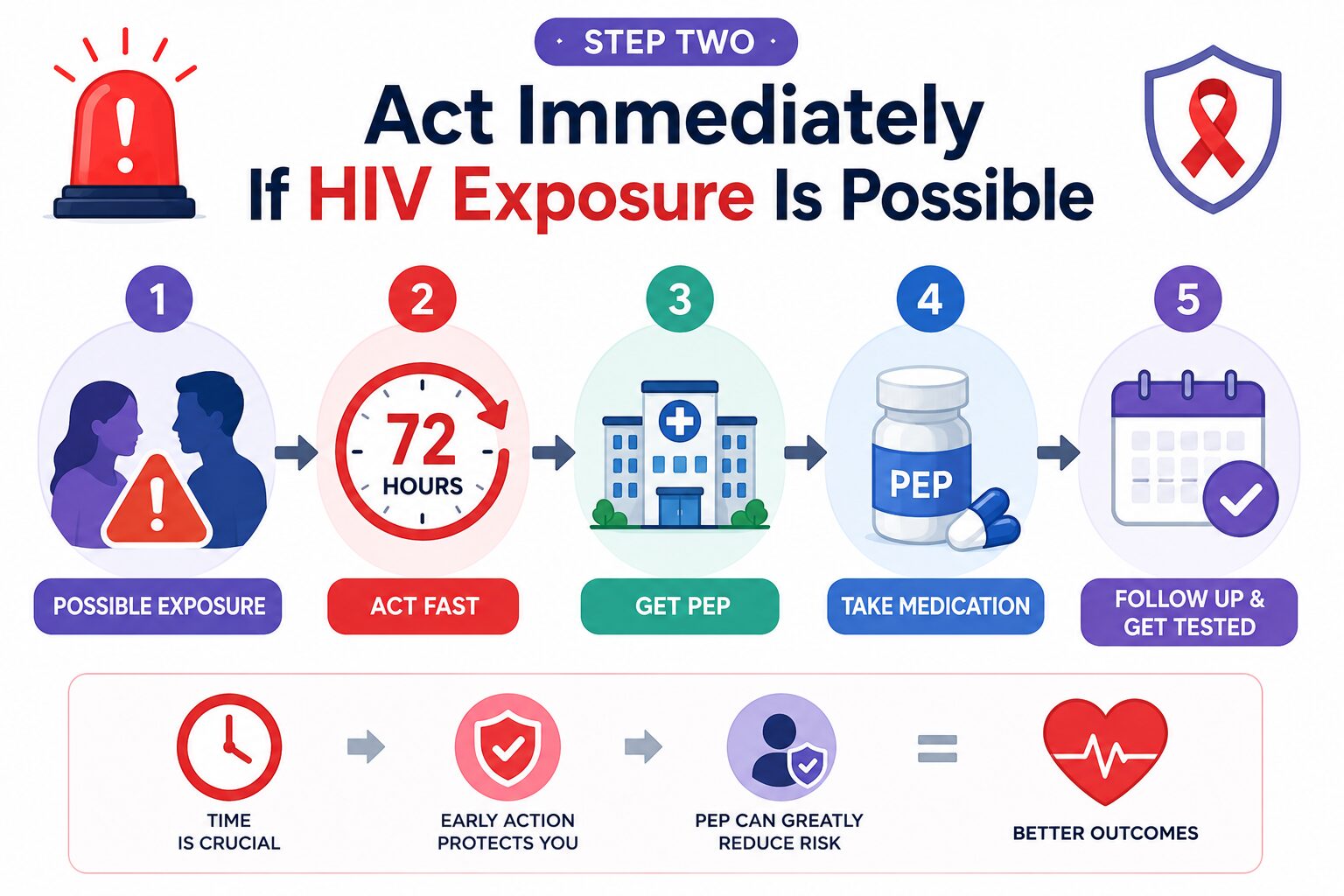
The seventy-two-hour window is a hard limit. PEP started after this window is not effective. If there is any possibility of HIV exposure, contact a healthcare provider, urgent care clinic, or emergency room today, not tomorrow.
Who Should Consider PEP?
PEP may be appropriate if you had unprotected sex with a partner known to be HIV-positive or of unknown status, if a condom broke during sex with a higher-risk partner, or if you were sexually assaulted. A healthcare provider will assess whether PEP is appropriate for your specific situation. Learn more about the benefits of telehealth and how virtual care can connect you with a provider quickly when time-sensitive decisions need to be made.
Step Three: Understand STI Window Periods Before Testing
One of the most important things to understand after a potential exposure is that testing too soon can give you a false negative result. Every STI has a window period between exposure and when a test can reliably detect the infection.
Window Periods by Infection
| STI | Typical Window Period |
| Chlamydia | 1 to 2 weeks |
| Gonorrhea | 1 to 2 weeks |
| Syphilis | 3 to 6 weeks (up to 90 days for full confidence) |
| HIV (antigen/antibody test) | 18 to 45 days |
| HIV (RNA test) | 10 to 33 days |
| Herpes (blood test) | 12 to 16 weeks |
| Hepatitis B | 6 weeks to 3 months |
| Hepatitis C | 8 to 11 weeks |
What This Means Practically
If you test on day three after an exposure, a negative result does not tell you much. Your provider may recommend testing at multiple time points — once shortly after the exposure to establish a baseline, and again after the relevant window period has passed to get a reliable result.
Step Four: Schedule STI Testing
Even if you are within a window period, scheduling testing is still the right step. A provider can discuss your specific exposure, order appropriate tests based on what you may have been exposed to, and advise on when to retest for accuracy. Book a confidential appointment to get evaluated promptly by a provider who can guide you through the right testing timeline.
What to Tell Your Provider
Be as specific as possible about what happened. This includes the type of sexual contact, whether protection was used and whether it failed, the date of the exposure, and any known information about the other person’s STI status. You will not be judged for this information — healthcare providers need it to help you effectively. Read our guide on protecting your health privacy to understand how your information is kept confidential when seeking sensitive medical care.
Which Tests Are Typically Ordered After Exposure?
A post-exposure STI panel typically includes chlamydia and gonorrhea, syphilis, HIV, and hepatitis B and C. Herpes testing may also be included depending on the nature of the exposure and whether any symptoms are present. Our STI and STD testing services are available through our women’s health clinic and can often be scheduled quickly for situations involving recent exposure.
Can You Test at Home?
At-home STI testing kits are available for several common infections including chlamydia, gonorrhea, HIV, and syphilis. They can be a useful option for people who have difficulty accessing a clinic, but they have limitations. Home kits do not cover all infections, some positive results require confirmation testing at a clinic, and they do not provide access to preventive treatments like PEP. If HIV exposure is a possibility, an in-person visit is essential.
Step Five: Watch for Symptoms — But Do Not Rely on Them
Most STIs produce no symptoms at all, particularly in the early stages. Waiting to see whether symptoms develop before getting tested is not a reliable strategy.
Symptoms That May Appear After Exposure
Some infections do produce early symptoms in certain people. These can include unusual discharge, burning during urination, sores or blisters on or around the genitals, rash, swollen lymph nodes, or flu-like symptoms including fever and fatigue. Flu-like symptoms appearing two to four weeks after a potential HIV exposure can sometimes indicate acute HIV infection, which is the period when the virus is most actively replicating.
When to Seek Same-Day Care for Symptoms
Contact a provider the same day if you develop:
- Sores, blisters, or open wounds in the genital area
- Significant discharge with odor
- Fever alongside genital symptoms
- Severe pelvic or abdominal pain
These symptoms warrant evaluation rather than waiting for a scheduled appointment.
Step Six: Protect Your Partners in the Meantime
Until you have received test results that confirm your status, taking steps to avoid transmitting a potential infection to others is the responsible course of action.
Practical Steps
Use condoms for all sexual activity until your results are confirmed. Be honest with any current partners about the situation so they can make informed decisions about their own health. If you are in an ongoing relationship, have a direct conversation rather than avoiding it.
This is not about blame, it is about protecting the people in your life with the same care you are extending to yourself.
Step Seven: Follow Up Based on Your Results
If Results Are Negative
A negative result within the window period does not rule out infection. Follow your provider’s recommendation on when to retest. For HIV in particular, a negative result at eighteen days should typically be confirmed with a repeat test at forty-five to ninety days for full confidence.
If Results Are Positive
A positive result is not a crisis. Most STIs are highly treatable. Bacterial infections including chlamydia, gonorrhea, and syphilis are curable with antibiotics. Viral infections including HIV, herpes, and hepatitis B are manageable with medication that allows people to live full, healthy lives. Your provider will walk you through the treatment plan and discuss partner notification.
Partner Notification
If you test positive, informing any recent sexual partners allows them to get tested and treated if needed. This can be done directly or, in some areas, through a health department service that notifies partners anonymously. Your provider or local health department can advise on the options available. Read our guide on whether health information appears on medical records to understand what stays confidential and what may be shared.
Checklist: What to Do After a Possible STI Exposure
Use this as a practical reference:
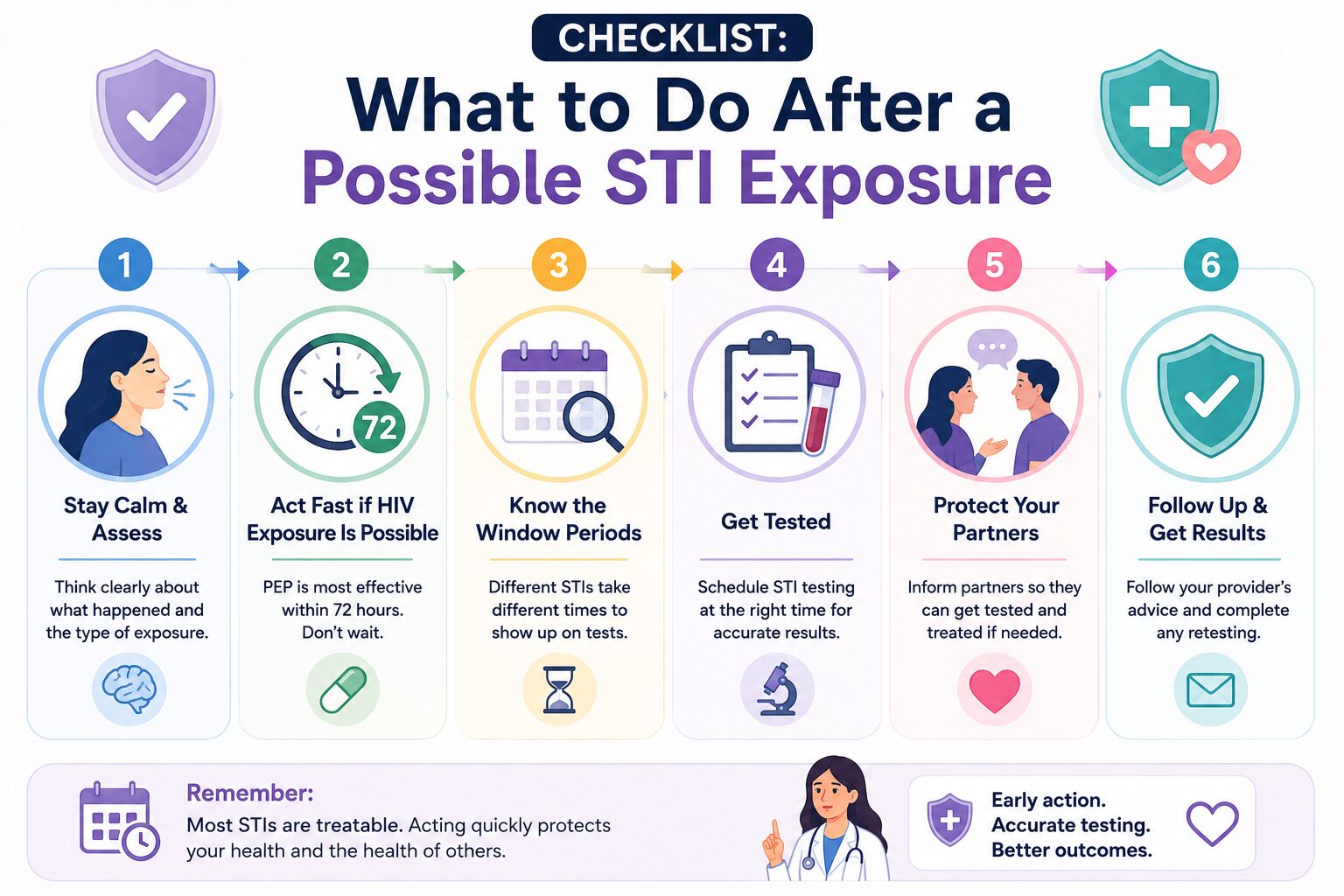
- Assess the type of exposure and any known information about the other person’s status
- If HIV exposure is possible, contact a provider within 72 hours to discuss PEP
- Schedule an STI testing appointment do not wait for symptoms
- Tell your provider the type of exposure, the date, and what you know about the other person’s status
- Ask which specific infections are being tested and when you should retest for accurate results
- Use barrier protection with all partners until results are confirmed
- Attend any recommended follow-up testing to confirm results after the window period
- If a result is positive, begin treatment promptly and discuss partner notification with your provider
Common Mistakes to Avoid
Testing too soon and trusting a negative result. A negative result within the window period does not mean no infection is present. Retesting at the appropriate time is essential.
Waiting for symptoms before seeking care. The majority of STIs cause no symptoms early on. Waiting means giving a potential infection more time to cause harm and be unknowingly transmitted to others.
Skipping the HIV conversation because it feels unlikely. HIV transmission risk varies by exposure type, but if there is any realistic possibility, PEP needs to be considered within seventy-two hours. The cost of missing that window is high.
Not telling your provider the full picture. Incomplete information leads to incomplete testing. Providers need accurate details about the exposure to recommend the right panel.
Assuming a normal Pap smear means no STIs. A Pap smear is not an STI test. It checks cervical cells for abnormal changes and does not screen for chlamydia, gonorrhea, HIV, or syphilis.
Avoiding partners until results come back without telling them why. Silently distancing yourself is not the same as protecting someone. A direct, calm conversation is more responsible and more respectful.
Frequently Asked Questions
How soon should I get tested after a possible STI exposure?
You should schedule testing as soon as possible, even if it is within the window period. Your provider can order a baseline panel and advise on when to retest for each specific infection. For HIV, contact a provider immediately to discuss PEP before the seventy-two-hour window closes.
Can I have an STI with no symptoms?
Yes, and this is extremely common. Chlamydia, gonorrhea, syphilis, HIV, and hepatitis can all be present with no noticeable symptoms, sometimes for months or years. This is exactly why testing rather than symptom monitoring is the recommended approach after a possible exposure.
What is the window period and why does it matter?
The window period is the time between exposure and when a test can reliably detect an infection. Testing before the window period ends can produce a false negative. Different infections have different window periods, ranging from one to two weeks for chlamydia and gonorrhea to up to three months for some other infections.
Is PEP always necessary after a possible HIV exposure?
Not always. PEP is a clinical decision based on the nature of the exposure, the known or estimated HIV status of the other person, and other risk factors. A healthcare provider will assess whether it is appropriate for your specific situation. What matters is that you contact a provider within seventy-two hours if HIV exposure is possible, so that decision can be made in time.
What should I tell my partner if I think I was exposed to an STI?
Tell them directly and calmly that you had a potential exposure and are getting tested. Give them enough information to decide whether they also need to be tested. This conversation protects both of you and is easier to have than most people expect.
Do I need to go to an emergency room, or can I see my regular doctor?
For time-sensitive situations such as possible HIV exposure where PEP may be needed, an urgent care clinic or emergency room is appropriate if your regular provider cannot see you the same day. For non-urgent testing after exposure, a women’s health clinic, sexual health clinic, or primary care provider is suitable.
Can an STI exposure be treated before I even test?
In some cases, yes. For HIV, PEP can be started based on exposure risk before a test result is available. For certain bacterial infections like chlamydia and gonorrhea, some providers may offer treatment based on a known exposure even before test results come back, particularly in high-risk situations. Your provider will advise based on your specific circumstances.
Final Takeaway
A possible STI exposure is stressful, but it is manageable especially when you act quickly and with clear information. The steps are straightforward: assess what happened, act immediately if HIV exposure is possible, schedule testing at the right time, protect your partners in the meantime, and follow through on results and treatment.
Most STIs are treatable. Many are curable. Early action consistently leads to better outcomes than waiting.
Our STI and STD testing services are available for anyone who needs prompt, confidential evaluation after a possible exposure. For broader sexual and reproductive healthcare, our women’s primary care services can coordinate testing, follow-up, and treatment in one place. If you have questions about your specific situation and want to speak with a provider quickly, scheduling an appointment is the fastest way to get personalized guidance.
For women using hormonal contraception, it is also worth knowing that birth control does not protect against STIs. Barrier methods are the only contraceptive option that also reduces STI transmission risk. Learn more about all available options through our birth control and contraceptive services.
Suggested External Sources
- Planned Parenthood
- American College of Obstetricians and Gynecologists (ACOG)
- World Health Organization (WHO)
- Mayo Clinic
- National Health Service (NHS)
Here are working links for each suggested source:
| Source | Page | URL |
|---|---|---|
| Planned Parenthood | What to expect after the abortion pill (side effects, warning signs) | https://www.plannedparenthood.org/learn/abortion/the-abortion-pill/what-can-i-expect-after-i-take-the-abortion-pill Planned Parenthood |
| Planned Parenthood | The Abortion Pill overview | https://www.plannedparenthood.org/learn/abortion/the-abortion-pill |
| ACOG | Medication Abortion (patient FAQ) | https://www.acog.org/womens-health/faqs/medication-for-achieving-an-abortion |
| WHO | Abortion care guideline | https://www.who.int/publications/i/item/9789240039483 |
| Mayo Clinic | Medical (drug-induced) abortion overview | https://www.mayoclinic.org/tests-procedures/medical-abortion/about/pac-20394687 |
| NHS | Abortion care / what happens | https://www.nhs.uk/conditions/abortion/ |

Dr. James Carter is a board-certified physician and lead clinician at Serenity Choice Health, specializing in reproductive health access and medication abortion protocols. With over 20+ years of experience, he combines clinical expertise with patient-centered care to ensure safe, compassionate, and confidential reproductive healthcare.