
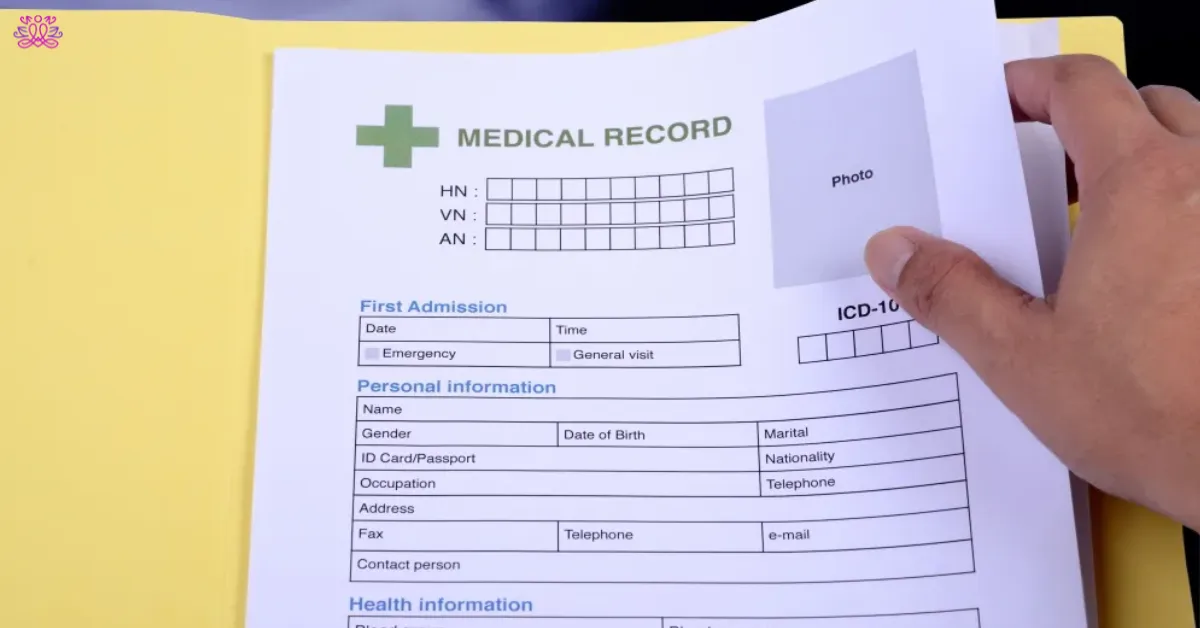
Yes, an abortion can appear in your medical record if a healthcare provider provides or documents the care. However, there is no single nationwide or public “permanent health record” that everyone can access. Who can see the information depends on the provider, record-sharing systems, insurance use, and applicable privacy laws.
If you are concerned about privacy, it helps to understand an important distinction: your medical record, pharmacy record and health insurance record are not necessarily the same thing.
An abortion provider may document your care even if you do not use insurance. If insurance is billed, however, the insurer may also receive information needed to process the claim.
For additional privacy information, see Serenity Choice Health’s abortion privacy guide and guide on how to keep your abortion private.
What Does “On Your Health Record” Actually Mean?
Many people imagine one permanent medical file containing every healthcare service they have ever received.
That is generally not how healthcare records operate in the United States.
Different organizations can maintain different pieces of health information.
| Record | What it may contain |
|---|---|
| Provider medical record | Visits, diagnoses, medications, tests and treatment notes |
| Electronic health record (EHR) | Medical information stored electronically by a healthcare organization |
| Pharmacy record | Prescriptions dispensed by a pharmacy |
| Insurance claim | Billing codes, providers, dates and charges submitted to an insurer |
| Explanation of Benefits (EOB) | Information about a healthcare claim processed by insurance |
| Health information exchange | Certain information shared electronically among participating healthcare organizations |
The federal government explains that electronic health information exchange can allow healthcare professionals and organizations to appropriately access and share patient information. You can learn more through HealthIT.gov’s information on health information exchange.
This means that having an abortion documented by one healthcare provider does not automatically mean every doctor in the country can see it.
Does Abortion Go on Your Medical Record?
An abortion provider generally creates a clinical record of the healthcare it provides.
Depending on your situation, that record may include:
- appointment dates;
- relevant health history;
- medications;
- laboratory results;
- ultrasound results when applicable;
- treatment notes;
- follow-up information.
Medical documentation helps providers deliver care and maintain an accurate clinical history.
However, a record existing at one clinic is different from that information being automatically available to every healthcare provider you may see in the future.
Research published in the Journal of the American Medical Informatics Association has highlighted how electronic interoperability can affect reproductive-health information sharing. See Khanna et al.’s discussion of reproductive-health information and healthcare interoperability.
Is an Abortion on a Permanent Medical Record?
There is no single nationwide “permanent medical record” containing every abortion or healthcare service a person has received.
Healthcare organizations maintain their own records and may retain them for different lengths of time.
Records may also be:
- stored electronically;
- archived;
- transferred when requested;
- shared through permitted healthcare information systems;
- retained according to state law and organizational policies.
Therefore, asking “Will abortion stay on my permanent medical record?” does not have one universal answer.
A better question is:
How long will the specific healthcare organization that treated me retain my records, and with whom can those records be shared?
How Long Are Abortion Records Kept?
There is no single nationwide period that determines how long abortion records are kept by every healthcare provider.
Retention can depend on:
- state law;
- provider licensing requirements;
- the patient’s age;
- the type of healthcare facility;
- other regulatory requirements;
- the healthcare organization’s retention policy.
One common misconception is that HIPAA establishes a single nationwide medical-record retention period. HIPAA does contain documentation requirements for covered organizations, but clinical medical-record retention also depends on other federal or state requirements and provider policies.
The U.S. Department of Health and Human Services HIPAA resources explain the federal privacy framework governing protected health information.
How Do You Find Out How Long Your Records Will Be Kept?
Ask the clinic directly:
“How long do you retain medical records from abortion care?”
You may also ask:
- Can I obtain a copy of my medical record?
- Is my information shared through a health information exchange?
- What is your privacy policy?
- How do I request an amendment if something in my chart is incorrect?
Do Abortion Clinics Keep Records?
Yes. Healthcare providers, including abortion clinics, generally maintain medical documentation about the care they provide.
The amount and type of information retained can depend on the services provided and applicable requirements.
Receiving confidential care does not necessarily mean that no medical record exists.
That distinction is important:
Confidential care means access to information is restricted according to applicable privacy rules. It does not normally mean that the healthcare provider creates no record at all.
Readers concerned about privacy may also find Serenity Choice Health’s page on confidential abortion services helpful.
Does Planned Parenthood Keep Records of Abortions?
Healthcare organizations providing abortion services generally maintain medical records about the services they provide.
However, there is not one reliable nationwide answer to “How long does Planned Parenthood keep medical records?”
Different Planned Parenthood affiliates may operate under different:
- state requirements;
- record-retention rules;
- healthcare systems;
- organizational policies.
If you previously received care from Planned Parenthood and want to know how long your records will be retained, contact the specific affiliate that provided your care.
Ask:
“What is your current medical-record retention policy, and how can I obtain a copy of my records?”
Avoid relying on a general internet answer for a specific affiliate’s retention period.
Will a Medication Abortion Show Up in My Medical Records?
Yes, a medication abortion can be documented in your medical record when it is prescribed or provided through a healthcare professional.
The provider’s record may include:
- the consultation;
- relevant medical history;
- medications prescribed;
- treatment information;
- follow-up care.
Depending on how medication is obtained, information could also exist in a pharmacy record or an insurance claim.
For information about medication abortion itself, see Serenity Choice Health’s guide to medication abortion.
Is There a Permanent Abortion Pill Record?
There is no special nationwide database that functions as a universal permanent list of everyone who has taken abortion pills.
However, records associated with treatment may remain with the healthcare organizations involved according to their applicable retention requirements.
For example:
- the prescribing provider may have a clinical record;
- a dispensing pharmacy may have a prescription record;
- an insurance company may have a claim if insurance was used.
These are separate record systems.
Does Paying Cash Keep an Abortion Off Your Medical Record?
Not necessarily.
Paying without insurance can potentially prevent an insurance claim from being submitted for the service, but it does not normally prevent the healthcare provider from documenting the care in your medical record.
This is an important distinction:
Paying privately may affect insurance records. It does not mean there is no provider medical record.
If cost and insurance privacy are concerns, Serenity Choice Health also has information about abortion costs without insurance.
Does Abortion Show Up on Insurance?
If health insurance is billed for abortion care, the insurer generally receives information necessary to process that claim.
The information could include:
- provider name;
- date of service;
- billing codes;
- charges;
- amount covered;
- patient responsibility;
- prescription claim information when applicable.
Insurance documentation may also appear through an Explanation of Benefits (EOB) or online insurance portal.
An EOB is not a medical record, but it can reveal information about healthcare services that were billed.
For more information, see Serenity Choice Health’s guide to abortion and insurance coverage.
You can also read specifically about whether abortion pills can be tracked through insurance.
Can You Keep an Abortion Off Your Insurance Records?
If insurance is not billed, there generally will not be a claim for that particular service submitted to that insurer.
If privacy is important, ask the provider before care is billed:
“Can I pay for this service myself without submitting a claim to my health insurance?”
HIPAA also provides an important right in certain self-pay circumstances.
Under 45 CFR §164.522, when an individual pays a covered healthcare provider in full out of pocket for a specific service and requests that information about that service not be disclosed to a health plan for payment or healthcare operations, the provider generally must agree to the restriction when the regulatory requirements are satisfied, unless disclosure is otherwise required by law.
However, this does not:
- delete the provider’s medical record;
- prevent every legally permitted disclosure;
- automatically apply to separate organizations;
- remove pharmacy records;
- erase information already submitted to an insurer.
Ask the provider how this right applies before the claim is submitted.
What About an Explanation of Benefits?
An Explanation of Benefits can be an important privacy concern, particularly when someone receives health coverage through another person’s policy.
Depending on the insurer and plan, an EOB may be:
- mailed;
- emailed;
- uploaded to an insurance portal;
- sent to the policyholder;
- sent to the patient.
If this is a concern, contact the insurance company before using coverage and ask:
“Can healthcare communications and EOBs be sent directly to me confidentially?”
HIPAA includes provisions concerning requests for confidential communications. The federal regulation is available at 45 CFR §164.522.
Your state may provide additional protections.
Are Abortion Records Public?
No. An abortion does not ordinarily become a public record simply because you received abortion care.
Medical information maintained by healthcare providers subject to HIPAA is generally protected health information.
The HHS HIPAA Privacy Rule establishes federal standards governing how covered healthcare organizations may use and disclose protected health information.
However, “private” should not be interpreted as “information can never legally be disclosed under any circumstances.”
HIPAA permits or requires disclosures in certain situations, and state laws may provide additional requirements or protections.
That is why healthcare websites should avoid absolute promises such as:
- “No one can ever access your abortion record.”
- “Your abortion can never be disclosed.”
- “Your abortion is completely untraceable.”
Those claims are too broad.
Is Abortion Information Protected by HIPAA?
If abortion information is held by a healthcare organization covered by HIPAA, it is generally treated as protected health information under the same federal privacy framework that applies to other qualifying medical information.
HIPAA establishes rules concerning:
- use of protected health information;
- disclosure of health information;
- patient access to records;
- requests to amend records;
- confidential communications;
- certain disclosure restrictions.
You can review HHS’s HIPAA information for individuals for more information about patient privacy rights.
It is also important to understand that not every company or app handling health-related information is necessarily covered by HIPAA.
Consumer apps and other non-HIPAA entities may be subject to different privacy laws. The Federal Trade Commission provides guidance concerning the Health Breach Notification Rule, which can apply to certain health apps and connected technologies.
For that reason, medical-record privacy and online abortion privacy are related but separate issues. See Serenity Choice Health’s guide to online privacy and abortion access for more information.
Can Other Doctors See That You Had an Abortion?
Possibly—but not automatically in every case.
Another healthcare provider may receive abortion-related information when:
- records are transferred;
- you authorize a release;
- healthcare organizations use connected EHR systems;
- information is available through a participating health information exchange;
- another use or disclosure is permitted by applicable law.
Electronic healthcare systems have made record sharing more efficient, but they also make it important for patients to understand how sensitive reproductive-health information moves between organizations.
Research has specifically examined these concerns in the post-Dobbs environment, including health information interoperability and reproductive privacy.
If you are concerned, ask:
“Does your organization participate in a health information exchange, and what choices do I have regarding information sharing?”
Can a Gynecologist Tell if You Had an Abortion?
A gynecologist may know about a prior abortion if:
- you tell them;
- it appears in records available to them;
- another provider sends the relevant records.
A routine gynecological examination months later does not ordinarily provide a definitive way to identify that a specific previous pregnancy ended through abortion rather than another pregnancy outcome solely from examination findings.
If your doctor asks about your pregnancy history, answering accurately can sometimes be clinically relevant.
If privacy is your concern, you can ask:
“How will this information be documented, and who may have access to it?”
Can You Delete an Abortion From Your Medical Record?
Patients generally have rights to access their medical information and request correction or amendment of information they believe is incorrect.
However, that does not create a general right to force a healthcare provider to delete accurate documentation of care.
HHS provides detailed information regarding the HIPAA right of access to medical records.
If something in your record is incorrect or incomplete, ask the healthcare provider:
“How do I submit a request to amend my medical record?”
How to Protect Your Privacy Before Abortion Care
If you are concerned about abortion medical records or insurance privacy, ask these questions before receiving care whenever possible.
1. Ask How Your Care Will Be Documented
Ask:
“What information will be placed in my medical record?”
This helps distinguish clinical documentation from insurance information.
2. Ask About Electronic Record Sharing
Ask whether the organization participates in a health information exchange or shares data with affiliated healthcare systems.
3. Request the Provider’s Notice of Privacy Practices
HIPAA-covered healthcare organizations generally provide information explaining how protected health information may be used and disclosed.
Read it before assuming a service is completely anonymous.
4. Ask How Long Records Are Kept
Because retention policies vary, ask the provider directly rather than relying on a universal number.
5. Discuss Insurance Before It Is Billed
Ask:
“What information could be sent to my health insurance if I use coverage?”
6. Ask About Self-Pay
If you do not want the service submitted to an insurance company, ask whether you can pay in full yourself.
If applicable, ask how to make a formal request restricting disclosure of that service to the health plan.
7. Ask About EOBs and Confidential Communications
Contact the insurer and ask where:
- EOBs are sent;
- email notifications go;
- portal notifications appear;
- mailed documents are delivered.
8. Check Pharmacy Billing
If medication will be dispensed through a pharmacy, ask whether insurance will be used there.
Your provider and pharmacy may maintain separate records.
9. Secure Your Patient Portal
Review:
- password security;
- proxy access;
- shared email accounts;
- notification previews;
- saved passwords;
- shared phones or computers.
Someone with access to your device or patient portal may see information even when the healthcare organization itself follows privacy requirements.
10. Think About Digital Privacy Separately
Medical records are only one part of reproductive-health privacy.
Search histories, apps, location information, messages and other digital information may operate under different privacy rules.
For more practical information, read How to Keep Your Abortion Private.
The Bottom Line: Does Abortion Go on Your Health Record?
An abortion can become part of the medical record maintained by the healthcare provider who treats you. However, there is no universal public abortion record or single nationwide permanent medical file automatically available to everyone.
Different information may exist with:
- your healthcare provider;
- a pharmacy;
- an insurance company;
- connected healthcare organizations.
How long those records are retained and who may access them depends on the organization, applicable privacy laws, record-sharing systems and how the care was paid for.
The most useful privacy questions are:
Who is creating the record?
Where will it be stored?
Will insurance be billed?
Will it be shared electronically?
How long will it be retained?
If privacy is important to you, ask those questions before receiving care whenever possible.
Confidential Care at Serenity Choice Health
If you are considering care through Serenity Choice Health and have questions about privacy, medical records, insurance billing or communications, contact the care team before your appointment.
You can also learn more about confidential abortion services and privacy when accessing abortion care.
The team can explain Serenity Choice Health’s current practices as they apply to your care.
For individualized legal questions about subpoenas, law enforcement, interstate care or state-specific privacy protections, consult a qualified attorney familiar with the laws of the relevant state.
FAQ Section
Does an abortion go on your health record?
Yes, an abortion can be documented in the medical record maintained by the healthcare provider who provides the care. However, there is no single nationwide public medical record automatically available to everyone.
How long are abortion records kept?
There is no universal U.S. retention period for abortion records. Requirements can vary according to state law, the type of healthcare organization and the provider’s record-retention policy. Ask the healthcare organization holding your record for its current policy.
Does Planned Parenthood keep records of abortions?
Healthcare providers generally maintain records of care they provide. However, retention policies can vary among Planned Parenthood affiliates and according to applicable state requirements. Contact the specific affiliate where you received care for an accurate answer.
Will a medication abortion show up in my medical records?
A medication abortion may be documented by the prescribing healthcare provider. Related information may also exist in pharmacy, laboratory or insurance records depending on how the care was provided and paid for.
Does abortion show up on insurance?
If health insurance is billed, the insurer generally receives information necessary to process the claim. An Explanation of Benefits or insurance portal may show the provider, date, billing information, charges or other details.
Are abortion records public?
No. Medical records are not ordinarily public simply because they involve abortion care. Medical information held by HIPAA-covered healthcare organizations is generally protected under federal privacy rules, although certain legally permitted or required disclosures can apply.
External Sources & Editorial References
- Khanna, R. R., Murray, S. G., Wen, T., et al. (2023). Protecting reproductive health information in the post-Roe era: interoperability strategies for healthcare institutions. Journal of the American Medical Informatics Association, 30(1), 161–166. Link
- Lee, L. S. (2024). HIPAA: Can the Privacy Rule Save the Patient-Physician Relationship in a Post-Dobbs World? UC Irvine Law Review. Link
- McGloin, M. (2025). Data Privacy in Crisis: How Crisis Pregnancy Centers Threaten the Personal Health Information of Women Seeking Abortion Care. Seton Hall Law Review. Link
- Spillerman, T. (2025). Sharing is not Always Caring: Protecting Reproductive Health Data with a Certified Health IT Segmentation Requirement. Federal Communications Law Journal. Link
- Zadushlivy, N., Biviji, R., & Williams, K. S. (2025). Exploration of reproductive health apps’ data privacy policies and the risks posed to users: qualitative content analysis. Journal of Medical Internet Research, 27, e51517. Link
- Reiser, H. C., & Singh, A. P. (2026). HITECH Meets Dobbs: Federal Mandates, State Laws, and the Complexities of Abortion Data Sharing. The Journal of Clinical Ethics. Link
- Madera, M., Bennett, A., Bertash, K., & Cahill, E. P. (2026). Society of Family Planning Research Practice Support: Digital and data security for abortion research in a post-Dobbs era—A primer for qualitative researchers. Contraception. Link
- Zubrzycki, C. (2026). The New Medical Privacy Federalism. SSRN. Link
Authoritative Government Resources
- U.S. Department of Health and Human Services — HIPAA Privacy Rule
- HHS — HIPAA Information for Individuals
- HHS — Patient Right of Access
- 45 CFR §164.522 — Privacy Requests and Restrictions
- HealthIT.gov — Health Information Exchange
- Federal Trade Commission — Health Breach Notification Rule
