
Not long ago, searching for abortion information meant typing a question into Google, scrolling past ads, clicking through three different websites, and still not being sure whether the answer you found was accurate, current, or even relevant to your state. For a topic as time-sensitive, legally complex, and emotionally charged as abortion, that experience was and still is genuinely exhausting.
Something has shifted. A growing number of women are now turning to AI chatbots to ask their most pressing reproductive health questions. Instead of wading through search results, they’re having a conversation. Instead of reading ten different pages, they’re getting a synthesized response in seconds.
This shift is real, it’s significant, and it raises important questions that deserve honest answers: Are AI tools actually reliable for abortion information? What are the risks? And when should someone put down the chatbot and speak to a real licensed provider instead?
Why Women Are Turning to AI Chatbots for Abortion Information
To understand why this trend is happening, you have to understand what the experience of searching for abortion information has traditionally felt like for many women.
Traditional search results for reproductive health topics are often a minefield. Legitimate medical sources compete for page space alongside crisis pregnancy centers organizations that frequently present themselves as neutral healthcare providers but exist specifically to discourage abortion. State-specific legal changes move faster than most websites update their content. And for anyone in a restrictive state, the fear that a search history could somehow be accessed or used against them adds a layer of anxiety to every click.
AI chatbots reduce a lot of that friction. The conversation feels private. There’s no list of websites that someone might find in a browser history. You type a question in plain language and get a plain language answer. For sensitive health topics where the fear of judgment, the need for discretion, and the urgency of the situation are all simultaneously present, that experience feels meaningfully different.
Digital privacy concerns around abortion access are not hypothetical. They’re a real part of how women navigate reproductive healthcare decisions in the current legal environment. AI chatbots, for all their limitations, feel less traceable than a search engine to many users and that perception alone is driving adoption.
There’s also the matter of information overload. A Google search for “how does the abortion pill work” returns millions of results. An AI chatbot returns a single, conversational response. For someone who is anxious, time-pressured, and not sure which source to trust, the latter is simply easier to process.
How AI Chatbots Answer Questions About Abortion
Understanding how these tools actually work is important before trusting what they say.
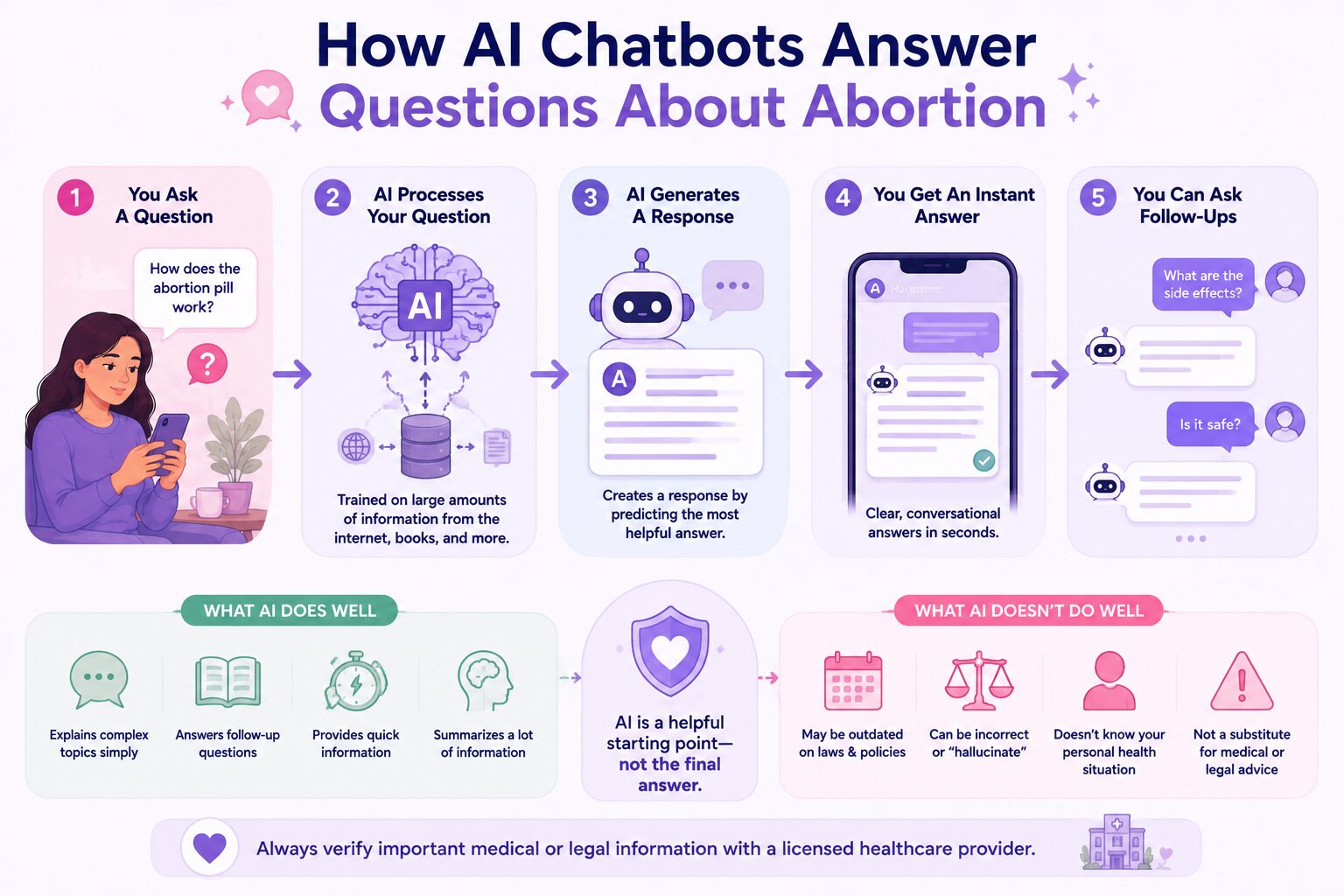
AI chatbots tools like ChatGPT, Google’s Gemini, Microsoft Copilot, and others are built on large language models (LLMs). These systems are trained on enormous datasets of text drawn from the internet, books, and other sources. When you ask a question, the model doesn’t look up an answer the way a search engine does. Instead, it generates a response based on patterns in the text it was trained on predicting, word by word, what a helpful answer would look like.
This is both the strength and the fundamental limitation of AI for health information. The strength: AI can synthesize complex information into clear, conversational language and respond to follow-up questions in context. The limitation: AI can be confidently wrong. The phenomenon known as “hallucination” where an AI generates plausible-sounding but factually incorrect information is a well-documented problem, and it is particularly dangerous in a medical context.
AI tools also have knowledge cutoffs. Most were trained on data up to a certain date and may not reflect recent changes in state abortion laws, updated FDA guidance, or new clinical protocols. Given how rapidly abortion laws have changed state by state since the Dobbs decision, this lag is not a minor issue.
What users often misunderstand about AI is that it is designed to sound helpful and authoritative. It doesn’t flag uncertainty the way a cautious doctor would. It doesn’t say “I’m not sure, you should verify this.” It generates responses that feel complete even when they’re not.
AI vs. Google: Which Is Actually Better for Reproductive Health Searches?
This comparison is worth taking seriously, because both tools have genuine strengths and real blind spots when it comes to healthcare information.
Where AI has an edge:
- Conversational responses that can be followed up with clarifying questions
- Plain language explanations of complex medical or legal concepts
- Reduced stigma asking an AI feels less exposing than googling something that might live in a search history
- Synthesis across multiple topics in a single response
Where search engines still win:
- Access to current, updated information from verified medical sources
- Direct links to licensed providers, clinics, and telehealth services
- Real-time information about state laws and legal changes
- The ability to find and evaluate the original source of any claim
The honest answer is that neither tool is ideal on its own for a decision as consequential as abortion care. AI can be a useful starting point for understanding concepts, building a base of knowledge, or formulating the right questions to ask a provider. But it should not be the final word on anything medical, legal, or state-specific.
The most dangerous pattern is someone in a time-sensitive situation relying entirely on an AI chatbot for guidance about medication protocols, gestational limits, or legal protections in areas where a small inaccuracy can have real consequences.
Can AI Chatbots Provide Accurate Abortion Information?
Sometimes yes, sometimes no and the problem is that it’s often hard to tell the difference.
For general, stable medical information how mifepristone and misoprostol work, what the typical side effects of a medication abortion are, what gestational limits generally apply, AI tools often perform reasonably well. This is information that doesn’t change frequently and is well-represented in the training data these models learned from.
The accuracy drops significantly when questions become state-specific, legally nuanced, or time-sensitive. “Is medication abortion legal in my state?” “Can I get abortion pills mailed to Texas?” “What are my rights if I travel to Illinois?” These questions require current, jurisdiction-specific, verified information and AI tools frequently get them wrong, outdated, or oversimplified.
The stakes of that inaccuracy are high. Someone who receives incorrect legal information from an AI chatbot and acts on it could face real consequences. Someone who receives incorrect medical information about dosing, timing, or warning signs could delay seeking care when they need it.
Understanding abortion safety from a medical perspective means knowing not just the general facts but the specific details that apply to your situation, your gestational age, and your health history. That kind of individualized guidance is something an AI simply cannot provide and it’s exactly what a licensed provider consultation is designed to do.
How AI Is Changing the Way People Ask Sensitive Health Questions
There’s something worth acknowledging here that goes beyond the practical: AI has changed the emotional experience of asking sensitive health questions.
Typing a question into a search engine still feels, to many people, like creating a record. The incognito browser helps, but most users know their data is still collected at multiple points. Asking an AI chatbot particularly through a standalone app rather than a browser feels more like a private conversation, even if it technically isn’t.
This perception of privacy is driving a meaningful behavioral shift. Women who might previously have delayed seeking information out of fear of judgment or exposure are asking questions earlier. They’re asking more of them. And they’re arriving at conversations with healthcare providers better-informed about their options.
That’s a genuinely positive development. Health literacy improves outcomes. Understanding your options before speaking with a provider leads to more productive consultations and better decision-making.
The risk is when the AI conversation becomes a substitute for the provider consultation rather than preparation for it. Knowing how to keep your abortion private is genuinely important but so is knowing when private research needs to give way to a real medical conversation.
Can AI Help Women Find Abortion Clinics and Telehealth Services?
This is one of the more practical questions about AI and reproductive healthcare and the answer is mixed.
AI chatbots can explain how telehealth abortion works, describe what a virtual consultation involves, and outline generally what to look for in a legitimate provider. They can explain the difference between medication abortion and in-clinic procedures, describe what telehealth benefits look like in practice, and help someone understand whether telehealth abortion might be right for their situation.
What AI tools are not reliable for is specific provider recommendations, real-time clinic availability, or up-to-date information about which services operate in which states. Provider networks change. State laws affect which telehealth services can operate where. Whether telemedicine abortion is legal in a given state is a question that requires current information not an AI model’s best guess based on training data from months or years ago.
For women in rural areas or underserved communities where access to abortion care is already limited, this distinction matters enormously. Being directed to a provider that no longer operates, or given incorrect information about legal access in your state, wastes time that some people simply don’t have.
The practical recommendation: use AI to understand your options and build your questions. Then use a verified, licensed provider to get answers specific to your situation.
What Are the Biggest Risks of Using AI for Abortion Information?
Let’s be direct about this, because minimizing the risks doesn’t serve anyone.
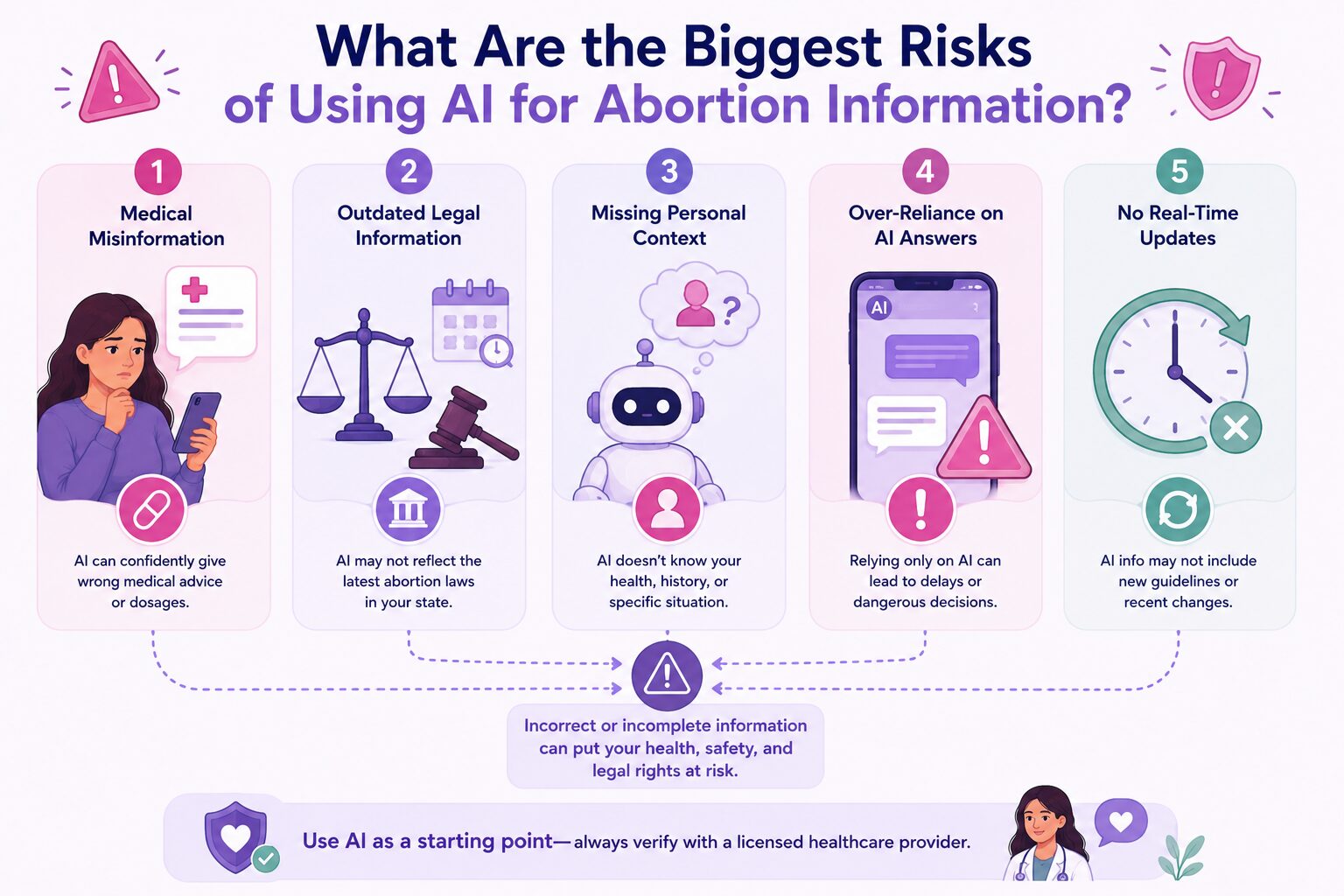
Medical misinformation. AI tools can generate incorrect information about dosing, timing, contraindications, or warning signs and present it with the same confident tone they use for accurate information. There is no internal flag that distinguishes a correct answer from a hallucinated one.
Outdated legal information. Abortion law in the United States has changed more rapidly in the past three years than in the previous three decades. An AI tool trained six months ago may be significantly out of date on what’s legal where. Acting on outdated legal information about shield laws, gestational limits, or interstate travel rights can create real consequences.
Missing context. AI provides general information. It doesn’t know your medical history, your gestational age, your state of residence, or your specific circumstances. Medical care is not general, it’s individual. The gap between “what’s generally true” and “what’s true for you specifically” is where mistakes happen.
Over-reliance. Perhaps the most insidious risk is the confidence that a clear, well-written AI response can create. When information is presented fluently and without hedging, it feels authoritative. That feeling can discourage people from seeking verification especially when they’re anxious and want to believe the first clear answer they receive.
For anyone trying to navigate how to get safe, verified abortion pills online, the guidance is consistent: AI can point you in a direction, but a licensed provider has to verify the details.
How Privacy Concerns Are Driving AI Adoption
It would be a mistake to dismiss privacy as a secondary concern in this conversation. For many women navigating abortion decisions particularly those in restrictive states it is the primary concern.
Protecting your abortion privacy involves thinking carefully about search history, location data, payment records, and communication channels. The concern isn’t paranoia, it’s a rational response to a legal environment where some states have shown interest in accessing digital data related to abortion decisions.
AI chatbots fit into this concern in a specific way: they feel more like a private conversation than a searchable record. Whether that perception fully reflects reality depends on the specific platform, its data retention policies, and how conversations are stored or used for training. But the perception itself is influencing behavior and understanding that behavior matters for anyone providing reproductive healthcare.
Confidential abortion services and privacy-forward care models exist specifically because privacy isn’t an afterthought in reproductive healthcare it’s foundational to access. The growth of AI as an information-seeking tool is, in part, a response to the same underlying concern.
How Healthcare Providers Are Responding to the AI Shift
Forward-thinking reproductive healthcare organizations are paying attention to this shift not to compete with AI, but to understand how it’s shaping the questions patients arrive with.
When someone has already asked ChatGPT about medication abortion and received a general overview, a consultation becomes more productive. They already have a baseline. They can ask more specific questions. The conversation moves faster and goes deeper.
The opportunity for healthcare providers is to be the verified, trustworthy destination that AI conversations point toward the place where general information becomes personalized guidance. That means being findable, being clear about what services are offered, and being accessible through channels that match how people are actually looking for care.
In-clinic abortion services, telehealth abortion care, abortion pill options, STI/STD testing, birth control consultations, and women’s primary care all of these represent the kind of comprehensive, human-centered care that no AI can replicate. What AI can do is help more people realize those services exist and feel ready to reach out.
The Future of AI in Reproductive Health Searches
The trajectory is clear: AI will play an increasingly significant role in how people seek health information, including reproductive healthcare. The tools are improving. Usage is growing. And the appeal of conversational, immediate, private addresses real friction points that traditional search has never fully solved.
What that means practically is that the stakes of AI accuracy in healthcare are only going to rise. The case for regulatory oversight of AI health information is strengthening. The need for healthcare organizations to actively correct misinformation and to be present and accessible when people transition from AI research to seeking actual care is becoming more urgent.
For women navigating abortion decisions right now, the most useful framing is this: AI is a starting point, not a destination. Use it to understand concepts, formulate questions, and reduce the anxiety of not knowing where to begin. Then bring those questions to a licensed provider who can give you accurate, personalized, up-to-date guidance based on your actual situation and your actual state’s laws.
What abortion shield laws actually protect and how they affect your access to care is exactly the kind of nuanced, current, legally specific information that requires a real source not a language model’s best approximation.
Frequently Asked Questions
Are women using AI chatbots instead of Google for abortion information?
A growing number are, particularly for initial research. Privacy concerns, information overload, and the appeal of conversational responses are the main drivers.
Can AI chatbots provide accurate abortion information?
For general concepts, often yes. For state-specific legal information or current provider details, AI is frequently inaccurate or outdated. Always verify with a licensed provider.
Is ChatGPT reliable for reproductive health questions?
It can be a useful starting point for general education, but it should not be trusted for specific medical guidance, dosing information, or current legal advice.
What are the risks of using AI for medical advice?
Misinformation presented confidently, outdated legal details, missing personal context, and over-reliance on AI responses instead of professional consultation.
Can AI help users find abortion clinics or telehealth services?
It can explain what those services involve and what to look for, but specific provider recommendations and real-time availability require verified, current sources.
Where should I go after AI research?
To a licensed provider. Schedule a confidential appointment to get personalized guidance based on your specific situation, location, and health history.

Dr. James Carter is a board-certified physician and lead clinician at Serenity Choice Health, specializing in reproductive health access and medication abortion protocols. With over 20+ years of experience, he combines clinical expertise with patient-centered care to ensure safe, compassionate, and confidential reproductive healthcare.