
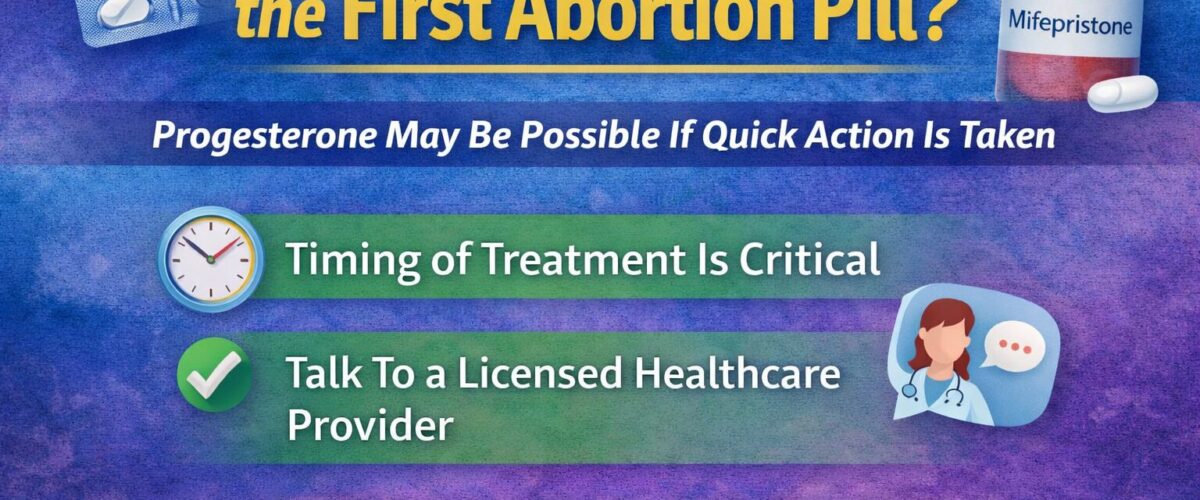
It may be possible in some cases if misoprostol has not yet been taken. However, abortion pill reversal using progesterone remains medically controversial, and major medical organizations state that evidence is limited and not conclusive. Immediate consultation with a licensed healthcare provider is essential.
How the Abortion Pill Works?
Understanding the two-medication sequence of abortion pill treatment is the foundation for understanding why changing your mind after the first pill and only the first pill is a clinically different situation than changing your mind after both have been taken.
Mifepristone The First Medication
Mifepristone, sold under brand names including Mifeprex and Carafem and historically known as RU-486, is a synthetic antiprogestin. Its entire mechanism of action is built around one target: progesterone. By occupying progesterone receptor sites throughout the body, mifepristone prevents your naturally produced progesterone from doing its job which is sustaining the uterine environment the developing pregnancy depends on to survive. Without active progesterone signaling, the uterine lining begins to deteriorate and the pregnancy loses its biological support system.
Misoprostol The Second Medication
Misoprostol is taken 24 to 48 hours after mifepristone. Where mifepristone works hormonally and silently, misoprostol works physically; it triggers powerful uterine contractions, softens and opens the cervix, and initiates the expulsion of the pregnancy from the uterus. This second medication is what physically completes the abortion process.
The distinction between these two medications matters enormously to your current situation. The process has two distinct stages and you are between them.
What Has Actually Happened in Your Body Since Taking Mifepristone
Since taking mifepristone, progesterone receptor blockade has begun. Your body’s progesterone is still being produced but is being prevented from reaching its intended receptors. The uterine lining has begun the process of destabilization. However and this is clinically important the physical expulsion of the pregnancy has not yet occurred. That requires misoprostol.
What this means is that your body is in a hormonally disrupted state, but the mechanical process of abortion has not been set in motion. This distinction is precisely what creates a potential window for intervention but that window is measured in hours, not days.
Can the Effects of Mifepristone Be Reversed?
The honest clinical answer is: possibly, if you act immediately.
The intervention that has been explored for this purpose works on a principle that is mechanistically logical: if mifepristone’s harm to the pregnancy comes from blocking progesterone receptors, then flooding the system with a high concentration of supplemental progesterone may allow the natural hormone to out-compete the drug for those receptor sites restoring the hormonal environment the pregnancy needs before the damage becomes irreversible.
Progesterone itself is not an experimental or unfamiliar medication. It has been a standard tool in obstetric care for more than five decades prescribed routinely to pregnant women at risk of miscarriage or preterm delivery. Its safety profile in pregnancy is well-documented, and current evidence does not associate progesterone supplementation with increased risk of fetal abnormalities or birth defects.
The clinical data surrounding this intervention reports a success rate in the range of 64 to 68 percent when treatment is initiated within the appropriate timeframe. That means roughly two out of every three patients who pursued this intervention in time and had not yet taken misoprostol went on to continue their pregnancy successfully. Those are not guaranteed outcomes but they are clinically meaningful ones for a patient who genuinely wants to continue her pregnancy.
The medical establishment remains divided on whether existing evidence meets the threshold for formal endorsement of this protocol. I share that context not to discourage you but because I believe you deserve full transparency. What I can tell you with confidence is that progesterone is safe, that the mechanism is rational, and that time is the determining variable in whether this option remains available to you at all.
How Effective and Safe Is Progesterone Treatment
Two questions I hear immediately from patients in this situation and they deserve direct answers:
Will it work? Clinical outcomes data shows a 64 to 68 percent success rate for pregnancies that continued following progesterone treatment initiated within the appropriate window. Success is strongly correlated with how quickly treatment begins after mifepristone. Earlier intervention produces better outcomes consistently.
Is it safe for the baby? Natural progesterone has been used in pregnant women for over 50 years with a well-established safety record. Current studies show no elevated risk of birth defects in pregnancies supported by progesterone supplementation. This is not an experimental substance, it is a bioidentical hormone that pregnant women produce naturally and that obstetricians have prescribed for decades.
When to Start Progesterone Treatment
The 24-Hour Window represents the strongest opportunity for successful intervention. Patients who initiated progesterone treatment within 24 hours of taking mifepristone have the highest reported rates of successful pregnancy continuation. If you are reading this within 24 hours of your first pill, you are in the most favorable window available to you.
The 72-Hour Boundary is the outer limit of documented clinical feasibility. Successful outcomes have been reported in patients who began treatment between 24 and 72 hours post-mifepristone, though success rates decrease as time from ingestion increases. Beyond 72 hours, the clinical rationale for intervention weakens significantly.
Every hour between now and when you speak with a provider is an hour of narrowing probability. The decision to explore this option cannot be deferred.
Changing Your Mind Is More Common Than You Think
Decisions made under the pressure of an unintended pregnancy with financial stress, relationship uncertainty, fear, and time pressure all converging sometimes feel different in the hours or days that follow.
That is not a character flaw. It is the reality of making profound decisions under difficult circumstances. You are not the first person to find yourself here, and whatever led you to this moment does not define you or your capacity to make the right decision going forward.
What matters right now is that you have accurate information, access to a licensed clinical provider, and the freedom to move forward in whatever direction genuinely reflects what you want. Your reproductive autonomy includes the full range of your choices including the choice to change your mind.
Serenity Choice Health: Care That Starts With Honesty
At Serenity Choice Health, our clinical focus is exclusively on medication abortion, telehealth abortion, and in-person abortion services. We are transparent about what we provide and committed to ensuring that every patient who comes to us has the complete medical information they need to navigate their reproductive healthcare decisions with clarity and confidence.
If you are a patient who came to us for abortion care and are now experiencing uncertainty or a genuine change of mind after taking mifepristone, our providers will speak with you openly about your clinical situation what has occurred hormonally since you took the medication, what the realistic options are given your specific circumstances and timing, and what each pathway forward involves. We will give you honest answers without pressure in either direction, because informed patients make better decisions for themselves.
If you are still in the process of deciding whether to begin medication abortion and want to fully understand every aspect of the experience including what happens between the two medications and what options exist if your feelings change our pre-procedure consultations are built around exactly that kind of thorough, transparent clinical conversation.
Telehealth and in-person appointments are both available, so you can access our clinical team in whatever way feels most comfortable and accessible for your situation.
You Are Not Alone And Time Is the One Thing You Cannot Recover
The most important clinical truth I can leave you with is this: every other variable in your situation, the emotional weight, the logistical questions, the uncertainty about the future can be worked through with time and support. The progesterone treatment window cannot be extended. It exists for a matter of hours, and it is already counting down from the moment you took mifepristone.
Whatever you decide, decide it with full information and clinical support not alone, not from a search engine, and not by waiting to see what your body does next without guidance.
You deserve real answers from a real provider right now.
Your window is open but it will not stay open. Book your confidential consultation at Serenity Choice Health today. Telehealth and in-person appointments are available so you can speak with a licensed provider, understand your precise clinical situation, and access whatever care path genuinely reflects what you want quickly, privately, and with the full support of an experienced clinical team.

Dr. James Carter is a board-certified physician and lead clinician at Serenity Choice Health, specializing in reproductive health access and medication abortion protocols. With over 20+ years of experience, he combines clinical expertise with patient-centered care to ensure safe, compassionate, and confidential reproductive healthcare.