
You live in Indiana. You are pregnant. You have heard that abortion is banned. But you have also heard that some people are still getting abortion pills and you do not know what is actually true. That confusion is not your fault. The legal landscape around abortion access in Indiana is genuinely complicated, and the misinformation circulating online makes it even harder to find a clear, honest answer.
This guide cuts through that noise. We will explain exactly what Indiana’s abortion ban covers, what telehealth abortion is, how shield laws create legal pathways for out-of-state care, and what your real options are right now. If you are in Indiana and need care, understanding these facts is the most important first step you can take.
If you need to speak with someone now, you can schedule a confidential telehealth consultation with our care team. We serve patients from states with restricted abortion access.
What Indiana’s Abortion Ban Actually Covers
Indiana enforces a near-total abortion ban that took effect in 2022 following the Supreme Court’s Dobbs decision. The law prohibits most abortions performed within the state. However, narrow exceptions do exist including cases involving rape, incest, fatal fetal anomalies, and situations where the pregnant person’s life is at serious risk.
What the law does not do is criminalize Indiana residents for seeking abortion care in another state. Traveling across state lines for a legal medical procedure is protected under federal interstate travel rights. Indiana cannot prosecute you for receiving care in Illinois or any other state where abortion is legal.
The law also targets providers, not patients. If an Indiana-based provider prescribes abortion medication, they face legal consequences under state law. But providers operating in shield-law states like Illinois are protected from Indiana prosecution entirely. That distinction is what makes telehealth abortion access possible for Indiana residents today.
What Is Telehealth Abortion and How Does It Work?
Telehealth abortion, also called medication abortion via telemedicine, allows you to consult with a licensed provider through a secure video or online appointment. If you are eligible, the provider prescribes the abortion pill regimen mifepristone and misoprostol which is then mailed directly to you or made available for pickup.
The medication abortion process works in two steps. Mifepristone is taken first to stop the pregnancy from progressing. Misoprostol is taken 24 to 48 hours later to complete the process. The FDA approves this regimen for use up to 10 weeks of pregnancy, though some providers offer care up to 12 weeks depending on clinical assessment.
The telehealth consultation itself is straightforward. You answer questions about your medical history, confirm your gestational age often through a prior ultrasound or last menstrual period dating and discuss any health considerations with the provider. The entire process can happen from home, which is one of the primary reasons telehealth abortion has become an important access point for people in restricted states.
To understand the full process in detail, you can read our guide on telehealth abortion care and learn more about how the abortion pill works.
Can Indiana Residents Legally Use a Telehealth Abortion Provider From Another State?
This is the most important question and the answer requires understanding shield laws.
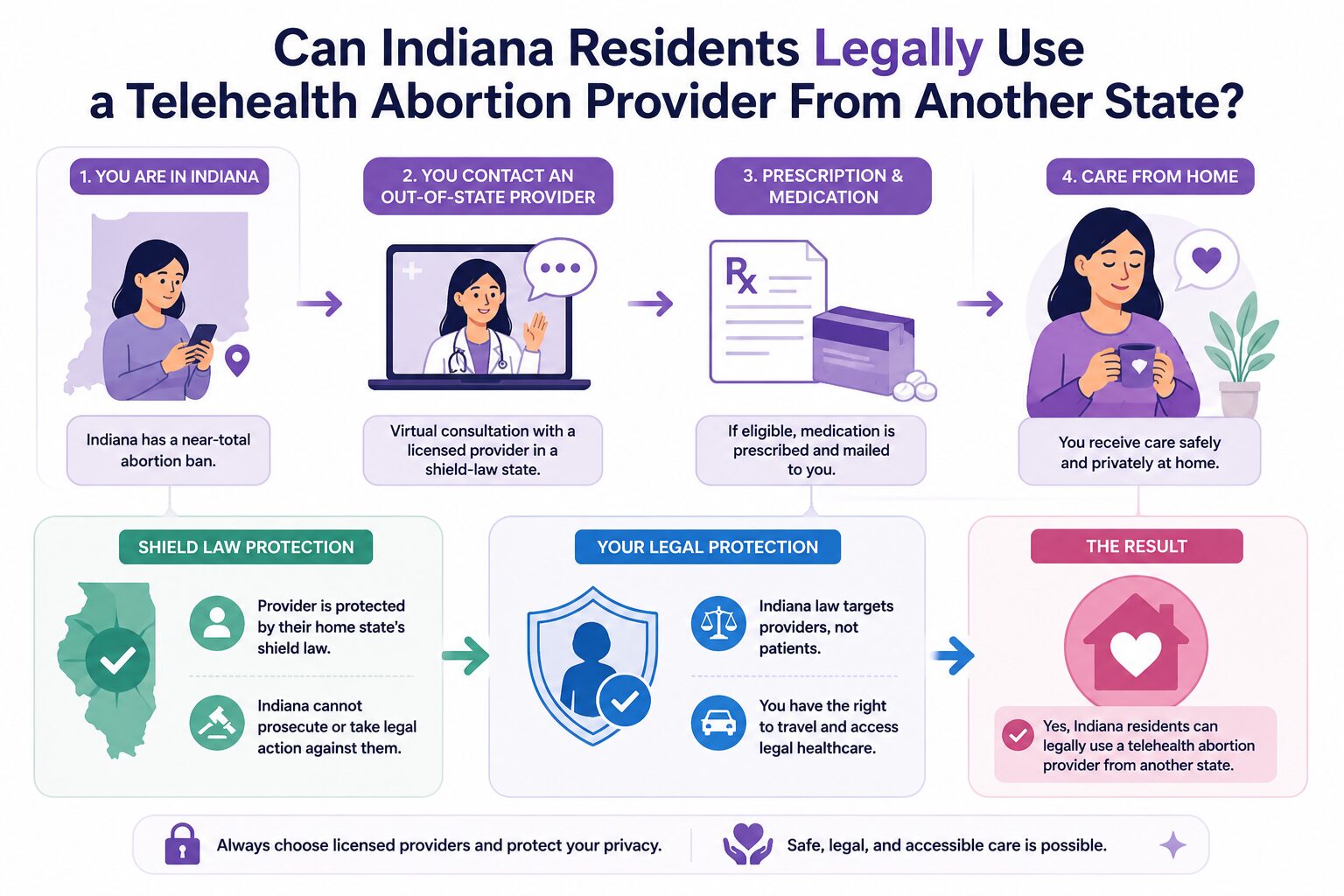
Several states, including Illinois, have passed abortion shield laws specifically designed to protect providers who offer care to patients living in states with abortion bans. These laws prevent Illinois-licensed providers from being extradited, investigated, or prosecuted under Indiana law. The provider is fully protected by their home state’s legal framework.
This means an Illinois-based telehealth abortion provider can legally consult with an Indiana resident and prescribe medication abortion and Indiana cannot take legal action against that provider. The shield law is their protection.
For patients, the risk picture is also relatively clear. Indiana’s abortion ban does not currently criminalize patients for seeking out-of-state care. No Indiana resident has been prosecuted for obtaining an abortion in another state or through a shield-law telehealth provider. That said, the legal landscape continues to evolve, and protecting your privacy remains genuinely important regardless of current enforcement patterns.
To understand exactly how these protections work, read our full guide on what abortion shield laws are and how they protect patients and whether telehealth abortion is legal from a restricted state.
How Indiana Women Are Actually Accessing Abortion Care Right Now
Despite the ban, Indiana residents have real options. Here is what people are actually doing.
Using a Shield-Law Telehealth Provider
The most logistically accessible option for many Indiana residents is connecting with a telehealth provider based in a shield-law state like Illinois. The consultation happens online, and medication can be mailed to an Indiana address depending on the provider’s protocols. This option works best for pregnancies under 10 to 12 weeks. Our telehealth abortion care is available to patients in restricted-access states, and you can book a confidential appointment to discuss your specific situation.
Traveling to Illinois for In-Clinic Care
Illinois has no gestational limits on abortion access and strong legal protections for both patients and providers. For Indiana residents particularly those in the northern part of the state Illinois is geographically close and a well-established destination for abortion care. If you prefer in-person support or your pregnancy is beyond the telehealth window, exploring in-clinic abortion services in Illinois is a straightforward option. For practical guidance, our resource on traveling to Illinois for abortion care covers everything you need to know before your trip.
Connecting With Abortion Funds
Financial and logistical barriers are real. Abortion funds exist specifically to help people in restrictive states cover the cost of care, travel, and accommodation. National funds like the National Abortion Federation Hotline and regional funds serving the Midwest can provide direct financial assistance. Do not let cost be the reason you delay support.
What to avoid: unverified websites selling abortion pills without a medical consultation. Sourcing medication from unknown online pharmacies carries genuine health risks. Always verify that you are working with a licensed medical provider. Our guide on how to safely get verified abortion pills online helps you identify legitimate sources.
Illinois: The Most Accessible Option for Indiana Residents
Illinois is the most important state in this conversation for Indiana residents. It sits directly on Indiana’s western border, has enacted some of the strongest reproductive rights protections in the country, and has specifically positioned itself as a destination for patients from neighboring restrictive states.
Illinois providers are protected by shield laws from prosecution under Indiana or any other banned state’s laws. Illinois has no gestational limit for abortion access. And Illinois offers both telehealth and in-clinic options meaning Indiana residents can choose the pathway that makes the most sense for their situation, timeline, and comfort level.
If you are considering Illinois as your access point, read our complete guide to why Illinois is the Midwest’s most accessible abortion destination.
Protecting Your Privacy as an Indiana Resident
Even though Indiana law currently targets providers rather than patients, protecting your privacy is still a smart and important step. Digital data has increasingly become part of abortion-related legal cases in other states, and being cautious costs nothing.
Here is what privacy-conscious care looks like in practice. Use a private browsing window or a VPN when researching abortion options online. Avoid period tracking apps that store your data on external servers. Pay for services with cash or a prepaid card when possible to avoid insurance or bank records. Be thoughtful about what you text or email regarding your plans.
On the medical records side your abortion care does not automatically appear on your Indiana insurance records or your primary care physician’s records if you use a separate provider. Out-of-pocket payment to a separate provider creates the cleanest paper trail.
For a thorough walkthrough of every privacy consideration, read our guides on protecting your digital privacy when seeking abortion care, whether abortion shows up on medical records, and how to keep your abortion completely private.
What to Expect During and After a Telehealth Medication Abortion
If you move forward with telehealth abortion care, here is a clear picture of what the experience involves.
Your telehealth consultation will cover your medical history, gestational age, and any health factors that affect which medications are safe for you. The provider will explain the process, answer your questions, and if you are eligible, issue a prescription. Medication typically arrives within a few days.
Mifepristone is taken first, usually by mouth. Misoprostol is placed under the tongue or vaginally 24 to 48 hours later. Cramping and bleeding begin within a few hours of taking misoprostol this is the medication working. Bleeding is typically heavier than a normal period and may include clots. Cramping can be significant and is usually managed with ibuprofen and a heating pad.
Most people complete the process within a few days. Light bleeding or spotting can continue for several weeks. A follow-up appointment often via telehealth confirms the abortion is complete.
For a complete walkthrough of the experience, read our guides on what to expect before, during, and after your abortion, what bleeding after the abortion pill looks like, and how to confirm the abortion pill worked.
If you have questions before booking, our care team is available. Schedule your confidential telehealth appointment and we will walk you through every step.
Frequently Asked Questions
Is telehealth abortion completely illegal in Indiana?
Indiana’s ban prevents in-state providers from prescribing abortion medication. It does not criminalize patients, and out-of-state providers operating under shield laws such as those based in Illinois can legally serve Indiana residents through telehealth.
Can abortion pills be mailed to an Indiana address?
Some shield-law telehealth providers do mail medication to Indiana. The legal risk under shield law protections falls on the provider’s home state framework not on the patient receiving care.
Will I get in legal trouble for getting a telehealth abortion as an Indiana resident?
Indiana’s law currently targets providers, not patients. No Indiana resident has been criminally prosecuted for seeking abortion care. However, protecting your digital and financial privacy remains a sensible precaution given the evolving legal landscape.
How far along can I be for a telehealth abortion?
Most telehealth abortion providers offer care up to 10 weeks of pregnancy. Some extend to 12 weeks. Beyond that threshold, in-clinic care such as our in-clinic abortion services in Illinois is the appropriate next step.
Does my Indiana doctor have to report if I had an abortion?
No mandatory reporting requirement compels your personal Indiana physician to report that you sought abortion care from a separate out-of-state provider. Standard medical privacy protections continue to apply to your records.
Can I use my Indiana health insurance to pay for telehealth abortion care?
Most Indiana insurance plans do not cover abortion services. Self-pay and abortion fund support are the most commonly used payment pathways for Indiana residents accessing out-of-state care.
How quickly can I get an appointment?
Telehealth consultations are often available within 24 to 48 hours. Book your confidential appointment here to get started as soon as possible.
What is the fastest way for an Indiana resident to access abortion care?
For pregnancies under 10 to 12 weeks, a shield-law telehealth provider is typically the fastest and most logistically accessible option. For later pregnancies, traveling to Illinois for in-clinic care is the recommended pathway.
You Have Options — Here Is Where to Start
Indiana’s abortion ban is real. But so is the care that remains available to you. Whether you are exploring telehealth abortion care from a shield-law provider, considering in-clinic abortion services in Illinois, or simply trying to understand the abortion pill process before making any decisions, accurate information and compassionate care are both within reach.
You do not have to navigate this alone. Schedule your confidential appointment today our team is here to help you understand your options and move forward with care that is right for you.

Dr. James Carter is a board-certified physician and lead clinician at Serenity Choice Health, specializing in reproductive health access and medication abortion protocols. With over 20+ years of experience, he combines clinical expertise with patient-centered care to ensure safe, compassionate, and confidential reproductive healthcare.