
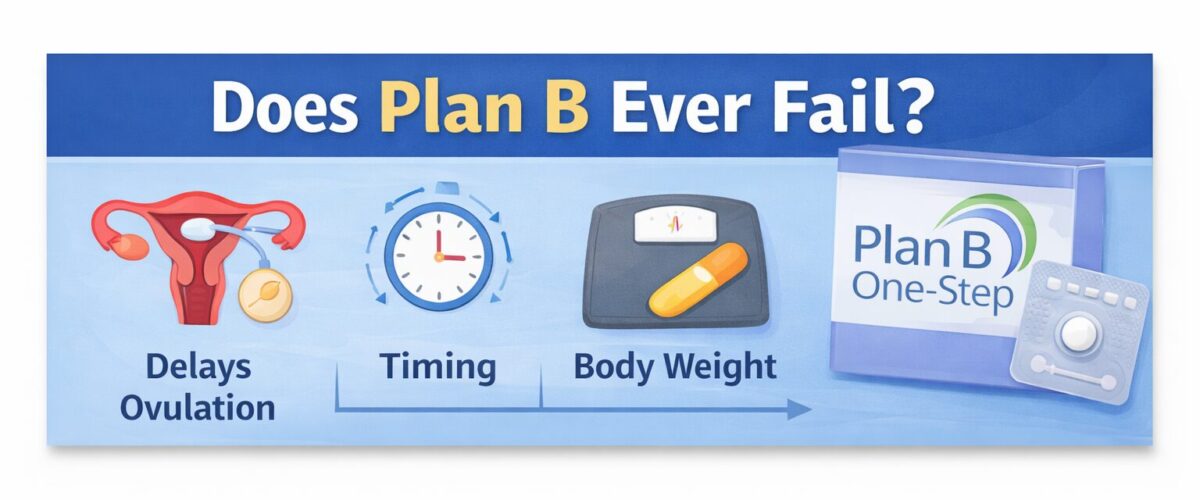
Yes, Plan B can fail under certain conditions:
- Ovulation has already occurred: Plan B primarily works by delaying ovulation, and if ovulation has already happened, it cannot prevent fertilization.
- Timing: It’s most effective within 24 hours (95%), but effectiveness drops significantly after 72 hours (58%).
- Body weight: Effectiveness decreases for individuals over 165-175 pounds.
- Drug interactions: Some medications like anticonvulsants and certain antibiotics can reduce Plan B’s effectiveness.
Though Plan B is not an abortion pill, if it fails and pregnancy occurs, a pregnancy test after 2-3 weeks will confirm whether further steps are needed.
What Is Plan B and How Does It Work?
Plan B One-Step and its generic equivalents including Take Action, Next Choice, and My Way is an over-the-counter emergency contraceptive containing levonorgestrel, a synthetic progestin hormone. It works primarily through one mechanism: preventing or significantly delaying ovulation so that sperm have no egg available to fertilize.
Secondary mechanisms may include thickening cervical mucus to impede sperm motility and potentially altering the uterine lining though the primary and most clinically significant action is ovulation suppression.
One clinical point I make with every patient who asks about Plan B: it is not the abortion pill. Plan B does not terminate an existing pregnancy. It does not work after a fertilized egg has already implanted in the uterine lining. Its entire mechanism is pre-fertilization; it is contraception, not abortion. If you are already pregnant when you take Plan B, it will have no effect on that pregnancy.
Can Plan B Fail?
Yes Plan B can and does fail, and understanding the specific circumstances under which it is most likely to fail is essential clinical knowledge for anyone relying on it as emergency contraception.
You Have Already Ovulated
This is the most significant and most frequently overlooked reason Plan B fails. Levonorgestrel works by preventing ovulation. Once ovulation has already occurred meaning a mature egg has already been released from the ovary Plan B has no mechanism to prevent that egg from being fertilized. If sperm are present in the reproductive tract when ovulation occurs, pregnancy can result regardless of whether Plan B was taken.
This is why tracking your menstrual cycle and understanding your personal ovulation window is genuinely important clinical knowledge not just for Plan B users but for anyone making contraceptive decisions based on timing. Women who take Plan B during or immediately after ovulation are in the highest-risk window for Plan B failure, and that failure is not due to anything they did wrong. It is simply the biological limitation of how the medication works.
Timing After Unprotected Sex
Plan B effectiveness is directly correlated with how quickly it is taken after unprotected intercourse. When taken within 24 hours, the success rate is approximately 95 percent. Taken between 25 and 48 hours, effectiveness drops to approximately 85 percent. Between 49 and 72 hours, it falls further to approximately 58 percent. Plan B is approved for use up to 72 hours after unprotected sex, but the clinical reality is that every passing hour reduces its probability of working. It is not equally effective across that entire 72-hour window earlier is meaningfully better.
Body Weight and Plan B Effectiveness
Clinical studies have raised important questions about whether levonorgestrel-based emergency contraceptives like Plan B are less effective in patients above certain weight thresholds. Research has shown that Plan B may be significantly less effective for individuals weighing over 165 to 175 pounds, with some studies suggesting near-complete loss of effectiveness at higher body weights due to changes in how the hormone is absorbed and distributed throughout the body.
This does not mean Plan B will definitely fail for patients in this weight range but it does mean that higher-weight patients may want to discuss alternative emergency contraception options with a provider. Ella (ulipristal acetate), a prescription emergency contraceptive, has demonstrated more consistent effectiveness across a broader weight range. The copper IUD, when inserted within five days of unprotected sex, is the most effective form of emergency contraception available regardless of body weight, with a failure rate of less than one percent.
Drug Interactions
Certain medications can interfere with levonorgestrel metabolism and reduce Plan B’s effectiveness. The most clinically significant interactions involve enzyme-inducing medications including rifampin, certain anticonvulsants such as phenytoin, carbamazepine, and phenobarbital, and the herbal supplement St. John’s Wort. If you take any of these regularly and need emergency contraception, Plan B may not be your most reliable option a conversation with a provider about alternatives is warranted.
What Is Plan B’s Actual Success Rate?
When taken within 72 hours of unprotected sex by someone who has not yet ovulated, Plan B prevents approximately 7 out of 8 pregnancies that would otherwise have occurred, roughly an 89 percent reduction in pregnancy risk overall. However, this average figure masks the significant variation based on timing, ovulation status, and individual factors discussed above.
Plan B is most effective when taken as early as possible after unprotected sex, by someone whose ovulation has not yet occurred, at a body weight within the range where the medication achieves full hormonal concentration. When all of these conditions are met, it is highly effective. When any of these conditions are not met, the failure rate increases meaningfully.
Common Side Effects of Plan B
Most side effects of Plan B are temporary, resolve within a few days, and do not indicate that anything has gone wrong. The most commonly reported experiences include nausea, particularly in the hours immediately following ingestion, irregular bleeding or spotting before your next period, changes in the timing of your next menstrual period which may arrive earlier or later than expected breast tenderness, headache, fatigue, and mild lower abdominal cramping.
One important clinical note on the pregnancy test timing question: because Plan B can alter your menstrual cycle timing, a period that arrives more than a week late after taking Plan B warrants a pregnancy test. A delayed period alone does not confirm Plan B failure, but it is the appropriate trigger for testing.
Signs Plan B May Not Have Worked
The most reliable sign that Plan B has not worked is a missed or significantly late period followed by a positive pregnancy test. Other early pregnancy symptoms persistent nausea, breast tenderness that does not resolve as your cycle progresses, fatigue, or frequent urination appearing two to three weeks after taking Plan B may also indicate that it was not effective.
One specific symptom pattern that requires urgent evaluation is sharp, one-sided pelvic pain appearing in the weeks following Plan B use. While Plan B does not cause ectopic pregnancy, any unintended pregnancy following emergency contraceptive failure carries a baseline risk of ectopic implantation a medical emergency. If you experience severe one-sided pelvic pain, shoulder pain, or dizziness in the weeks after taking Plan B, seek emergency medical evaluation immediately regardless of pregnancy test results.
Does Plan B Work During Ovulation?
This is one of the most clinically important questions patients ask and the answer requires honesty rather than reassurance. Plan B does not reliably work during ovulation. Its primary mechanism is preventing ovulation from occurring. Once ovulation has already happened, taking levonorgestrel has no established ability to prevent fertilization or implantation at the level that would reliably prevent pregnancy.
If you know or suspect you were ovulating when unprotected sex occurred, Plan B may offer limited protection at best. In this scenario, discussing alternative emergency contraception options particularly the copper IUD, which is effective even post-ovulation by preventing implantation with a provider as quickly as possible is the most clinically sound course of action.
When Plan B Is Not Enough?
If you took Plan B and are now concerned it may not have worked because your period is late, because you know you were ovulating when you took it, because of your body weight, or simply because the uncertainty is weighing on you the next step is clinical confirmation, not continued waiting.
A pregnancy test taken at least two to three weeks after taking Plan B provides a reliable result. If that test is positive, you have an unintended pregnancy and a set of options that deserve careful, medically accurate, judgment-free clinical support.
At Serenity Choice Health, we provide compassionate, evidence-based reproductive healthcare exclusively through medication abortion, telehealth abortion, and in-person abortion services. If Plan B has failed and you are facing an unintended pregnancy, our clinical team is here to give you accurate information about your options, answer your questions without pressure, and provide the care you need whether through a private telehealth consultation from home or an in-person appointment at our clinic.
Get Clinically Accurate Guidance at Serenity Choice Health
Uncertainty after taking Plan B is one of the most anxious waiting periods a person can experience. Whether you are in that waiting period now, have received a positive pregnancy test after Plan B failure, or simply want to speak with an experienced provider about your reproductive health options Serenity Choice Health is here to support you with the clinical accuracy and genuine compassion you deserve.
Do not navigate this alone. Book your confidential consultation at Serenity Choice Health today. Telehealth and in-person appointments are available so you can get real answers, real support, and access to the reproductive healthcare you need quickly, privately, and without judgment.

Dr. James Carter is a board-certified physician and lead clinician at Serenity Choice Health, specializing in reproductive health access and medication abortion protocols. With over 20+ years of experience, he combines clinical expertise with patient-centered care to ensure safe, compassionate, and confidential reproductive healthcare.