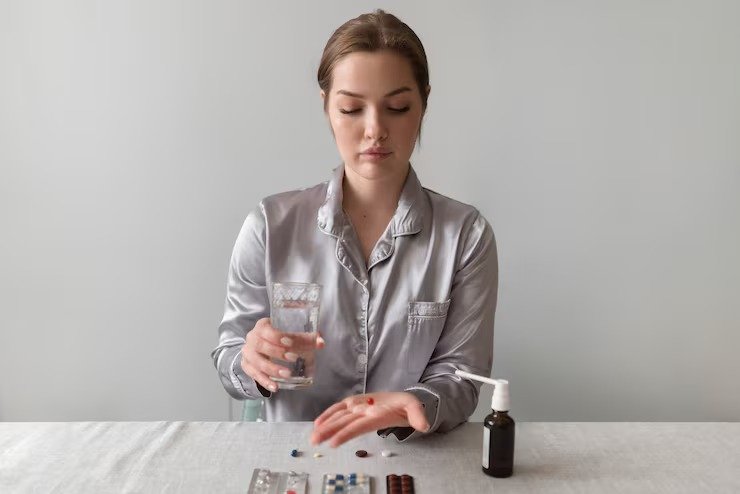

Misoprostol itself is cleared from the bloodstream relatively quickly. After it is absorbed, it is rapidly converted into its active form, misoprostol acid, which has a short plasma half-life of roughly 20 to 40 minutes. For most people, blood levels therefore fall substantially within a few hours.
However, this does not mean all of misoprostol’s effects stop within a few hours. Cramping, bleeding, nausea, chills, diarrhea, and uterine contractions may continue after the medication level in the bloodstream has already dropped.
Bleeding or spotting can continue for days or sometimes longer because the uterus is recovering—not because misoprostol is still circulating at high levels in your body.
How Quickly Does the Body Process Misoprostol?
Misoprostol is absorbed relatively quickly and then converted to an active metabolite called misoprostol acid.
Misoprostol acid is the substance primarily responsible for the medication’s effects.
Its plasma half-life is short—generally around 20 to 40 minutes. A half-life is the amount of time it takes the concentration of a drug in the bloodstream to decrease by approximately half.
Because the half-life is short, circulating levels drop rapidly after the medication has been absorbed.
In practical terms, most active misoprostol in the bloodstream is reduced to very low levels within several hours, although the exact timing can vary depending on how the medication was taken and individual differences in absorption and metabolism.
Does the Way I Take Misoprostol Affect How Long It Stays in My Body?
Yes. The route of administration affects how quickly misoprostol is absorbed and how long measurable concentrations remain elevated.
Misoprostol may be administered:
- Between the cheek and gum, called buccal administration
- Under the tongue, called sublingual administration
- Vaginally
- Orally in certain medical regimens
Sublingual administration generally produces a relatively rapid and high peak concentration.
Vaginal administration tends to produce slower absorption and more prolonged drug levels compared with some oral routes.
That means there is not one exact clearance time that applies to every person or every method of taking misoprostol.
Always use the route specifically recommended by your healthcare provider.
Why Do I Still Have Symptoms if Misoprostol Leaves the Blood So Quickly?
The amount of medication circulating in your bloodstream and the duration of its physical effects are not the same thing.
Misoprostol triggers uterine contractions and cervical changes that help the pregnancy pass. Once those processes have started, the uterus can continue contracting and bleeding even as the concentration of misoprostol acid in the bloodstream falls.
That is why you may continue experiencing:
- Cramping
- Vaginal bleeding
- Passing clots
- Fatigue
- Abdominal tenderness
- Mild nausea
- Other recovery symptoms
after most of the medication has already been metabolized.
The continuing symptoms generally reflect the abortion and recovery process rather than misoprostol simply remaining in your bloodstream.
How Long Do Misoprostol Side Effects Last?
Different effects have different timelines.
Cramping
Strong cramping commonly occurs during the hours after misoprostol is taken.
The most intense cramps usually improve after the pregnancy passes, although milder cramps can continue intermittently afterward.
Learn more about how long abortion pain can last.
Chills
Chills and shivering are common temporary misoprostol effects.
They often improve within several hours and should generally resolve within about 24 hours.
Diarrhea
Misoprostol-related diarrhea usually lasts several hours and generally becomes significantly better within 24 hours.
Nausea
Nausea may occur during the active medication-abortion process and generally improves as the effects of misoprostol wear off.
Bleeding
Bleeding lasts much longer than misoprostol remains in the bloodstream.
Heavy bleeding commonly occurs during the active phase, followed by lighter bleeding or spotting that may continue for days or sometimes longer.
This does not mean misoprostol is still actively circulating in your system.
How Long Does Misoprostol Stay Detectable in Blood?
Misoprostol is rapidly converted into misoprostol acid, and blood concentrations decline quickly because of its short half-life.
Routine healthcare blood tests do not normally test specifically for misoprostol.
Standard tests such as:
- Complete blood counts
- Pregnancy hormone tests
- Routine metabolic panels
- Standard emergency-room blood tests
are not designed to identify whether someone previously took misoprostol.
Specialized laboratory techniques can measure misoprostol metabolites for research or specific analytical purposes, but this is different from ordinary clinical testing.
For more information, read Can abortion pills show up in blood tests later?.
How Long Does Misoprostol Stay in Urine?
Misoprostol metabolites are eliminated from the body, including through the urine.
However, there is not a routine clinical urine test that healthcare providers generally use to determine whether someone previously took misoprostol.
A standard urine pregnancy test detects hCG, the pregnancy hormone, not misoprostol.
This distinction is important because a pregnancy test may remain positive for some time after a successful medication abortion even though the abortion medications themselves have already been metabolized.
Why Can a Pregnancy Test Stay Positive if Misoprostol Is Already Gone?
Pregnancy tests do not detect misoprostol.
They detect human chorionic gonadotropin (hCG).
After a pregnancy ends, hCG does not disappear immediately. It gradually falls over time, so a sensitive home pregnancy test may remain positive for several weeks.
Therefore:
Misoprostol can already be cleared from your bloodstream while your pregnancy test is still positive.
A positive test soon after medication abortion does not by itself prove that misoprostol is still in your body or that the abortion failed.
Read more about why a pregnancy test can remain positive weeks after abortion pills.
Does Bleeding Mean Misoprostol Is Still in My System?
No.
Bleeding can continue long after the active medication has been metabolized.
Misoprostol begins a process in which the uterus contracts and empties. After the main pregnancy tissue passes, the uterine lining continues healing and shedding.
This can cause bleeding that:
- Becomes lighter
- Stops and starts
- Changes from red to brown
- Gradually becomes spotting
These patterns can continue during recovery without indicating that misoprostol is still circulating.
You can read more about why bleeding may stop and start after abortion pills.
Does Misoprostol Build Up in the Body?
With the abortion regimens normally prescribed by healthcare professionals, misoprostol is not considered a medication that remains stored in the body for weeks.
Because misoprostol acid has a short half-life, the body processes each dose relatively quickly.
However, additional doses may sometimes be prescribed as part of a medication-abortion regimen. Each dose produces another period of drug absorption and effect.
This is one reason you should follow the exact dose and timing provided by your healthcare professional rather than taking additional tablets because you think the previous dose has “worn off.”
Should I Take More Misoprostol Once It Leaves My System?
Not unless your healthcare provider or treatment instructions tell you to.
The fact that misoprostol has a short half-life does not mean you need to keep taking it until bleeding stops.
Medication-abortion regimens are designed around:
- The dose
- Route of administration
- Pregnancy duration
- Whether mifepristone was used
- Your clinical circumstances
Taking more medication unnecessarily can increase side effects without providing additional benefit.
If you are unsure whether another dose is required, contact your abortion provider.
How Do I Know Whether Misoprostol Worked?
You cannot determine whether the abortion was successful simply by calculating how long misoprostol remains in your body.
Signs commonly associated with the process include:
- Cramping
- Vaginal bleeding
- Passing clots or pregnancy tissue
- Pregnancy symptoms gradually improving
However, symptoms vary from person to person.
Follow-up may involve your symptoms, a pregnancy test at the appropriate time, hCG testing, ultrasound, or another method recommended by your healthcare provider.
Learn more about signs that abortion pills have worked.
What if I Still Feel Pregnant After Misoprostol?
Pregnancy symptoms do not always disappear immediately.
Symptoms such as nausea or breast tenderness may take some time to improve because pregnancy hormones decline gradually after the pregnancy ends.
However, persistent or increasing pregnancy symptoms can sometimes indicate an ongoing pregnancy.
If you continue feeling pregnant or had very little bleeding after misoprostol, contact your healthcare provider for follow-up.
Our guide on what to do if you took abortion pills but still feel pregnant explains this in more detail.
Can Misoprostol Cause Symptoms the Next Day?
Yes.
Even though circulating medication levels decline rapidly, you may still experience symptoms the following day.
These may include:
- Mild cramping
- Bleeding
- Fatigue
- Mild stomach upset
- General soreness
These symptoms can reflect the continuing uterine and recovery process.
However, some symptoms deserve medical attention rather than being assumed to be delayed medication effects.
Contact your healthcare provider if you develop persistent fever or chills more than 24 hours after misoprostol, worsening abdominal pain, significant weakness, or other concerning symptoms.
When Should I Seek Medical Care?
Follow the emergency instructions given by your abortion provider.
Seek urgent medical evaluation for concerning symptoms such as:
- Bleeding that soaks two full-size pads per hour for two consecutive hours
- Fainting or difficulty staying conscious
- Severe or worsening abdominal or pelvic pain
- Difficulty breathing
- Severe weakness
- Inability to remain hydrated
- Persistent fever or chills more than 24 hours after misoprostol
- Any other warning sign your healthcare professional has told you requires urgent evaluation
Misoprostol’s short half-life does not mean a serious symptom should be ignored simply because several hours have passed since the medication was taken.
Medication Abortion Support With Serenity Choice Health
Serenity Choice Health provides medically guided abortion pill care and can answer questions about how misoprostol works, medication timing, cramping, bleeding, side effects, and follow-up.
Eligible patients may also receive care through our telehealth abortion services.
If you have already taken misoprostol and are unsure whether your symptoms are normal or whether the abortion was successful, our clinical team can review your individual situation.
Book Your Confidential Appointment Today
If you have questions about misoprostol, abortion-pill timing, bleeding, cramping, pregnancy testing, or recovery, speak confidentially with our clinical team.
Click Here to Book Your Confidential Appointment with Serenity Choice Health
This information is intended for general education and does not replace individualized medical advice. Follow the medication, follow-up, and emergency instructions provided by your healthcare professional.

Dr. James Carter is a board-certified physician and lead clinician at Serenity Choice Health, specializing in reproductive health access and medication abortion protocols. With over 20+ years of experience, he combines clinical expertise with patient-centered care to ensure safe, compassionate, and confidential reproductive healthcare.