
One of the biggest confusions about reproductive healthcare in America is understanding how Medicaid covers abortion. There are many different rules governing abortion coverage, whether due to various federal laws, state funding decisions or individual circumstances.
There is a lack of certainty about what care someone may be able to access due to all of the considerations that are being taken into account at this time when there is a real need for clarity.
This guide outlines Medicaid’s structure, how and when Medicaid covers abortions, why there is so much variation in funding, what restrictions exist, and how to obtain full Medicaid benefits if an individual does not qualify for Medicaid’s full reimbursement. It also provides information on how to navigate financial aid programs and where individuals can find additional sources of financial assistance.
What Is Medicaid and Why It Matters in Abortion Care
Medicaid is the United States public health insurance program for low-income families and individuals. Medicaid covers healthcare services provided through various public health systems, including private insurance agencies, state Districts of Public Health, local governments, hospitals, medical schools, community health centers, and other not for profit health providers.
Medicaid is jointly funded by federal and state governments. Medicaid’s shared funding structure has important implications for the rules around the provision of abortion services.
While the federal government establishes the minimum standards for Medicaid, states determine how they administer Medicaid. This means that states determine eligibility requirements, what medical services are covered, and how much to reimburse providers for providing covered services.
Due to this structure, Medicaid is not the same across the nation. Two people who each have Medicaid can have radically different access to abortion care based solely on the state where they reside.
Medicaid covers many vital healthcare services such as:
- physician services and inpatient hospital care
- pregnancy-related services
- care in the event of a medical emergency
- preventive health maintenance
- prescription drugs
As a result, abortion care is not treated in the same manner as other services because of the federal restrictions applicable to federally funded abortion services.
Does Medicaid Cover Abortion?
The answer to the question is yes; however, Medicaid will only cover an abortion if certain criteria are met from two different perspectives: First, the federal government has placed limits on Medicaid coverage because of the Hyde Amendment; second, many states have opted to use state revenue to cover abortion services. If you’re also wondering whether does insurance cover abortion beyond Medicaid, the answer depends on your plan and state.
This indicates that coverage is dependent on the following factors:
- Federal restrictions (Hyde Amendment)
- State government policies for the use of state funds
No one rule governs abortion coverage, rather there are a number of unique rules for each state.
The Hyde Amendment: The Key Federal Restriction
The Hyde Amendment is the largest restriction on how Medicaid provides funding for abortions.
The Hyde Amendment prohibits payment with federal Medicaid dollars for the vast majority of abortions, allowing exceptions only when:
- The abortion is necessary because the pregnancy resulted from rape.
- The abortion is necessary because the pregnancy resulted from incest.
- The abortion is necessary to save the mother’s life.
Under these three circumstances, Medicaid dollars can be used for abortion services; in all other circumstances, Medicaid dollars cannot be used to pay for abortion services.
The Hyde Amendment is not a ban on abortion but restricts payments for abortions that are federally funded. Medicaid is jointly funded by the states and the federal government so the Hyde Amendment greatly restricts abortion coverage by many states unless they use their own funds.
How States Expand or Restrict Medicaid Abortion Coverage
The states have a large degree of control over how they fund Medicaid and as a result, this results in three primary categories of abortion coverage within the states:
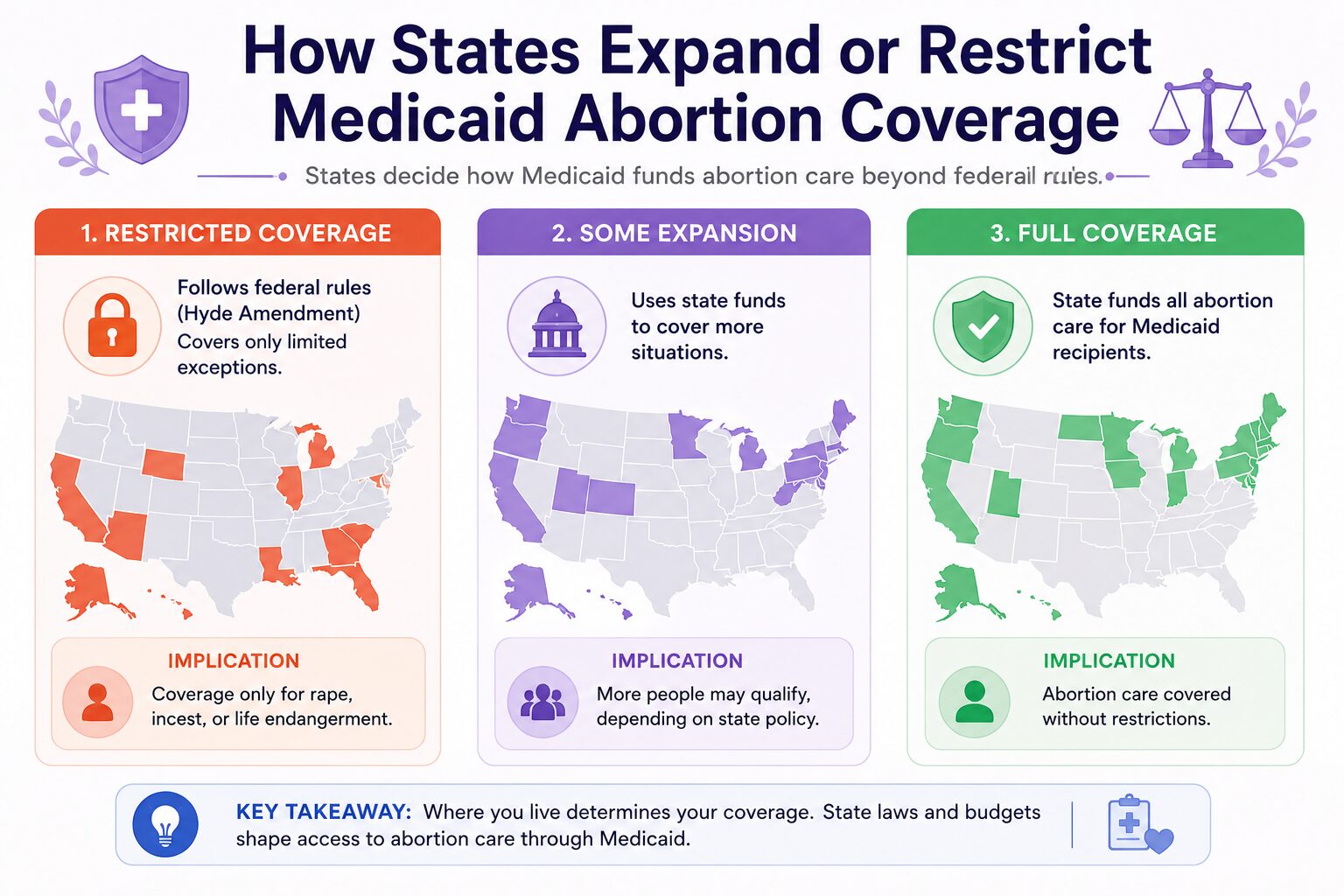
- States that adhere strictly to the federal Hyde Amendment, resulting in the least amount of coverage for Medicaid recipients;
- States that utilize their own funds to provide additional coverage to Medicaid recipients beyond the Hyde Amendment; and
- States that have a more liberalized view of health care coverage and therefore require that all Medicaid recipients be provided with abortion coverage without regard to the restrictions of the Hyde Amendment.
Access to abortion services differs widely across the United States due to geography.
Medicaid will only contribute to the cost of an abortion for women living in the large amount of states that don’t have expanded Medicaid eligibility if one of the exceptions applies (i.e. if a woman was raped or pregnant due to incest or if continuing a pregnancy would create a serious threat to her life).
When Medicaid Does Cover Abortion
The factors for which a woman would qualify for federal financial assistance funding via Medicaid can be broken down into three categories:
- Medicaid will pay for abortions if they were caused by rape or incest.
- Medicaid will pay for abortions if there is a serious risk of the woman’s life being jeopardized by continuing with the pregnancy (which can occur with certain types of medical complications).
- If a woman lives in a state that has decided to pay for abortions using state funds, then abortion may be covered (using state funds) without restrictions under state policy, rather than using federal funds.
Under certain conditions, some women (even those under the exceptions provided under federal law and those who are eligible for either state-funded or federal funded) may still have to provide proof or medical documentation of their eligibility prior to Medicaid actually approving the reimbursement.
Why Medicaid Coverage Is Different Across States
Medicaid coverage for abortions is different from state to state due to a decentralized healthcare system in the United States.
The Federal Government establishes minimum standards, while each individual state determines how they will implement these minimums in addition to the additional funding provided by Congress. States will also decide whether they want to grant additional funding for the same purpose.
A large number of factors determine how much your state provides for abortion coverage. Some of the factors that impact abortion coverage:
- State political policies.
- Your individual state’s budget decisions for healthcare.
- Any relevant legal rulings specific to your state.
- Available providers.
As a result, access to abortion through Medicaid differs from state to state, with some states having more extensive Medicaid coverage for abortions than other states only covering minimum Medicaid Federal Requirements related to abortions.
Can Medicaid Be Used for Abortion in Another State?
One of the most common misconceptions is whether or not you can use your state’s Medicaid for an abortion performed outside of your home state; and in general, it can only be used in your home state. So, when you go to another state for abortion-related services, your home state’s Medicaid plan will generally not cover the procedure (unless you are eligible for certain exceptions).
Therefore, if you are contemplating getting an abortion in another state, you will face additional challenges with regard to the financial and logistical aspects of obtaining the services. It is also important to understand what is involved when traveling for an abortion before making any decisions.
What Costs Medicaid May Not Cover Even When Eligible
Medicaid covers abortion procedure costs, but does not necessarily cover all costs associated with abortions. These costs usually include the following types of things:
- Costs for traveling to a provider that is not local (this may include transportation, gas and/or air fare).
- Costs for lodging if an overnight stay is required due to the need for distance between the provider and where the patient lives.
- Lost wages due to time away from work for both the abortion procedure and recovery.
- Child care expenses, if needed, while the patient is attending an appointment or recovering from the procedure.
Indirect costs can be substantial and act as barriers to accessing medically necessary service even when that service has been approved for coverage. Understanding abortion costs in Illinois or abortion pill costs can help you better prepare for out-of-pocket expenses.
How to Check If You Qualify for Medicaid Abortion Coverage
Understanding how to determine eligibility for Medicaid abortion coverage means understanding both income guidelines and state policy regarding the expanded and restricted coverage of abortion services under Medicaid.
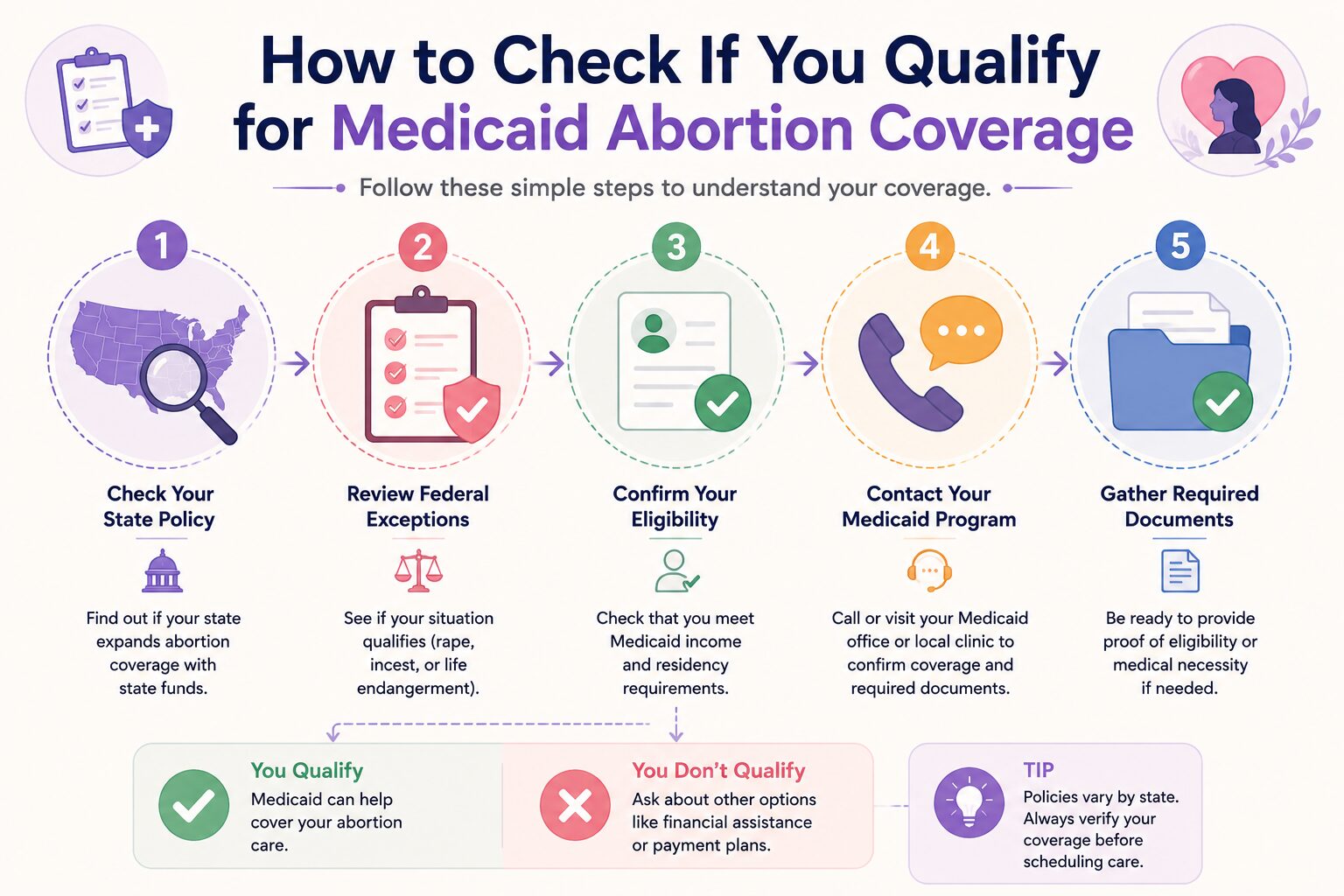
There are 3 steps involved in checking whether you qualify for Medicaid coverage for an abortion:
- Verify whether or not your state has expanded abortion coverage under Medicaid beyond the federally mandated restrictions.
- Verify if you qualify under one of the federally allowable exceptions (rape, incest or medically necessary) to be covered by Medicaid for having an abortion.
- Call your Medicaid provider or healthcare clinic and confirm what documents will need to be provided in order for your abortion service to be paid for by Medicaid. Since state policy can be quite variable, it is advisable to get direct verification.
What Happens If Medicaid Does Not Cover Your Abortion?
If, in your situation, Medicaid does not cover abortion costs, you can still pursue alternative ways to lessen those expenses. Many people utilize nonprofit abortion funds that offer patients some financial help. These funds assist patients in covering their abortion procedure costs, sometimes as well as their travel/hotel costs.
There are other ways to pay for your abortion, like clinics that provide income-based pricing options, sliding fee scales based on your ability to pay or payment plans through the clinic or with the help of another organization. You can also explore abortion financial aid programs that may be available in your state.
Additionally, some people who use partial Medicaid assistance also seek funds through private means (such as family or friends).
How Abortion Support Systems Work Together
In the majority of situations, access to an abortion does not come through one source of revenue. Abortion patients will typically:
- Have partial/more complete Medicaid coverage (partial coverage may still allow for payment from a fund);
- Receive financial assistance through an abortion fund;
- Receive financial assistance from their abortion provider;
- Utilize income-based pricing options in clinics;
- Have more than one option to obtain funds to pay for the procedure.
Together, these various forms of assistance and support create a network of assistance, so that all barriers to accessing an abortion can be reduced for patients.
Serenity Choice Health and Medicaid Abortion Support
For many patients, more than one of these options will be necessary. When primarily using Medicaid as your funding source to cover your abortion costs, Serenity Choice Health will offer you support throughout the process to understand your Medicaid abortion coverage and how to access it, and can offer you support and education to navigate the complex (and often changing) Medicaid policies that are often different in many states throughout the nation.
The process of understanding eligibility for Medicaid can be very overwhelming. Serenity Choice Health helps by providing guidance on various eligibility factors, explaining Medicaid coverage in practical terms, and also identifying other available forms of financial assistance if Medicaid does not apply in full.
The goal is not only to provide guidance but also to reduce confusion so all patients can get an understanding of what options may exist for them. Senior-level professionals are particularly helpful in providing assistance to patients who have unclear policies regarding Medicaid, states that have restricted Medicaid services or who face unexpected out-of-pocket expenses. Whether you prefer telehealth abortion care or an in-person visit, our team is here to support you.
Conclusion
In the United States, Medicaid and Abortion coverage are quite complicated because they are governed by Federal laws and State regulations.
In some particular states, Medicaid will cover abortions based upon specific states and the situations surrounding the abortion will also impact the eligibility for the coverage.
It is important for individuals to understand how Medicaid works; what it does or does not cover to make informed decisions about their overall health care.
Programs that support the financial assistance of individuals can help individuals navigate these complex Medicaid laws and include, nonprofit abortion funds and providers such as Serenity Choice Health who will provide assistance to individuals in finding available access to obtain the care they need even when they cannot obtain it through Medicaid.
Frequently Asked Questions (FAQ)
Does Medicaid cover abortion in all states? No. Whether Medicaid will pay for an abortion depends on state regulations and federal restrictions. Some states provide a wider range of abortion services than others.
What is the Hyde Amendment? The Hyde Amendment is a federal law prohibiting the use of Medicaid funds to pay for an abortion except in cases of sexual assault or incest or when the health of the mother is endangered.
Can Medicaid fully cover abortion costs? Medicaid could potentially cover 100% of an abortion if the state provides for it or if the state allows for full reimbursement of abortion services from its own source of funds.
Can I use Medicaid in another state for abortion? In most cases, you cannot use your Medicaid insurance in another state to pay for an abortion. Generally, your Medicaid insurance will only cover health care services provided in the state in which you have been enrolled.
What can I do if Medicaid does not cover abortion? You can check with your state’s Medicaid program on how to obtain payment assistance through other programs such as abortion financial aid programs, abortion pill options, income-based abortion clinics, etc. You can also schedule an appointment with Serenity Choice Health to discuss your options directly.

Dr. James Carter is a board-certified physician and lead clinician at Serenity Choice Health, specializing in reproductive health access and medication abortion protocols. With over 20+ years of experience, he combines clinical expertise with patient-centered care to ensure safe, compassionate, and confidential reproductive healthcare.