
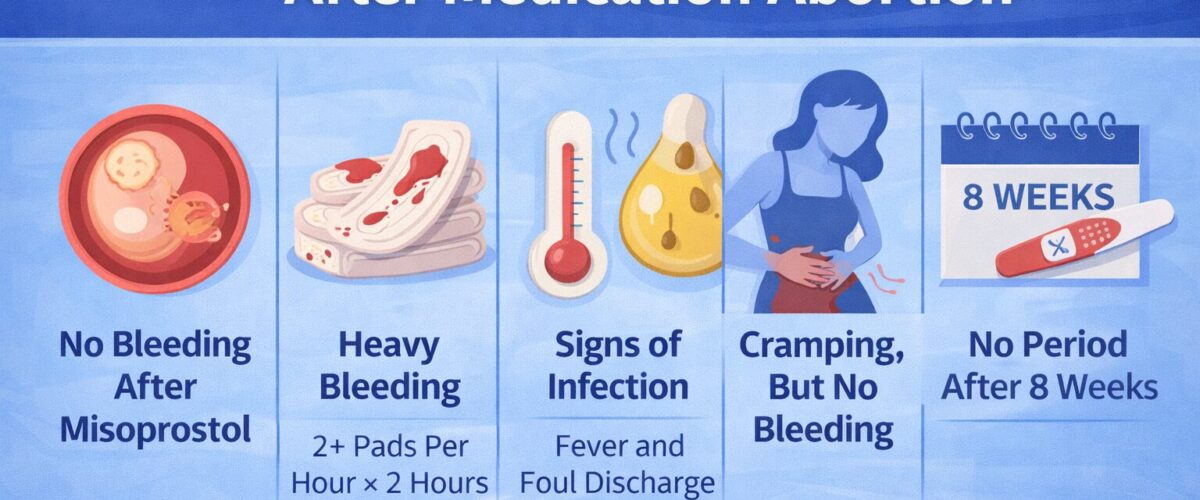
After taking the abortion pill (mifepristone and misoprostol), most patients recover without complications. However, certain symptoms may signal serious issues and require immediate medical evaluation.
- No bleeding 24 hours after misoprostol: Could indicate an ectopic pregnancy.
- Heavy bleeding: Soaking 2+ pads per hour for 2 hours, large blood clots, or signs of hemorrhage.
- Infection symptoms: Fever, chills, foul-smelling discharge, severe pelvic pain.
- Cramping but no bleeding: Could be a sign of an incomplete abortion or ectopic pregnancy.
- No period after 8 weeks or continued pregnancy symptoms: May indicate incomplete abortion.
When in Doubt, Seek Care: Contact your healthcare provider immediately if you experience concerning symptoms to ensure safe and timely care.
What Is Normal After Taking the Abortion Pill?
After mifepristone, most patients experience minimal physical change perhaps mild nausea, light spotting, or fatigue. The medication works hormonally and silently.
After misoprostol, taken 24 to 48 hours later, the picture changes significantly. Heavy bleeding typically begins within one to four hours, accompanied by strong uterine cramping. Passage of clots and pregnancy tissue is expected and normal. Nausea, vomiting, diarrhea, chills, and low-grade fever in the hours immediately following misoprostol are all common side effects of the prostaglandin medication itself and typically resolve within a few hours.
What follows over the next one to three weeks is gradually decreasing bleeding lighter than the initial heavy phase transitioning to spotting and eventual cessation as the uterus heals.
Everything outside this pattern deserves attention. Several specific symptom presentations require emergency care immediately.
No Bleeding 24 Hours After Taking Misoprostol
If you took misoprostol and nothing happened, no significant bleeding, no cramping, no tissue passage within 24 hours this is a clinical red flag that requires same-day provider contact rather than continued waiting.
The most serious concern in this scenario is an undetected ectopic pregnancy. An ectopic pregnancy occurs when the embryo has implanted outside the uterus most commonly in a fallopian tube rather than in the uterine cavity. Abortion pills cannot treat ectopic pregnancy. Misoprostol’s mechanism requires the pregnancy to be in the uterus for bleeding and expulsion to occur. If the pregnancy is ectopic, misoprostol will not produce the expected bleeding response and the underlying ectopic pregnancy will continue to develop, carrying a serious risk of fallopian tube rupture and internal hemorrhage if undetected.
Why am I not bleeding after taking misoprostol is one of the most urgent questions a patient can ask, and it deserves an immediate clinical answer not a search engine result. Contact your provider or go to an emergency room without delay if no bleeding occurs within 24 hours of misoprostol.
Other reasons misoprostol may produce minimal bleeding include poor medication absorption, incorrect administration technique, or medication that was not stored properly. A provider evaluation can determine the cause and appropriate next step which may include a repeat dose of misoprostol, ultrasound confirmation of the pregnancy’s location, or in-person intervention.
Hemorrhagic Bleeding: When Heavy Becomes Too Heavy
Heavy bleeding after the abortion pill is expected. Hemorrhagic bleeding is a medical emergency. Knowing the clinical threshold that separates the two is essential.
The emergency threshold for post-abortion bleeding is soaking through two or more thick full-size menstrual pads per hour for two consecutive hours. This level of blood loss indicates hemorrhage either from incomplete abortion with retained tissue causing the uterus to contract inadequately, or from another uterine complication requiring immediate medical intervention.
Additional signs that bleeding has crossed into dangerous territory include passing blood clots larger than a lemon, feeling lightheaded, dizzy, or faint which indicates significant blood volume loss a rapid or pounding heart rate, pallor, confusion, or extreme weakness. Any of these symptoms accompanying heavy bleeding constitute an emergency requiring immediate transport to the nearest emergency room. Do not wait to see if it slows down on its own.
Signs of Uterine Infection After the Abortion Pill
Uterine infection clinically called endometritis is one of the most serious complications of incomplete abortion, occurring when retained pregnancy tissue creates conditions for bacterial growth inside the uterine cavity. Left untreated, uterine infection can progress to sepsis, a life-threatening systemic response that requires hospitalization and aggressive medical management.
The warning signs of infection after the abortion pill that require prompt medical evaluation include a fever exceeding 100.4°F (38°C) lasting more than four hours, chills or rigors, severe abdominal or pelvic pain that is not adequately controlled by ibuprofen or prescribed pain medication, a rapid heart rate, foul-smelling vaginal discharge, and general malaise or flu-like symptoms appearing in the days following the procedure.
A critical clinical nuance: a low-grade temperature and mild chills in the first few hours after misoprostol is a known prostaglandin side effect and does not necessarily indicate infection. It is fever that persists beyond the first four to six hours post-misoprostol, or that develops or returns in the days following the procedure, that triggers genuine concern for infectious complication.
If you develop fever with any combination of the above symptoms particularly foul-smelling discharge and worsening rather than improving pelvic pain seek emergency evaluation immediately. Sepsis following incomplete abortion can deteriorate rapidly, and early antibiotic treatment is essential.
Misoprostol Cramping But No Bleeding: What It Means
Experiencing intense cramping after misoprostol without corresponding heavy bleeding is a specific symptom pattern that warrants clinical attention beyond simple reassurance. While mild cramping with only light bleeding can occur in very early pregnancies at five weeks or less, significant cramping without meaningful bleeding at later gestational stages is a signal that the medication may not be working as intended or that the pregnancy may not be in the uterus.
Only light bleeding after misoprostol when you expected more, or pain but no bleeding after the abortion pill, are symptoms that put ectopic pregnancy high on the differential diagnosis. Sharp, one-sided pelvic pain particularly if it radiates to the shoulder, is accompanied by dizziness, or intensifies rather than subsiding is a clinical emergency presentation. Go to an emergency room. Do not wait for a provider callback.
No Period After Eight Weeks or Continued Pregnancy Symptoms
If your menstrual period has not returned within eight weeks of taking the abortion pill, or if you are still experiencing pregnancy symptoms persistent nausea, breast tenderness, fatigue, frequent urination at two weeks or more post-procedure, these are signs that the abortion may not have been complete or successful.
Continued pregnancy symptoms two weeks after medication abortion indicate that pregnancy hormone levels have not declined as expected. This pattern can represent incomplete abortion with retained tissue still producing hCG, or in rare cases, an ongoing pregnancy that the medication failed to terminate.
A home pregnancy test taken four to six weeks post-procedure can provide an initial indication that a strongly positive test at this timeframe warrants immediate clinical evaluation. A serum hCG blood test ordered by your provider gives a definitive, quantitative answer. Neither symptom monitoring nor a single home test is sufficient on its own to confirm complete abortion.
How to Stop Diarrhea After Taking Misoprostol?
Diarrhea following misoprostol is one of the most commonly reported gastrointestinal side effects and is a direct result of the prostaglandin’s effect on smooth muscle throughout the body not just the uterus. For the majority of patients, misoprostol-related diarrhea is self-limiting and resolves within a few hours of the medication being absorbed.
Managing diarrhea after misoprostol involves staying well hydrated to replace fluids lost, resting, and avoiding dairy products and high-fat foods during the acute phase. Over-the-counter loperamide can help manage symptoms once the misoprostol has been fully absorbed generally after two to three hours. Diarrhea that persists beyond 24 hours, is accompanied by blood in the stool, or is associated with fever and worsening abdominal pain warrants clinical evaluation to rule out infectious complication.
The Symptoms That Most Commonly Get Dismissed And Shouldn’t
In my clinical experience, the warning signs patients most commonly wait too long on are not the dramatic ones the hemorrhage that fills two pads an hour is hard to ignore. The symptoms that get dismissed are the ones that feel like they might just resolve: a fever that seems mild, pain that is present but feels manageable, bleeding that stopped earlier than expected and feels like good news.
Infection after the abortion pill does not always announce itself loudly. Retained tissue does not always produce escalating symptoms immediately. A fever of 100.6°F that has been present for six hours is not mild it is a clinical sign that requires evaluation today, not tomorrow.
The safest approach after medication abortion is to treat unexpected or persistent symptoms as clinical concerns until proven otherwise not to normalize them and hope for the best.
Serenity Choice Health: Full Clinical Support Throughout Your Medication Abortion
At Serenity Choice Health, we believe that safe medication abortion care extends far beyond the moment the prescription is filled. We specialize exclusively in medication abortion, telehealth abortion, and in-person abortion services and our clinical support includes comprehensive guidance on what to expect, what to watch for, and when to seek emergency care.
Our patients receive clear, personalized clinical instructions before their procedure covering normal expected symptoms, specific emergency warning signs relevant to their gestational age and individual health history, and direct contact pathways to reach our clinical team when concerns arise. Post-procedure follow-up coordination to confirm complete abortion is a standard component of every patient’s care plan.
Whether you are currently in the post-abortion recovery period and experiencing symptoms you want evaluated, are preparing to begin medication abortion and want to understand the full clinical picture before you start, or have had a procedure elsewhere and need clinical support for your recovery our team is here.
When in Doubt, Seek Care
The final clinical principle I share with every medication abortion patient is the same one I am sharing with you: when you are uncertain whether a symptom is normal or concerning, the cost of seeking evaluation and being told everything is fine is trivially small compared to the cost of waiting on a genuine complication.
Emergency rooms and urgent care providers see medication abortion complications regularly. You will not be judged. You will be evaluated. And if something is wrong, you will receive the treatment that protects your health and your future.
Do not manage uncertainty alone. Book your confidential consultation at Serenity Choice Health today. Telehealth and in-person appointments are available so you can access clinical support before, during, and after your medication abortion from a team that takes your health as seriously as you do.

Dr. James Carter is a board-certified physician and lead clinician at Serenity Choice Health, specializing in reproductive health access and medication abortion protocols. With over 20+ years of experience, he combines clinical expertise with patient-centered care to ensure safe, compassionate, and confidential reproductive healthcare.