
Something significant has shifted in how women access abortion care in America. Quietly, without a single headline capturing the full picture, virtual abortion care has overtaken in person clinic visits as the preferred path for millions of women. Not just because of laws. Not just because of politics. But because telehealth abortion care is genuinely better, faster, more private, more accessible, and less stressful for a growing majority of patients.
This is not a temporary workaround. It is a fundamental transformation in how reproductive healthcare is delivered. And understanding why it is happening tells you a great deal about what patients actually need versus what the traditional healthcare system has been providing.
This article breaks down why telehealth abortion care is growing faster than physical clinics, what is driving patient preference, how the process works, and what this shift means for the future of reproductive healthcare access in the United States.
Why Telehealth Abortion Care Is Growing So Quickly
The numbers tell a clear story. Medication abortion the kind that can be prescribed via telehealth and taken at home, now accounts for the majority of abortions in the United States. That figure has risen sharply since 2021, when the FDA changed its rules to allow certified providers to prescribe mifepristone via telemedicine and mail it directly to patients.
That single regulatory shift opened a door that millions of women walked through almost immediately.
What Changed After Roe v. Wade
The Dobbs decision in 2022 accelerated a trend that was already underway. As physical clinics closed across restrictive states, telehealth providers stepped in not just as a fallback option, but as a genuinely better alternative for many patients. Providers operating in shield law states like Illinois, California, and New York began offering virtual consultations and mailing medications to patients across the country.
The result was a rapid expansion of virtual reproductive healthcare that has not slowed down since. Women who had never considered telehealth for any medical issue found themselves choosing it for abortion care and discovering it was a better experience than they expected. For a complete picture of how access has evolved, our guide on abortion pill access after Roe v. Wade covers the full timeline.
Why Younger Patients Prefer Digital Healthcare
There is also a generational dimension to this shift. Younger women, the demographic most likely to seek abortion care are also the demographic most comfortable with digital healthcare. They schedule doctor appointments online, use telehealth for primary care, order prescriptions through apps, and expect healthcare to meet them where they are. Telehealth abortion fits naturally into a healthcare model they already use and trust. Many of these same women already access women’s primary care services, virtually abortion care is simply another dimension of that same expectation.
The expectation of convenience, privacy, and digital access is not a niche preference, it is quickly becoming the standard for an entire generation of healthcare consumers.
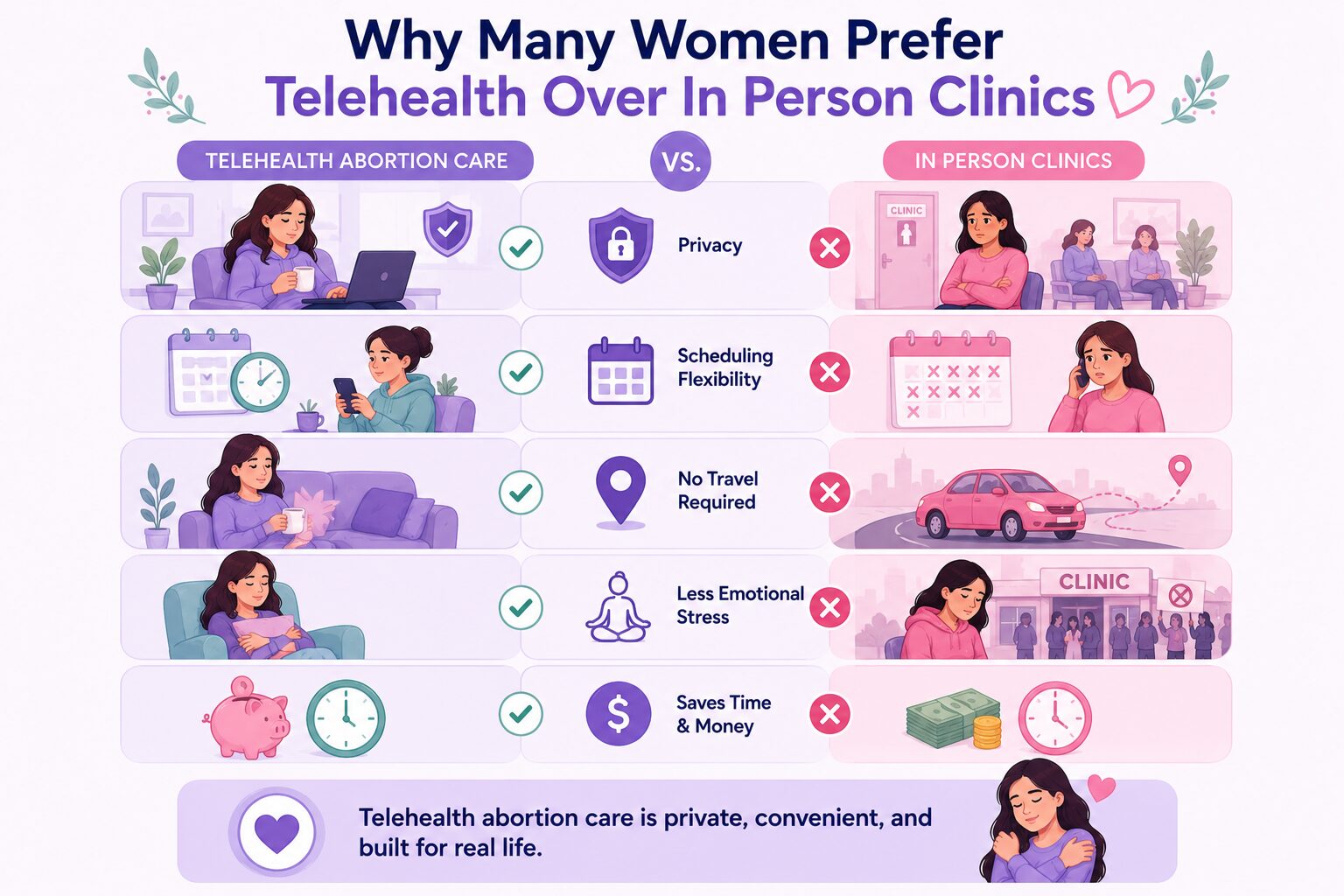
Why Many Women Prefer Telehealth Over In Person Clinics
Understanding the growth of virtual abortion care requires understanding what is wrong or simply inconvenient about in person clinics for many patients. The reasons women choose telehealth are not abstract. They are specific, practical, and deeply personal.
Privacy That Clinics Cannot Always Provide
Walking into an abortion clinic requires a level of public exposure that telehealth eliminates entirely. For women in small towns, tight knit communities, or situations where someone might recognize them, even the act of parking near a clinic carries risk. Protesters outside clinic entrances are a documented reality in many locations. The waiting room itself is shared with strangers, with paper forms to fill out strips away privacy at multiple points.
Telehealth removes all of this. A virtual consultation happens from a private space of your choosing, on a device you control, at a time that works for you. No waiting room. No parking lot. No visible building to enter. The privacy advantage is not marginal for many women, it is the deciding factor.
Our confidential abortion services and how to keep your abortion private guides cover the full privacy picture for anyone navigating this concern.
Scheduling Flexibility That Fits Real Life
Clinic appointments require availability during specific hours, often on weekdays, often with significant wait times before the appointment itself. For women who work hourly jobs without paid time off, who have children without backup childcare, or who cannot explain a full day’s absence to a partner or family member, that scheduling requirement is a genuine barrier.
Telehealth consultations can happen in the evening, on a lunch break, or on a weekend. They take 20 to 40 minutes rather than a full day. They require no travel time. For working women and parents which is to say, the majority of women seeking abortion care this flexibility is not a nice to have. It is essential.
Reduced Emotional Stress
The emotional experience of walking into a clinic under current conditions in many parts of the country is not neutral. Protesters, security screenings, crowded waiting rooms, and the logistical burden of getting there all add stress to an already significant healthcare experience. Multiple studies have documented that patient anxiety is higher in clinic settings than in home based telehealth settings for comparable procedures.
Telehealth reduces that stress load significantly. Being in a familiar, comfortable environment, your own home, your own space during a medical procedure changes the emotional experience in ways that matter. Our abortion pain management guide covers how environment and anxiety both affect physical pain perception during medication abortion, which is directly relevant here.
How Telehealth Abortion Care Actually Works
For anyone who has not used virtual abortion care, the process is more straightforward than many expect and significantly more medically thorough than the “ordering pills online” framing that sometimes appears in news coverage.
The Virtual Consultation Process
The process begins with a secure online health screening form covering your last menstrual period, medical history, current medications, and pregnancy details. A licensed clinician reviews this and meets with you through an encrypted video call or secure messaging platform not an automated chatbot, but an actual licensed medical professional.
During the consultation, the clinician confirms your eligibility for medication abortion, answers your questions, addresses any medical concerns, and issues a prescription if you qualify. The standard eligibility window is up to 10 to 12 weeks of pregnancy. The entire consultation takes 20 to 40 minutes, after which your prescription is processed and medications are shipped.
Our abortion pill service page covers exactly what is included in a complete telehealth medication abortion experience from first consultation through follow up care.
How Medications Are Prescribed and Delivered
The standard medication abortion regimen involves two medications. Mifepristone is taken first, blocking progesterone and stopping the pregnancy from developing. Misoprostol is taken 24 to 48 hours later, causing the uterus to contract and expel the pregnancy tissue. This combination has a 95%+ success rate when used correctly and is supported by the FDA, WHO, and American College of Obstetricians and Gynecologists.
Medications are shipped in plain, discreet packaging with no identifying information on the outside. Standard delivery takes three to five business days; expedited options are typically available. Our full guide on how to take mifepristone and misoprostol together walks through the complete process step by step.
What Follow Up Care Looks Like
Legitimate telehealth providers do not disappear after the prescription is sent. Clinical support is available throughout the process by secure message or phone. A follow up pregnancy test at three to four weeks confirms the abortion is complete. If anything feels wrong at any point, the clinical team is reachable. This is what distinguishes reputable telehealth abortion care from unverified online sources; it is a complete medical experience, not a transaction. Our before, during and after care guide covers every stage in detail.
Why Clinics Are Struggling to Keep Up
The growth of telehealth abortion care is not happening in isolation. It is happening alongside significant challenges facing physical abortion clinics, challenges that existed before Dobbs and have intensified since.
Clinic Closures and Geographic Healthcare Deserts
Since the Dobbs decision, more than 100 abortion clinics have closed across the United States. In some states, every clinic has closed. The geographic concentration of remaining clinics in urban centers has created healthcare deserts in large regions where the nearest abortion provider is hours away.
This is not just a problem for patients in restricted states. Even in states where abortion is fully legal, rural patients may face significant travel burdens to reach the nearest clinic. When the alternative is a 20 minute telehealth consultation from home, the choice becomes straightforward for anyone who qualifies for medication abortion.
Long Wait Times and Appointment Shortages
Clinics that remain open in protected states are experiencing significantly increased demand as patients travel from restricted states for care. Wait times have extended in many locations. Appointment availability has tightened. For a time sensitive medical situation medication abortion is most effective earlier in pregnancy waiting weeks for a clinic appointment is not a neutral inconvenience. It is a medical risk.
Telehealth providers can typically schedule consultations within days, sometimes same day. For patients managing a time sensitive situation, that difference matters enormously.
Staffing and Operational Challenges
Running an abortion clinic under current political conditions requires specialized staffing, security infrastructure, and legal risk management that creates real operational costs and challenges. Many providers have left the field entirely due to legal exposure in restricted states. The staffing pipeline for clinic based abortion care has been constrained in ways that telehealth which allows licensed providers to practice from protected states partially bypasses.
The Biggest Advantages of Virtual Abortion Care
When patients and clinicians compare telehealth abortion to in clinic care, several advantages emerge consistently.
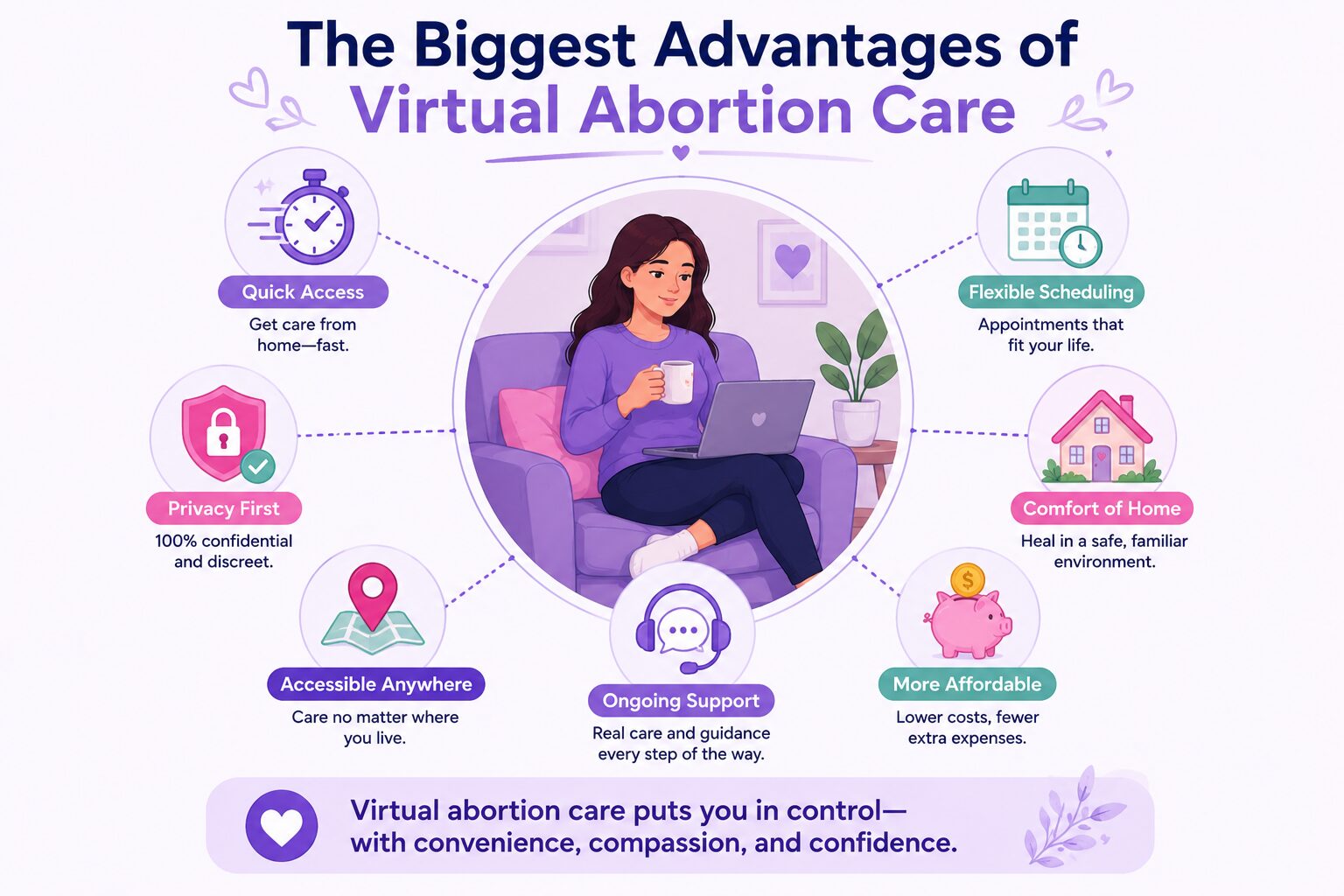
Speed of access: Virtual consultations can happen within days of deciding to seek care. No scheduling wait, no travel time, no appointment backlog.
Cost: Telehealth medication abortion typically costs $150 to $500 often less than in clinic procedures when travel costs, lodging, and time off work are factored in. Our abortion pill cost guide breaks down what to expect and how financial assistance works.
Privacy: Every layer of the telehealth process is more private than the clinic equivalent from consultation to prescription to delivery.
Accessibility for rural patients: Women in rural areas who previously had no realistic local option can now access care from home. This represents a meaningful expansion of reproductive healthcare equity.
Comfort: Being at home during the most physically intense part of medication abortion the cramping and bleeding that follows misoprostol is genuinely more comfortable than recovering in a clinical setting. You have your own bed, your own bathroom, your own support system around you.
Is Telehealth Abortion Care Safe and Legitimate?
The safety question comes up consistently and the answer, backed by extensive research, is straightforwardly yes.
Medication abortion has one of the strongest safety profiles in reproductive medicine. The FDA, WHO, and ACOG all recognize it as safe and effective. Serious complications occur in less than 1% of cases. The telehealth delivery model does not change the medication’s safety profile; it changes how the prescription is issued, not what the medication does.
What matters for safety is using a legitimate provider. Legitimate telehealth abortion providers employ licensed clinicians, operate in states with legal protections, use HIPAA compliant platforms, offer complete aftercare support, and are transparent about their credentials and data practices. Reputable providers also offer comprehensive reproductive health services beyond abortion including STI and STD testing which is a strong signal that they operate as a full spectrum healthcare practice rather than a single service operation.
Red flags to avoid: providers with no clinician involvement, no verifiable credentials, pressure to pay via untraceable methods only, and no aftercare support. Our guide on how to get safe, verified abortion pills online provides a complete checklist for evaluating any provider.
For women who need or prefer in person care, our in-clinic abortion services remain fully available. Surgical abortion in a clinical setting with complete medical support is still the right choice for many patients, particularly those further along in pregnancy.
What the Future of Abortion Access Looks Like
The trajectory is clear. Telehealth abortion care is not a temporary response to a temporary situation. It is a permanent feature of reproductive healthcare, one that serves patients better in multiple dimensions than the traditional clinic model did for millions of women.
The legal landscape will continue evolving. Federal challenges to mifepristone access and telehealth prescribing authority are ongoing. Some restrictions will tighten; others will be blocked by courts. But the patient preference for virtual care driven by privacy, convenience, accessibility, and comfort is not going away regardless of the legal environment.
What is emerging is a two track system: telehealth for patients who qualify for and prefer medication abortion at home, and in clinic care for patients who need surgical abortion or who are beyond the gestational window for medication abortion. Both have a permanent and important role. Beyond abortion itself, telehealth is also reshaping how women access ongoing reproductive care from birth control and contraceptive services to follow up care creating a more complete and continuous model of reproductive healthcare than the clinic visit alone ever provided.
Staying informed about your state’s current legal landscape matters more than ever. Our guides on abortion laws in Illinois, abortion shield laws, and telehealth abortion legality provide current, state specific information to help you understand what is available to you right now.
Ready to Access Care?
Serenity Choice Health offers confidential, compassionate abortion care through both telehealth and in clinic services. Our licensed providers are here to help you understand your options and access care safely wherever you are, whatever your situation.
Explore our abortion pill service for at home medication abortion, learn about our telehealth abortion care, or schedule a confidential consultation to speak with our team directly.
Frequently Asked Questions
Why are telehealth abortions becoming more popular?
Telehealth abortion combines privacy, convenience, speed, and accessibility in ways that physical clinics cannot match for most patients. The ability to consult with a licensed provider from home, receive medications by discreet mail, and manage recovery in a comfortable environment represents a genuine improvement over the clinic experience for millions of women.
Is telehealth abortion safer than a clinic visit?
Medication abortion whether accessed via telehealth or clinic has the same strong safety profile. The FDA, WHO, and ACOG all recognize it as safe and effective with a serious complication rate of under 1%. Safety depends on using a legitimate, licensed provider not on whether the consultation happened virtually or in person.
Can abortion pills really be prescribed online?
Licensed clinicians in states with telehealth abortion protections can legally prescribe mifepristone and misoprostol via virtual consultation. This has been FDA-permitted since 2021 and is standard practice for certified providers.
Why do many women prefer virtual abortion care over clinics?
The most commonly cited reasons are privacy, scheduling flexibility, elimination of travel burden, reduced emotional stress, and the comfort of being at home during recovery. For rural patients, telehealth may also represent the only realistic option given the distance to the nearest clinic.
Do telehealth abortions cost less than clinic visits?
Typically yes when total costs are compared. Telehealth medication abortion costs $150 to $500 through most US providers. In-clinic procedures often cost more, and when travel expenses, lodging, time off work, and childcare are factored in, the total cost difference can be significant.
Can I access telehealth abortion care in a restrictive state?
In many cases, yes through providers operating in shield law states who can legally prescribe and mail medications across state lines. The specific options available depend on your state’s current laws. Contact our team for a confidential conversation about what is available in your specific situation.
For complete guidance, read our medication abortion explained guide, our abortion safety and medical facts resource, and our full abortion procedures guide.

Dr. James Carter is a board-certified physician and lead clinician at Serenity Choice Health, specializing in reproductive health access and medication abortion protocols. With over 20+ years of experience, he combines clinical expertise with patient-centered care to ensure safe, compassionate, and confidential reproductive healthcare.