

Since the Supreme Court overturned Roe v. Wade in June 2022, one question has quietly become one of the most searched in reproductive healthcare: Can I legally leave my state to get an abortion somewhere else?
The short answer is yes interstate travel for abortion care is legal under current federal law. But the longer answer involves a patchwork of state laws, ongoing legal battles, and real-world complexities that every person navigating this question deserves to understand clearly.
This article breaks down what the law actually says, what the realistic risks are, who can help you travel, and how to protect your privacy along the way. If you’re weighing your options, you deserve accurate information not fear-driven headlines or political spin.
Is It Legal to Travel Across State Lines for an Abortion?
Yes. Under current federal law, traveling from one state to another to receive abortion care is legal.
The right to interstate travel is considered a fundamental constitutional right, rooted in multiple provisions of the U.S. Constitution including the Privileges and Immunities Clause, the Commerce Clause, and protections recognized under the 14th Amendment. Courts have consistently upheld that Americans have the right to move freely between states, including for the purpose of receiving medical care.
This means that even if you live in a state where abortion is banned or heavily restricted, you retain the legal right to travel to a state where abortion is legal and receive care there. The abortion itself would be governed by the laws of the state where it takes place, not the state you came from.
This is not a loophole or a gray area. It is a well-established legal principle. The question is not really whether you can travel, it’s whether your home state can reach across its own borders and punish you for what you did somewhere else. And on that question, the legal landscape is more complicated.
Can Your Home State Stop You From Traveling for an Abortion?
This is where real anxiety lives and it deserves a careful answer.
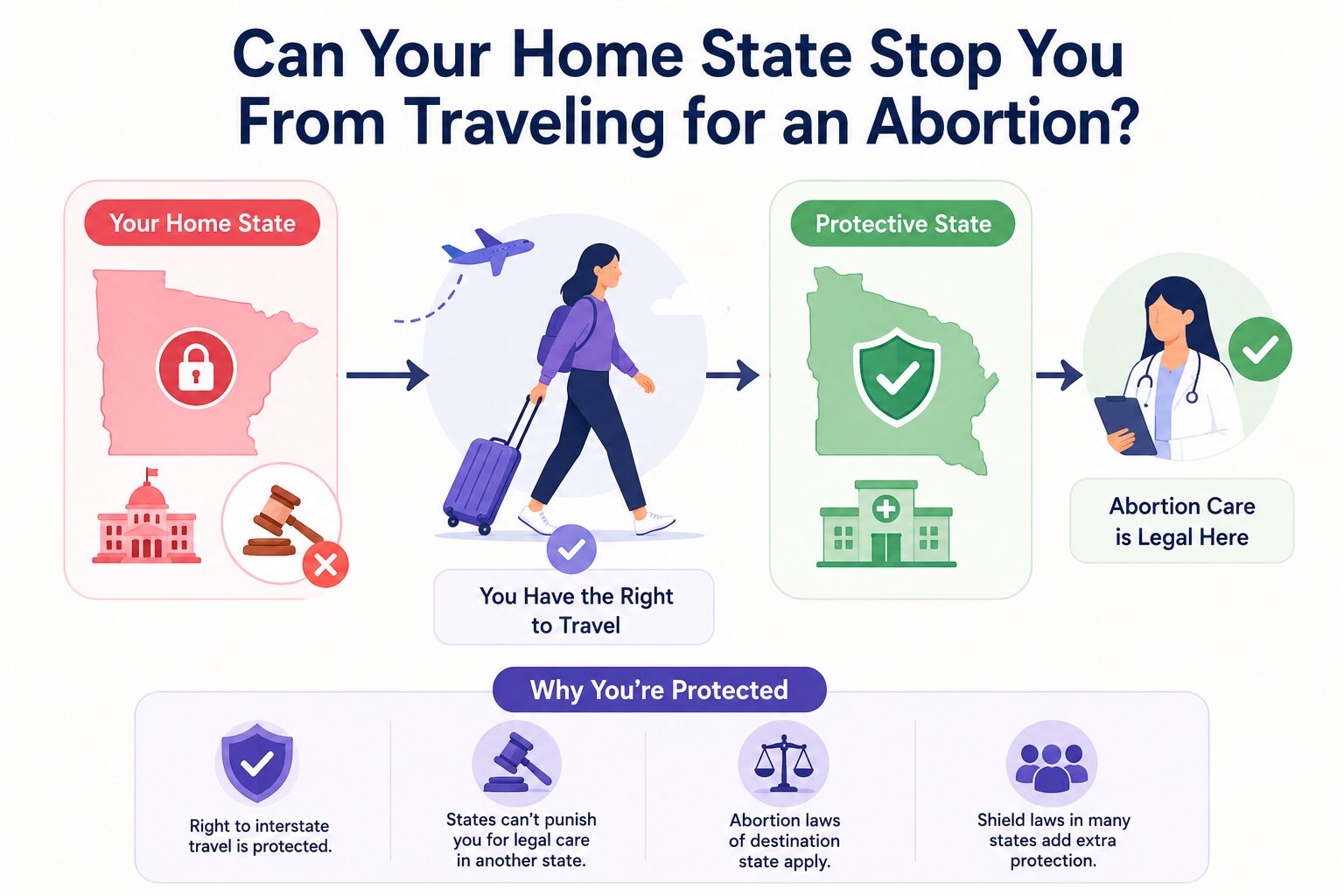
Several states have explored or proposed legislation that would attempt to restrict residents from leaving to obtain abortion care, or would create civil liability for those who help someone do so. As of 2026, no state has successfully enacted and enforced a law that directly criminalizes a resident for traveling to another state for an abortion. Courts have generally been skeptical of such laws, viewing them as an unconstitutional overreach of state authority.
The constitutional right to travel between states is deeply embedded in American legal tradition. State laws, with very limited exceptions, cannot reach beyond a state’s own borders to regulate conduct that occurs legally in another state. If you travel to Illinois, for example, and receive abortion care there legally, Illinois law not your home state’s law governs what happened.
That said, some states have passed laws creating civil liability meaning private citizens (not the government) can sue someone for “aiding or abetting” an abortion. Texas’s SB 8 was an early and prominent example of this model. Whether these civil liability provisions can be used against someone for helping a person travel out of state remains legally contested and has not been definitively resolved.
The honest answer: the legal risk of traveling itself is currently very low. The risk of helping someone travel, in certain states, is less clearly defined.
Can You Be Arrested for Crossing State Lines to Get an Abortion?
For most people, in most circumstances, the realistic answer is no.
No state currently has an enforceable law that makes it a crime for a person to leave the state and obtain an abortion legally elsewhere. Criminal prosecution for interstate abortion travel would face steep constitutional hurdles and no such prosecution has been successfully carried out as of this writing.
What has happened is that some state attorneys general have made public statements suggesting they might pursue such cases, which has created fear and confusion often intentionally. The gap between political rhetoric and what courts would actually permit is significant.
Legal experts across the political spectrum largely agree that criminalizing interstate travel for medical care would face serious constitutional challenges and would likely not survive judicial review. That doesn’t mean no one will try. But it does mean that, right now, traveling to a state where abortion is legal to receive care is not something that should land you in criminal jeopardy.
If you are in a high-restriction state and have specific concerns about your situation, consulting with a reproductive rights attorney even briefly can give you clarity tailored to your exact circumstances.
What Are Abortion Shield Laws and How Do They Protect Travelers?
Abortion shield laws are one of the most important legal developments for people traveling across state lines for care and one of the least understood.
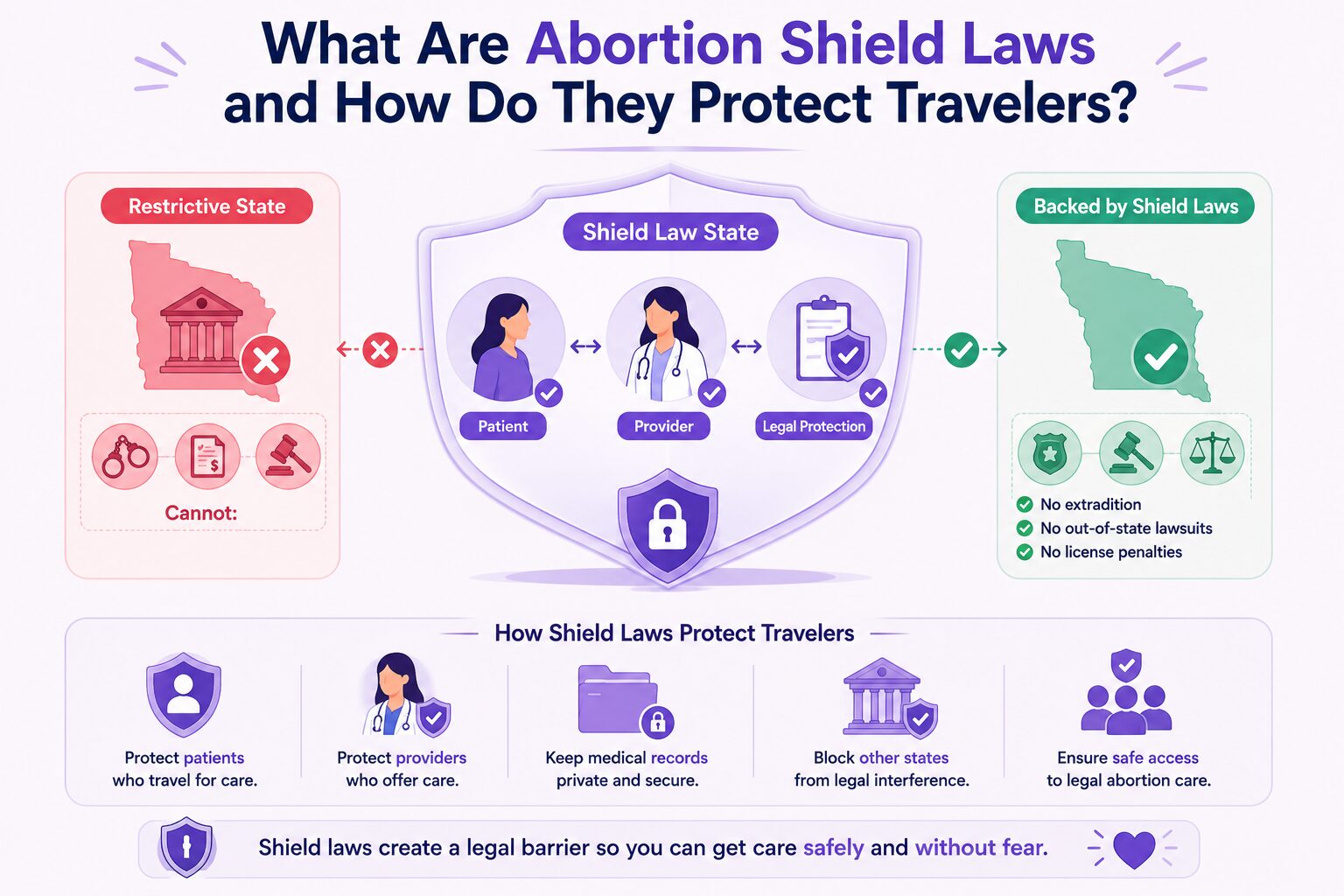
Shield laws are enacted by abortion-supportive states to protect their own healthcare providers and residents from legal consequences imposed by other states. In practical terms, they mean that a doctor in Illinois who provides abortion care to a patient from Texas cannot be extradited to Texas, sued in Texas courts under Texas law, or have their medical license revoked at Texas’s request.
Several states including California, New York, Illinois, Colorado, Washington, and others have passed shield legislation of varying strength. These laws create a meaningful legal firewall between providers in protective states and the legal reach of restrictive states.
For patients, shield laws provide indirect but important protection. They make it more viable for out-of-state providers to offer care without fear of cross-state legal exposure, which keeps those providers in business and accessible to travelers. They also signal that the state takes seriously its commitment to protecting people who come there for care.
Shield laws are not unlimited; they apply within the enacting state’s jurisdiction and have not been fully tested in federal court. But they represent a significant layer of legal protection in the current landscape.
Which States Currently Allow Out-of-State Abortion Patients?
Many states not only permit but actively welcome out-of-state abortion patients. These are states where abortion is legal, providers are licensed and operating, and in many cases state law explicitly protects both patients and providers from out-of-state legal interference.
States with strong current abortion access and legal protections include Illinois, New York, California, Colorado, Washington, New Mexico, New Jersey, Maryland, and several others. These states have invested in expanding provider capacity specifically because they anticipated an influx of patients from neighboring restrictive states after Dobbs.
Illinois in particular has become a significant destination for patients from surrounding states where abortion is banned or severely restricted. Illinois’s Reproductive Health Act explicitly protects the right to abortion, and the state has been described as a reproductive healthcare hub for the Midwest. If you’re in the region and exploring your options, understanding what Illinois offers is worth your time.
Most states with legal abortion do not require residency. You do not need to be a state resident to receive care there; you simply need to be present in the state when the procedure takes place. Some providers may have their own scheduling or logistical requirements for out-of-state patients, but residency is not typically a legal barrier. Many full-service reproductive health clinics also offer women’s primary care alongside abortion services, which can be useful if you need to address other health concerns during the same visit.
For a detailed breakdown of what getting an abortion in another state involves practically, including what to expect and how to prepare, that guide covers the specifics.
Can Friends, Family Members, or Partners Help You Travel?
This is one of the most emotionally charged questions in this space because for many people, the ability to have support during a difficult medical experience matters enormously.
Under federal law, there is no prohibition on a friend, family member, or partner driving you to another state to receive legal abortion care. Providing transportation for someone seeking legal medical care is not a federal crime.
The complexity arises again at the state level, specifically in states that have passed laws attempting to create civil liability for “aiding and abetting” an abortion. Some of these laws are broadly written and could theoretically be interpreted to include transportation assistance. Whether they could be enforced against someone for helping a person travel to another state where the abortion takes place legally is genuinely legally uncertain and has not been conclusively resolved in court.
What legal experts generally say: the risk to someone who simply drives a friend to a clinic in another state is low, but not entirely zero in certain specific state contexts. The risk increases for someone who actively helps arrange, fund, or coordinate abortions in a state where they’re illegal, as opposed to helping someone travel to where they’re legal.
Having someone accompany you for emotional support is something you absolutely should not have to forgo out of unfounded fear. If you’re concerned about a specific state’s law, connecting with a reproductive rights organization in your area can help you understand what the actual risk profile looks like.
Can Employers Legally Cover Abortion Travel Costs?
Yes and many do. Following the Dobbs decision, a significant number of major employers updated their healthcare benefits to include coverage for abortion-related travel expenses for employees who live in states where access is restricted.
These benefits are generally structured as healthcare expense reimbursements, often administered through Health Reimbursement Arrangements (HRAs) or travel stipends. The IRS has provided guidance indicating that abortion-related travel expenses can qualify as deductible medical expenses, which supports the legitimacy of employer coverage programs.
From a legal standpoint, employers in states where abortion is banned face some legal uncertainty about whether offering these benefits exposes them to liability under state law; this varies by state and is still being litigated in some jurisdictions. Most large national employers have determined the legal risk to be manageable relative to the employee benefit and have moved forward with coverage.
For employees: check your benefits documentation or speak confidentially with HR about what travel coverage your employer provides. Many people don’t know these benefits exist until they need them. Understanding what insurance may cover is also worth reviewing before your trip so you know what out-of-pocket costs to plan for.
What About Minors Traveling Across State Lines for an Abortion?
This is one of the most legally complicated areas in abortion travel law, and it varies significantly by state.
Many states require parental consent or parental notification before a minor can obtain an abortion. These requirements apply in the state where the abortion takes place meaning a minor traveling from a restrictive state to a permissive one will still be subject to whatever parental involvement laws exist in the destination state, not just their home state.
Some states have more permissive parental involvement laws requiring notification of only one parent, or having more accessible judicial bypass processes (a legal procedure that allows a minor to obtain court permission to proceed without parental involvement). This is one reason the destination state matters for minors specifically, not just whether abortion is legal there.
Minors retain the constitutional right to interstate travel. A parent or guardian accompanying a minor for abortion care faces the same legal landscape described above. The act of traveling is legal, but some states have attempted to create liability for facilitating a minor’s out-of-state abortion without the other parent’s consent.
If you are a minor or are helping a minor access abortion care across state lines, connecting with a reproductive rights legal helpline before traveling is strongly recommended. Organizations like the Repro Legal Helpline and Planned Parenthood’s legal resources can provide confidential guidance.
How to Protect Your Privacy When Traveling for Abortion Care
Privacy protection when traveling for abortion care deserves serious attention not because you’re doing anything illegal, but because digital records can be subpoenaed, shared, or accessed in ways that create real-world consequences.
Your phone is the biggest risk. Location data, search history, text messages, and app data can all potentially be accessed through legal processes. Before traveling, consider reviewing your digital privacy practices and taking concrete steps to minimize your exposure.
Practical steps that matter: use a private browser or a browser with strong privacy settings for all abortion-related searches, turn off location sharing in apps that don’t need it, use encrypted messaging apps for sensitive conversations, and be thoughtful about what you say in regular SMS texts or unencrypted email.
For payment privacy: paying with cash for travel-related expenses (gas, lodging, food) avoids creating a financial paper trail. Credit and debit card transactions are logged and can, in theory, be accessed through legal processes.
Medical privacy under HIPAA protects your health records; providers cannot share your medical information without your consent except in narrow circumstances. However, HIPAA protections have limits, and some states have attempted to create exceptions for abortion-related records. Understanding your full privacy rights before you travel is worth doing.
A comprehensive guide to keeping your abortion private covers the specific steps most relevant to protecting yourself in the current legal environment.
How Much Does Traveling for an Abortion Cost?
Traveling for abortion care involves costs beyond the procedure itself and for many people, those additional expenses are what make access genuinely out of reach.
Typical travel-related costs include transportation (gas, flights, or bus fare), lodging if an overnight stay is required, childcare for children left at home, and lost wages from missed work. Depending on how far you’re traveling and how many days you need, these costs can range from a couple hundred dollars to significantly more.
The cost of the abortion procedure itself varies by type and gestational age. Medication abortion is generally less expensive than procedural abortion. Illinois offers some of the more accessible pricing in the Midwest if you’re researching specific costs in the region, a breakdown of abortion costs in Illinois can help you plan realistically.
Financial assistance is available. Abortion funds are nonprofit organizations specifically designed to help cover procedure costs, travel, lodging, and related expenses for people who can’t afford them. Finding abortion financial aid programs in your region is a concrete first step if cost is a barrier. The National Abortion Federation Hotline and the Brigid Alliance are two national resources that specifically help with travel-related costs.
Some people also use a travel visit as an opportunity to take care of other reproductive health needs in one trip such as STI/STD testing or discussing birth control and contraceptive options with a provider. Consolidating care this way can reduce the number of trips and overall out-of-pocket costs over time.
Know Your Rights, Then Make Your Decision
The legal right to travel across state lines for abortion care is real and currently protected. Understanding that right and the practical landscape around it is what allows you to make decisions based on facts rather than fear.
If you’re exploring your options, confidential abortion services are available both in-person and remotely. You can schedule an appointment with a licensed provider, explore telehealth abortion care if that fits your situation, learn about the abortion pill as an option, or book in-clinic abortion services if you prefer in-person care.
Whatever your situation, you have more options than you may realize and you deserve care that is safe, legal, and centered around your needs.
Frequently Asked Questions
Is it legal to travel to another state for an abortion?
Yes. Interstate travel for abortion care is legal under federal law and protected by constitutional travel rights.
Can my state punish me for getting an abortion in another state?
No state has successfully enforced such a law. The legal consensus is that states cannot criminalize conduct that occurs legally in another state, though some states have explored civil liability approaches.
Can I be arrested for crossing state lines for abortion care?
No state currently has an enforceable law criminalizing a patient for traveling to receive legal abortion care elsewhere. Realistic prosecution risk is very low.
Can someone drive me to another state for an abortion?
Generally yes. Providing transportation to someone receiving legal medical care in another state is not a federal crime. Some state-level civil liability laws are broadly written but have not been enforced in this context.
Will my insurance cover abortion travel costs?
It depends on your plan and employer. Many large employers now offer travel reimbursement benefits. Review your benefits or speak with HR confidentially.
How can I protect my privacy when traveling for abortion care?
Use private browsing, encrypted messaging, cash payments where possible, and review your phone’s location-sharing settings before traveling.

Dr. James Carter is a board-certified physician and lead clinician at Serenity Choice Health, specializing in reproductive health access and medication abortion protocols. With over 20+ years of experience, he combines clinical expertise with patient-centered care to ensure safe, compassionate, and confidential reproductive healthcare.