
For millions of Americans, the abortion pill quietly became the most relied-upon form of reproductive healthcare in the years following the Supreme Court’s 2022 decision to overturn Roe v. Wade. No waiting rooms. No long drives. No appointments that required taking a full day off work. Just a private, at-home option that worked if you could access it.
But “if you could access it” has become the defining question of reproductive care in 2026. Whether you can get a medication abortion today depends less on medicine and more on geography, politics, and which legal protections happen to exist in your state.
This guide cuts through the noise. We’ll explain what actually changed after Roe, where medication abortion stands legally right now, how telehealth abortion works, and what real options exist for people in states with restrictions. No scare tactics, no political spin, just the information you need.
What Changed for Medication Abortion After Roe v. Wade
Before June 2022, federal constitutional protections meant that abortion access including medication abortion existed as a baseline right across all fifty states. After the Dobbs v. Jackson Women’s Health Organization ruling, that changed overnight. The question of abortion access was handed back to individual states, and the legal landscape fractured almost immediately.
In the months and years that followed, roughly half the states moved to restrict or ban abortion in various forms. Some enacted near-total bans. Others passed laws specifically targeting medication abortion attempting to restrict mifepristone prescriptions, criminalize telehealth consultations, or ban abortion pills from being mailed within their borders.
At the same time, something unexpected happened: medication abortion didn’t disappear. In fact, it became more central to reproductive healthcare than ever before. According to data tracked by reproductive health researchers, medication abortion now accounts for the majority of all abortions performed in the United States. The reasons are straightforward: it’s private, it can be done at home, it doesn’t require a surgical procedure, and telehealth made it genuinely accessible in ways that clinic-based care could not always match.
What Roe’s fall really did was split the country into two realities. In one set of states, access to the abortion pill became easier and more streamlined than it had ever been. In another set, it became legally fraught, medically risky to provide, and sometimes outright unavailable through conventional channels.
Is the Abortion Pill Still Legal in 2026?
The short answer: yes but it depends enormously on where you are.
Mifepristone, the first medication used in a two-drug abortion regimen (typically followed by misoprostol), remains FDA-approved at the federal level. The FDA’s approval has been legally challenged multiple times since 2022, but as of 2026, the drug remains available through certified prescribers under the FDA’s Risk Evaluation and Mitigation Strategy (REMS) program. Federal courts have repeatedly upheld the FDA’s authority over drug approvals, which means mifepristone is still legal to prescribe and dispense nationwide at the federal level.
State law, however, is a different story entirely.
States with strong abortion protections — including California, Illinois, New York, Colorado, Washington, and about a dozen others have explicitly protected medication abortion access. Many of these states have also passed shield laws, which are a particularly important development worth understanding.
Shield laws are state statutes that protect healthcare providers who prescribe or dispense abortion medication to patients located in other states. In plain terms: a doctor in Illinois can, under Illinois law, prescribe medication abortion to a patient located in Texas and Illinois law protects that doctor from being prosecuted by Texas authorities. The patient may still face risk depending on their own state’s laws, but the provider is shielded.
States with severe restrictions have taken a different path. Around a dozen states have near-total abortion bans that include medication abortion. Several have passed laws specifically targeting telehealth abortion consultations, attempting to require in-person visits before abortion medication can be prescribed. A handful have tried to ban abortion pills from being mailed to addresses within their borders.
The practical result is a patchwork that can be genuinely confusing. Someone in Georgia faces very different options than someone in Georgia who happens to be within driving distance of a clinic just over the North Carolina border. Laws also continue to change state legislatures keep acting, and courts keep ruling which means the specifics can shift month to month.
How Telehealth Abortion Works in 2026
If you’ve never looked into telehealth abortion before, the basic process is simpler than most people expect.
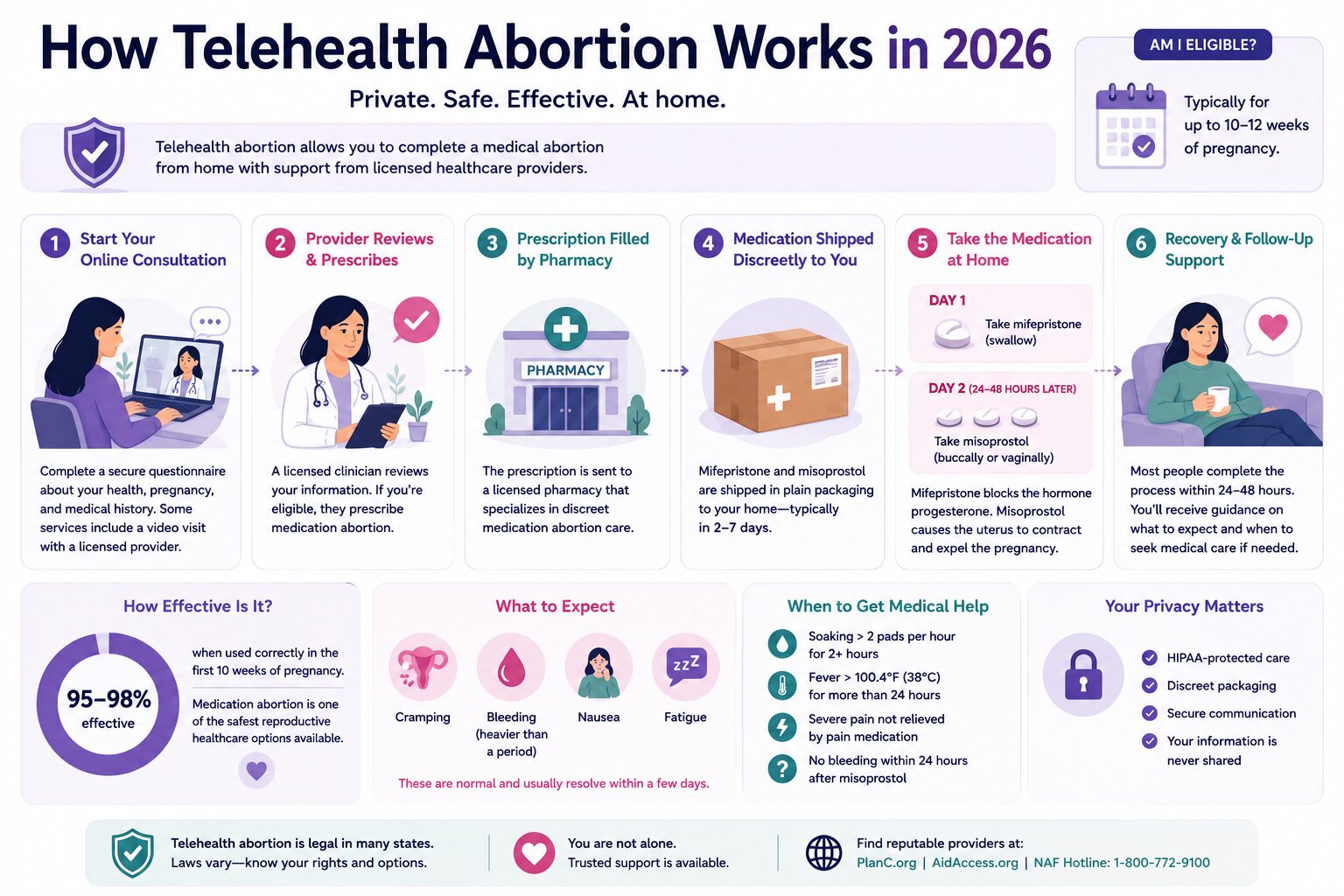
You start with an online consultation, typically a questionnaire covering your health history, last menstrual period, any symptoms that might indicate an ectopic pregnancy, and other relevant medical information. Some services conduct a video appointment; others work primarily through asynchronous messaging reviewed by a licensed clinician. Most require that you be under 10 to 12 weeks of pregnancy for medication abortion to be appropriate.
If the provider determines you’re a good candidate, they write a prescription for mifepristone and misoprostol, which is filled by a pharmacy and shipped to you directly. Depending on the service and your location, shipping can take anywhere from two days to about a week. Most established telehealth abortion providers use discreet packaging.
The medication itself is taken in two stages. Mifepristone is taken first, blocking the hormone progesterone needed to sustain the pregnancy. Misoprostol is taken 24 to 48 hours later, causing the uterus to contract and expel the pregnancy. The process is similar to an early miscarriage, and for most people at or under 10 weeks, it’s completed within a day or two at home.
Effectiveness is high. Studies consistently show medication abortion is around 95 to 98 percent effective when used correctly in early pregnancy.
What to look for in a legitimate provider: Established telehealth abortion services are staffed by licensed physicians or nurse practitioners. They conduct real medical screenings, not just checkboxes. They have protocols for managing complications (which are uncommon but do occur). They protect your personal and medical information by looking for HIPAA compliance statements and privacy policies that explicitly address reproductive health data, since this has become a particular concern given that some states have attempted to use digital records in abortion prosecutions.
Be cautious of websites that offer pills without any medical consultation at all, and especially wary of unvetted overseas pharmacies. Medical screening isn’t bureaucracy, it genuinely exists to catch situations, like ectopic pregnancies, where medication abortion would be dangerous. This is especially relevant for those in rural areas or areas where there is limited access to abortion service clinics.
Can Abortion Pills Be Mailed to Restricted States?
This is one of the most searched questions in reproductive healthcare right now, and the honest answer is: it’s complicated, and the risk profile is different for providers versus patients.
Due to shield laws in states like Massachusetts, Colorado, Washington, and others, providers operating from those states can legally (under their own state law) mail abortion medication to patients in states where abortion is restricted. This happens, and it’s been happening at an increasing scale since 2022.
The murkier question is what risk a patient takes by receiving those pills. Most legal experts note that the primary legal risk falls on providers, not patients — and shield laws are specifically designed to insulate providers from prosecution by out-of-state authorities. Most states with abortion bans have focused their enforcement efforts on providers and, in some cases, those who assist or facilitate. Patients themselves have faced prosecution in only rare, contested circumstances.
That said, digital privacy matters here. Data brokers, location history, search records, and payment information have all been discussed as potential sources of evidence in abortion-related investigations. Practical steps like using a browser in private mode, using a virtual private network (VPN), paying with a prepaid card, and not using a shared family plan for related calls or searches are worth considering if you have concerns about privacy.
Common myths worth addressing: Receiving abortion pills online through the mail is not automatically a federal crime. The Comstock Act, a 19th-century law that anti-abortion advocates have argued could be used to criminalize mailed abortion medication, has not been successfully applied to block current telehealth abortion operations as of 2026, though legal battles around it continue. Aid Access, Plan C, and similar organizations provide regularly updated guidance on mailing policies and risks by state.
States With the Most and Least Abortion Access in 2026
Rather than an exhaustive list, which would be outdated within months, here’s a working framework for understanding where things stand.
States with broad access: California, Colorado, Illinois, New York, New Jersey, Massachusetts, Washington, Oregon, Nevada, Vermont, Connecticut, Maryland, and most of New England protect medication abortion access and have passed shield laws protecting providers. Telehealth abortion is available and legal in these states, often through multiple providers.
States with near-total bans: Texas, Alabama, Arkansas, Idaho, Kentucky, Louisiana, Mississippi, Missouri, Oklahoma, South Dakota, Tennessee, West Virginia, and Wisconsin (with some ongoing legal proceedings) have bans that affect or entirely restrict medication abortion through conventional channels. Note that laws in several of these states are subject to ongoing litigation.
States in the middle: Florida, Arizona, Georgia, North Carolina, Iowa, Nebraska, and several others have restrictions but not outright bans as of this writing. Some have gestational limits (typically 6 or 12 weeks). Some restrict telehealth specifically but allow in-person prescriptions. The situation in these states is particularly fluid.
If you need current state-specific information, the Guttmacher Institute, Planned Parenthood’s website, and AbortionFinder.org maintain regularly updated state-by-state guides.
What Options Exist If Your State Restricts Abortion?
If you’re in a state with restrictions, you’re not out of options but understanding what’s available takes a bit of research.
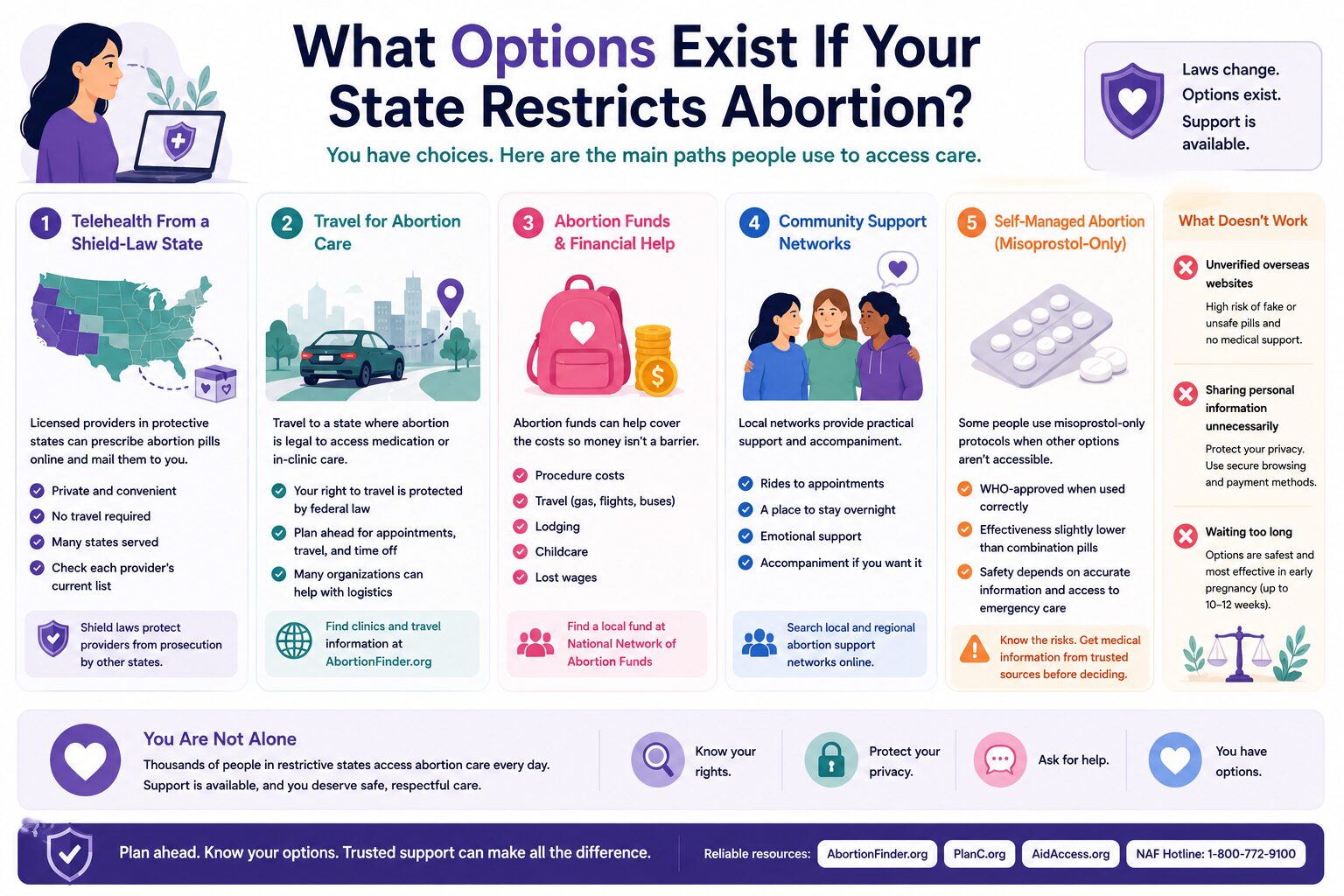
Telehealth from a shield-law state. Services like Aid Access, Hey Jane, Just the Pill, and others operate from states with legal protections and mail to patients in many restricted states. Availability varies; check each provider’s current list of states served.
Traveling for care. Many people in restrictive states travel for an abortion to the nearest accessible state for medication or procedural abortion. Organizations like the National Abortion Federation and Brigid Alliance provide funding and logistical support for travel, including help with transportation and lodging costs. You can also learn more about getting an abortion in another state before making any plans.
Abortion funds. The National Network of Abortion Funds connects patients with local funds that can cover procedure costs, travel, childcare, and lost wages. This is especially important given that abortion care, even through telehealth, carries costs that can be prohibitive for lower-income patients.
Community support. Networks like Midwest Access Coalition and others operate in specific regions to connect people with practical support rides, places to stay overnight, accompaniment. These networks have grown substantially since 2022.
What doesn’t work: attempting to obtain medication from unverified overseas websites without any medical screening. Beyond the legal uncertainty, the medical risk of taking abortion medication without proper assessment, particularly the risk of an undetected ectopic pregnancy, which can be life-threatening is real.
Safety, Effectiveness, and Privacy: What Patients Need to Know
Medication abortion is one of the most studied pharmaceutical regimens in reproductive medicine. The evidence base accumulated over decades of use in the U.S. and internationally is clear: when used as directed in appropriate candidates at early gestational ages, it is safe and highly effective.
Common side effects include cramping, bleeding, nausea, and fatigue, essentially the experience of an early miscarriage, because physiologically that’s what’s happening. Most people manage at home without complications.
Warning signs that warrant medical attention include soaking more than two thick pads per hour for two consecutive hours, fever lasting more than 24 hours, severe abdominal pain not relieved by standard pain medication, or no bleeding within 24 hours of taking misoprostol. These complications are uncommon but real, and having a plan for where to seek care if needed is a practical step worth taking in advance.
On digital privacy: this has become a genuine concern since 2022. Period-tracking app data, location services, search history, and even medical records have been discussed in the context of abortion-related investigations. Pragmatic steps include using DuckDuckGo or private browsing for abortion-related searches, checking privacy settings on health apps, and being aware that messages on shared accounts may not be private.
What Comes Next for Medication Abortion Access
The landscape in 2026 is not settled, and anyone honest will tell you that. Several federal court cases touching on mifepristone’s FDA approval, the scope of state abortion bans, and interstate prescribing authority are working their way through the legal system. Telehealth abortion policy continues to be a legislative battleground in multiple states. The FDA’s regulatory authority over mifepristone remains a point of ongoing political contest.
What’s clearly true is that medication abortion has become the central front in the broader fight over reproductive access. It’s private, it’s accessible, it works early in pregnancy when most abortions occur, and it doesn’t require physical infrastructure the way clinic-based care does. That combination makes it both the most accessible option for millions of people and the most politically contested.
For patients navigating this in real time: stay current, use reliable sources, and know that organizations specifically built to help people access care regardless of where they live exist and are actively operating. If you’re ready to take the next step, schedule an appointment with Serenity Choice Health to discuss your options with a trusted care team.
Frequently Asked Questions
Can you still get abortion pills online in 2026?
Yes, in many states. Telehealth providers operating from shield-law states serve patients in most of the country, though availability varies by state. Learn more about how to buy abortion pills online safely and legally.
Which states allow mailed abortion pills?
States with shield laws including California, Illinois, Colorado, Massachusetts, Washington, and others permit providers to mail medication to patients in other states. Whether receiving those pills carries legal risk for the patient depends on your state’s specific laws.
How much does telehealth abortion cost?
Costs range widely from around $150 to $500 or more depending on the provider and whether insurance covers it. Many providers offer sliding scale fees, and abortion funds can help with costs for those who qualify.
What is a shield law?
A state statute that protects healthcare providers from prosecution by other states for providing abortion care, including telehealth prescriptions, to patients located outside the shield-law state.
Is the abortion pill safe?
Yes, with appropriate screening. Mifepristone and misoprostol have a long safety record. Serious complications are uncommon. The importance of medical screening primarily to rule out ectopic pregnancy is real, which is why reputable telehealth providers conduct genuine medical reviews before prescribing.

Dr. James Carter is a board-certified physician and lead clinician at Serenity Choice Health, specializing in reproductive health access and medication abortion protocols. With over 20+ years of experience, he combines clinical expertise with patient-centered care to ensure safe, compassionate, and confidential reproductive healthcare.