

Medication abortion uses a two-drug regimen (mifepristone followed by misoprostol) to terminate pregnancy up to 11 weeks of gestation. The current standard of care involves 200mg mifepristone followed by 800mcg buccal misoprostol 24-48 hours later, which is verified to be 95-98% effective with a major complication rate of less than 0.4% according to FDA data.
What Is the Abortion Pill and How Does It Work?
The abortion pill is a medication-based method that uses two different medicines mifepristone and misoprostol taken in sequence to end an early pregnancy up to 11 weeks (77 days) from the first day of your last menstrual period. Mifepristone works by blocking progesterone, the hormone necessary for pregnancy continuation, causing the uterine lining to break down and stopping embryonic development. Misoprostol, taken 24-48 hours later, causes the uterus to contract and expel the pregnancy tissue through the vagina, similar to a miscarriage. This two-step protocol has been the FDA-approved standard since 2000 and represents the most studied method of early pregnancy termination, with over 5 million uses in the United States alone and decades of safety data from countries worldwide.
The medication abortion process is distinct from emergency contraception (Plan B or ella), which prevents pregnancy before it occurs, whereas the abortion pill terminates an existing pregnancy. It is also different from surgical abortion procedures, which physically remove pregnancy tissue from the uterus using suction or instruments. Medication abortion allows the process to occur at home over several hours to days, giving patients privacy and control over their environment during the abortion. The combination of mifepristone and misoprostol is significantly more effective than using misoprostol alone (95-98% vs. 85% success rate), which is why the two-drug regimen is the clinical standard of care in the United States and most developed countries.
How Effective Is the Abortion Pill at Different Weeks of Pregnancy?
The abortion pill is highly effective, with success rates ranging from 93-98% depending on gestational age and the specific protocol used. Research published in the New England Journal of Medicine demonstrates that effectiveness is highest in very early pregnancy (up to 8 weeks) at approximately 98%, decreases slightly to 96-97% between 8-9 weeks, and ranges from 93-95% at 9-11 weeks of gestation. These success rates refer to complete abortion without need for surgical intervention, though even in cases requiring follow-up surgical evacuation, serious complications remain exceedingly rare. The World Health Organization recognizes medication abortion as an essential reproductive health intervention with a safety profile superior to many common over-the-counter medications and comparable to the natural miscarriage rate.
| Gestational Age | Effectiveness Rate | Success Definition |
|---|---|---|
| Up to 8 weeks | 98% | Complete abortion without surgical follow-up |
| 8-9 weeks | 96-97% | Complete abortion without surgical follow-up |
| 9-10 weeks | 95-96% | Complete abortion without surgical follow-up |
| 10-11 weeks | 93-95% | Complete abortion without surgical follow-up |
The 2-5% of cases that require follow-up care typically involve incomplete abortion (retained tissue requiring removal) rather than ongoing pregnancy. Factors that may affect effectiveness include accurate gestational dating (which is why ultrasound confirmation is important), adherence to the medication protocol (taking misoprostol as directed 24-48 hours after mifepristone), and individual anatomical or hormonal variations. Some studies suggest that body mass index (BMI) does not significantly affect medication abortion effectiveness, contrary to earlier concerns, though research continues to evaluate optimal dosing across different patient populations.
For comprehensive effectiveness data, see our guide on abortion pill effectiveness chart.
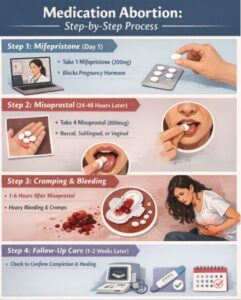
What Is the Step-by-Step Process for Taking the Abortion Pill?
The medication abortion process follows a specific protocol designed to maximize effectiveness while minimizing complications and side effects.
Step 1: Clinical Appointment and Mifepristone (Day 1)
You attend an in-person or telemedicine appointment where a healthcare provider confirms pregnancy, determines gestational age via ultrasound or medical history, reviews your health history to ensure medication abortion is appropriate, provides counseling about the process and alternatives, and dispenses the medications. You take mifepristone (one 200mg tablet) either at the clinic or at home shortly after the appointment. Mifepristone blocks progesterone receptors, preventing the pregnancy from continuing to develop. Most people experience minimal symptoms after taking mifepristone some light spotting or mild cramping, but many feel completely normal. This medication begins the abortion process but does not complete it; misoprostol must be taken 24-48 hours later for the abortion to occur.
Step 2: Misoprostol at Home (24-48 Hours Later)
Between 24-48 hours after taking mifepristone, you take misoprostol (typically four 200mcg tablets, total 800mcg) using one of three routes: buccal (placing tablets between gum and cheek for 30 minutes then swallowing what remains), sublingual (placing tablets under tongue for 30 minutes), or vaginal (inserting tablets deep into vagina). Buccal administration is most commonly recommended because it balances effectiveness with tolerability, causing fewer gastrointestinal side effects than sublingual while being equally effective. You should be in a comfortable, private location where you can rest for 6-8 hours after taking misoprostol, with access to a bathroom, pain medication, heating pad, maxi pads, and a support person if desired.
For detailed instructions, see how to take mifepristone and misoprostol together.
Step 3: Cramping and Bleeding (1-6 Hours After Misoprostol)
Cramping typically begins 1-4 hours after taking misoprostol, though some people experience symptoms within 30 minutes while others don’t feel anything for 6+ hours. The cramping intensifies as your uterus contracts to expel the pregnancy, with peak pain occurring when you’re passing the pregnancy tissue (usually 3-6 hours after taking misoprostol). You’ll experience heavy bleeding with blood clots ranging from grape-sized to lemon-sized or larger, along with visible pregnancy tissue that appears white, gray, or pink. The heaviest bleeding and strongest cramping last 4-6 hours for most people, then gradually decrease in intensity though lighter bleeding continues for 1-4 weeks. Pain management during this phase includes ibuprofen 800mg every 6 hours (most effective for cramping), acetaminophen, heating pads, rest, and relaxation techniques.
For pain management strategies, see abortion pain management.
Step 4: Follow-Up Care (1-2 Weeks Later)
Follow-up is essential to confirm the abortion was complete and that you’re healing normally. This can be accomplished through a clinic visit with ultrasound, a telemedicine appointment with home pregnancy test, or self-assessment using a urine pregnancy test 3-4 weeks after taking mifepristone (a negative test confirms success). At Serenity Choice Health, we provide 24/7 nurse hotline access during the medication abortion process so patients can call with questions or concerns at any time.
See how to know if abortion pill worked for verification methods.
What Are the Common Side Effects of Medication Abortion?
Side effects from medication abortion are expected and normal as your body responds to the medications and expels the pregnancy.
Expected Side Effects (Experienced by Most People):
- Heavy bleeding with large blood clots for 4-6 hours, then moderate bleeding for several days
- Strong cramping similar to severe menstrual cramps or early labor contractions
- Nausea (50-70% of people)
- Chills and feeling cold, often with shaking (70-80% of people)
- Diarrhea (30-40% of people)
- Vomiting (20-30% of people)
- Headache
- Dizziness
- Fatigue
- Low-grade fever up to 100.4°F (38°C)
These side effects are primarily caused by misoprostol and typically resolve within 6-12 hours after taking it. The chills can be particularly dramatic many people describe violent shaking and needing multiple blankets but this is a normal prostaglandin response and doesn’t indicate infection or complication. Ongoing light to moderate bleeding for 1-4 weeks after medication abortion is also expected and normal as your uterus completes healing.
When to Seek Medical Attention (Rare but Serious):
- Soaking through 2 or more maxi pads per hour for 2+ consecutive hours (possible hemorrhage)
- Fever of 100.4°F (38°C) or higher lasting more than 24 hours (possible infection)
- Severe abdominal pain that doesn’t improve with pain medication or gets progressively worse
- Foul-smelling vaginal discharge distinct from normal blood odor (possible infection)
- No bleeding within 24 hours after taking misoprostol (medication may not have worked)
- Continued or worsening pregnancy symptoms one week after taking medications
The serious complication rate for medication abortion is extremely low less than 0.4% according to comprehensive FDA safety reviews. When complications do occur, they’re almost always treatable with antibiotics (for infection) or surgical evacuation (for retained tissue or hemorrhage). Death from medication abortion is extraordinarily rare, occurring in approximately 0.00064% of cases, which is significantly lower than the maternal mortality rate from continuing pregnancy to term.
Clinical Perspective
In our practice at Serenity Choice Health serving patients from Chicago’s south suburbs and northwest Indiana communities including Homewood, Tinley Park, Park Forest, Munster, and Dyer, we’ve observed that patients who take ibuprofen 800mg immediately when taking misoprostol before cramping starts report 30-40% better pain control than those who wait until cramping is already severe. We also find that patients who prepare their environment in advance (heating pad ready, comfortable clothes, entertainment available, support person present) feel more confident and less anxious throughout the process. The most common question we receive on our 24/7 hotline is “How do I know if I passed the pregnancy?” and we reassure patients that the abortion is usually complete even if they didn’t see identifiable tissue, which is why follow-up confirmation is so important.
Is Medication Abortion Safe for Everyone?
Medication abortion is extremely safe for the vast majority of people seeking early pregnancy termination, but certain medical conditions require alternative approaches. You can safely have medication abortion if you are less than 11 weeks pregnant (77 days from first day of last menstrual period), in generally good health, able to access emergency medical care if needed, and willing to have alternative options if medications don’t work completely. Most chronic health conditions including diabetes, hypertension, depression, anxiety, and obesity do not prevent medication abortion, though your provider will review your specific medical history.
Medical conditions that may prevent medication abortion include:
- Chronic adrenal failure or long-term corticosteroid therapy
- Bleeding disorders or current anticoagulant use
- Inherited porphyrias
- Allergy to mifepristone or misoprostol
- Confirmed or suspected ectopic pregnancy (pregnancy outside the uterus)
- IUD currently in place (must be removed first)
- Uncontrolled severe asthma
Additionally, medication abortion cannot be used if you cannot access emergency medical care within 1-2 hours, if you don’t have a safe, private place to complete the abortion, or if you are unable to pursue alternative options if medications fail. Your healthcare provider will review your complete medical history, current medications, and individual circumstances to determine if medication abortion is appropriate for your specific situation.
How Does Medication Abortion Compare to In-Person Care?
Medication abortion can be accessed through in-person visits at clinics or through telemedicine (telehealth). Both methods are highly safe and effective, with the choice between them based on personal preference, legal availability, and individual circumstances.
| Factor | Telemedicine Medication Abortion | In-Person Medication Abortion |
|---|---|---|
| Availability | Limited by state law | Available in most states |
| Appointments | Video consultation from home | In-clinic consultation |
| Ultrasound | May use home ultrasound or in-clinic ultrasound | In-clinic ultrasound |
| Medication delivery | Mailed or picked up at pharmacy | Dispensed at clinic |
| Privacy | Complete privacy at home | Clinic setting |
| Timeline | Can be faster in some cases | Same-day or next-day available |
| Follow-up | Video visit or home pregnancy test | In-clinic ultrasound or phone follow-up |
| Cost | Often $300-$500 | $400-$600 |
People often choose telemedicine abortion because of privacy, convenience, and reduced travel burden. Others prefer in-person visits for direct provider contact and immediate ultrasound confirmation. For more information on access methods, see is telemedicine abortion legal and can I get an abortion pill through telehealth.
Where Can You Get the Abortion Pill?
The abortion pill is available through in-person abortion clinics and telemedicine services, though availability varies significantly by state due to legal restrictions. In Illinois, abortion is fully legal and protected through all stages of pregnancy, with medication abortion widely available at clinics throughout the state including Serenity Choice Health in Matteson, which serves patients from Chicago’s south suburbs and northwest Indiana. Illinois has no mandatory waiting periods, no gestational limits for medically necessary abortions, and explicit legal protections for out-of-state patients through shield laws that prevent other states from accessing medical records or prosecuting patients for receiving legal care in Illinois.
Telemedicine medication abortion (also called “abortion by mail”) involves a video consultation with a licensed provider in states where it is legal. This option expanded significantly during the COVID-19 pandemic and continues to be available in states where abortion is legal, though some states have banned or restricted telemedicine abortion specifically. Patients traveling from states where abortion is banned (such as Indiana, Missouri, or Wisconsin) typically cannot receive medication by mail and must come to Illinois in person for care.
For state-specific information, see what states allow telehealth abortion, abortion laws in Illinois complete guide, and abortion pills in Indiana.
To access medication abortion:
- Call a clinic directly to schedule an appointment
- Bring valid photo ID and insurance card if you have coverage
- Plan for 1-2 hours at the clinic for consultation, ultrasound, and receiving medications (in-person visits)
Insurance and financial assistance:
Illinois Medicaid covers all abortion services at no cost, most private insurance plans cover abortion, and financial assistance is available through Chicago Abortion Fund, Midwest Access Coalition, and National Abortion Federation for those who need help affording care. See abortion financial aid and find abortion financial aid programs in Illinois.
Communities served:
Homewood, Tinley Park, Park Forest, Munster, IN, Dyer, IN, and surrounding areas.
Does the Abortion Pill Affect Future Fertility or Pregnancy?
Medication abortion has zero impact on future fertility or pregnancy outcomes according to extensive research spanning multiple decades and millions of patients. You can become pregnant again as soon as 2 weeks after medication abortion even before your first period returns because ovulation can resume within 10-14 days of completing the abortion. This means fertility returns immediately to your baseline pre-pregnancy level, and you should start using contraception right away if you want to avoid pregnancy.
Studies published in major medical journals including Obstetrics & Gynecology and Human Reproduction demonstrate conclusively that medication abortion does not cause infertility, does not increase risk of miscarriage in subsequent pregnancies, does not increase risk of ectopic pregnancy, does not cause birth defects in future children, does not lead to preterm birth in future pregnancies, and does not affect ability to breastfeed in the future.
The medications themselves (mifepristone and misoprostol) are completely eliminated from your body within 24-48 hours, leaving no residual effects on your reproductive system or hormonal function. Your menstrual cycle typically returns to its normal pattern within 4-8 weeks after medication abortion, with your first period usually arriving 4-6 weeks after taking mifepristone. Some people experience irregular periods for 1-2 cycles as hormones readjust, but this is temporary and doesn’t indicate any problem with fertility or reproductive health.
Research specifically examining people who had multiple medication abortions shows no cumulative negative effect on fertility or pregnancy outcomes. In other words, having 2, 3, or more medication abortions throughout your reproductive life does not damage your ability to have healthy pregnancies when you choose to. The American College of Obstetricians and Gynecologists (ACOG) confirms that abortion whether medication or in-person is not associated with any long-term health risks including cancer, mental health disorders, or reproductive problems. Your body returns to its pre-pregnancy state after abortion just as it would after miscarriage or giving birth.
For more information, see can you get pregnant after an abortion and how fertile are you after an abortion.
What About Emotional and Mental Health After Medication Abortion?
The most common emotional response after abortion is relief, according to the landmark Turnaway Study which followed nearly 1,000 people who had abortions and compared them to those who were denied abortions. Research consistently demonstrates that the majority of people who have abortions whether medication or in-person do not regret their decision and do not experience negative mental health consequences. In fact, people denied wanted abortions experience worse mental health outcomes, higher rates of anxiety and depression, and greater financial hardship than those who received abortions. The myth of “post-abortion syndrome” or universal psychological trauma following abortion is not supported by scientific evidence and is rejected by all major medical and mental health organizations including the American Psychological Association.
That said, emotional responses to abortion are individual and varied, and all feelings are valid whether they’re relief, sadness, grief, numbness, or a complex mixture of emotions. Some people feel certain and peaceful about their decision while still feeling sad about the circumstances that led to needing an abortion. Others feel conflicted or ambivalent even when they know abortion is the right choice for them. Temporary sadness, mood changes, or emotional sensitivity in the days and weeks following medication abortion are normal as your hormones readjust from pregnant to non-pregnant state pregnancy hormones drop rapidly after abortion, which can affect mood similarly to postpartum hormone changes. These temporary hormone-related emotional changes typically resolve within 2-3 weeks as your cycle normalizes.
If you’re experiencing significant distress, anxiety, or depression after medication abortion that persists beyond a few weeks or interferes with daily functioning, professional mental health support can help. Resources include the All-Options Talkline (1-888-493-0092) which provides free, non-judgmental emotional support before, during, and after abortion; Exhale Pro-Voice which offers text-based counseling; and therapist directories specifically for pro-choice mental health providers who won’t impose anti-abortion beliefs in therapy.
See abortion and mental health and recover emotionally after an abortion for additional resources.
Frequently Asked Questions
How long does medication abortion take from start to finish?
The complete medication abortion process spans 1-4 weeks from taking mifepristone to full recovery, though the active abortion phase lasts only 4-8 hours. You take mifepristone on day 1, misoprostol 24-48 hours later (day 2-3), experience heavy bleeding and cramping for 4-8 hours after misoprostol, then have lighter bleeding that gradually decreases over 1-4 weeks. Most people feel physically recovered within 2-3 days and can return to normal activities, though bleeding continues for weeks as your uterus completes healing.
See how long does the abortion pill take for detailed timeline information.
Can you take the abortion pill if you’re breastfeeding?
Yes, medication abortion is safe while breastfeeding and does not harm your nursing infant. Small amounts of mifepristone and misoprostol pass into breast milk, but these levels are not harmful to babies. Some providers recommend pumping and discarding breast milk for 4-6 hours after taking each medication as a precaution, though this is not medically necessary. Your milk supply may temporarily decrease due to the hormonal changes of ending pregnancy, but will return to normal within a few days.
What if you vomit after taking the abortion pills?
If you vomit within 30 minutes of swallowing mifepristone, call your clinic you may need to take another dose because your body didn’t have time to absorb it. If you vomit more than 30 minutes after taking mifepristone, the medication was already absorbed and you don’t need to do anything. For misoprostol taken buccally (in cheeks), vomiting doesn’t affect absorption because the medication is absorbed through your cheek tissues before you swallow it, so even if you vomit while the pills are dissolving or shortly after, it won’t impact effectiveness.
Does insurance cover the abortion pill?
Most private insurance plans in Illinois cover medication abortion because state law prohibits treating abortion differently from other medical procedures. Illinois Medicaid covers all abortion services at zero cost with no copays or deductibles. If you’re unsure about your coverage, call the number on your insurance card and ask “Does my plan cover abortion services?” If you’re paying out of pocket, medication abortion costs $400-$600 at most Illinois clinics, and financial assistance is available through abortion funds.
See does insurance cover abortion and abortion pills cost.
Can medication abortion be reversed after taking mifepristone?
Claims about “abortion pill reversal” using high-dose progesterone are not supported by quality scientific evidence, and this intervention is not endorsed by the American College of Obstetricians and Gynecologists or other major medical organizations. The single study claiming reversal was possible was halted early due to safety concerns. Some pregnancies continue after taking only mifepristone without taking misoprostol, but this is unpredictable and cannot be controlled. If you’re uncertain about your decision, don’t take mifepristone until you’re sure once you’ve taken both medications, the abortion will almost certainly proceed.
Get Medication Abortion at Serenity Choice Health
At our Matteson, Illinois clinic located just minutes from the Indiana border, we provide medication abortion through in-person appointments and telemedicine consultations with comprehensive support, clear instructions, and compassionate care.
We offer:
- Same-day and next-day appointments
- Medication abortion through 11 weeks
- Detailed counseling about what to expect
- All medications included in one price
- 24/7 nurse hotline support
- Follow-up care to confirm success
- Sliding scale fees based on income
- Insurance acceptance (including Illinois Medicaid)
- Financial assistance connections
- Privacy protection under Illinois shield laws
Call us today to:
- Schedule your medication abortion
- Ask questions about the process
- Verify insurance coverage
- Learn about financial assistance
- Get same-day or next-day care
Serving patients from:
- Chicago south suburbs
- Northwest Indiana
- Throughout Illinois and surrounding states
Additional resources:
- How to take mifepristone and misoprostol
- How does an abortion actually work
- Medication abortion pill process cost

Dr. James Carter is a board-certified physician and lead clinician at Serenity Choice Health, specializing in reproductive health access and medication abortion protocols. With over 20+ years of experience, he combines clinical expertise with patient-centered care to ensure safe, compassionate, and confidential reproductive healthcare.