
Thousands of women travel to Illinois every year for abortion care they cannot access in their home state. They come from Missouri, Indiana, Kentucky, Wisconsin, Iowa, Tennessee, and beyond states where abortion has been banned or severely restricted since the Dobbs decision. Many of them have never done anything like this before. They are navigating an unfamiliar process, often under time pressure, often without knowing exactly what to expect or what it will cost.
If you are in that situation right now, this guide is for you.
Illinois has become one of the most important reproductive healthcare destinations in the United States not by accident, but through deliberate legal infrastructure, provider expansion, and a state commitment to protecting abortion access that few other states match. Understanding what Illinois offers, how to access it, what it costs, and how to protect your privacy will make the entire process significantly less stressful.
Let us start with the most important question.
Can Women From Banned States Legally Get an Abortion in Illinois?
Yes completely and without reservation.
Illinois abortion law protects access as a fundamental right under the Illinois Reproductive Health Act. There is no residency requirement. You do not need to be an Illinois resident, have an Illinois address, or have any prior connection to the state. You simply need to be present in Illinois when care is provided.
Does Illinois Accept Patients From Other States?
Every abortion provider in Illinois accepts out-of-state patients. This is not a courtesy, it is standard practice, and many Illinois providers have specifically expanded their capacity to serve the influx of patients from neighboring restricted states since 2022. There is no additional paperwork, no special approval process, and no legal distinction between in-state and out-of-state patients under Illinois law.
What Illinois Law Says
The Illinois Reproductive Health Act, passed in 2019, explicitly protects abortion as a fundamental right under state law. Illinois has also enacted some of the strongest shield laws in the country — legislation that protects providers from legal consequences imposed by other states and prevents Illinois from cooperating with out-of-state investigations into abortion care provided legally here.
This means that a doctor who provides abortion care to a patient from Indiana cannot be extradited to Indiana, sued under Indiana law, or have their medical license revoked at Indiana’s request. For patients, this creates a stable and genuinely safe environment for care. Our complete Illinois abortion laws guide and Illinois Reproductive Health Act guide explain the full legal framework.
Common Legal Myths
The most common fear that stops women from traveling to Illinois is the belief that their home state can somehow punish them for it. Under current law, this is not how interstate jurisdiction works. Conduct that is legal under Illinois law receiving abortion care is governed by Illinois law, not the law of the state you came from. No patient has been successfully prosecuted for traveling to Illinois for abortion care. For a full breakdown of interstate travel rights, our guide on traveling across state lines for abortion addresses every aspect of this question directly.
Why Illinois Has Become the Midwest’s Primary Abortion Access Hub
Illinois did not become the region’s primary abortion destination by default. It became one by choice through legislation, provider investment, and a policy environment that actively supports reproductive healthcare access.
Geographic Advantages
Illinois sits at the center of a region where abortion access has dramatically contracted. Missouri has a near-total ban. Indiana has severely restricted access. Kentucky, Tennessee, and Arkansas have near-total bans. Wisconsin has faced significant restrictions. For the tens of millions of women of reproductive age in these states, Illinois is often the closest state with full legal protection.
Chicago is directly accessible from all of these states by car, bus, train, or a short flight. But access is not limited to Chicago. Illinois has providers across the state, including in cities like Champaign, Springfield, and Bloomington that may be closer for patients in southern Indiana, central Missouri, or western Kentucky.
The Scale of Out-of-State Patients
Since the Dobbs decision, Illinois providers have seen a dramatic and sustained increase in out-of-state patients. Some providers report that the majority of their patients now come from other states. This is not a temporary surge; it is the new baseline of reproductive healthcare access in the Midwest, and Illinois providers have scaled their operations accordingly.
Our complete resource on Illinois as the Midwest’s abortion access hub covers the full picture of why Illinois is the region’s most important access point.
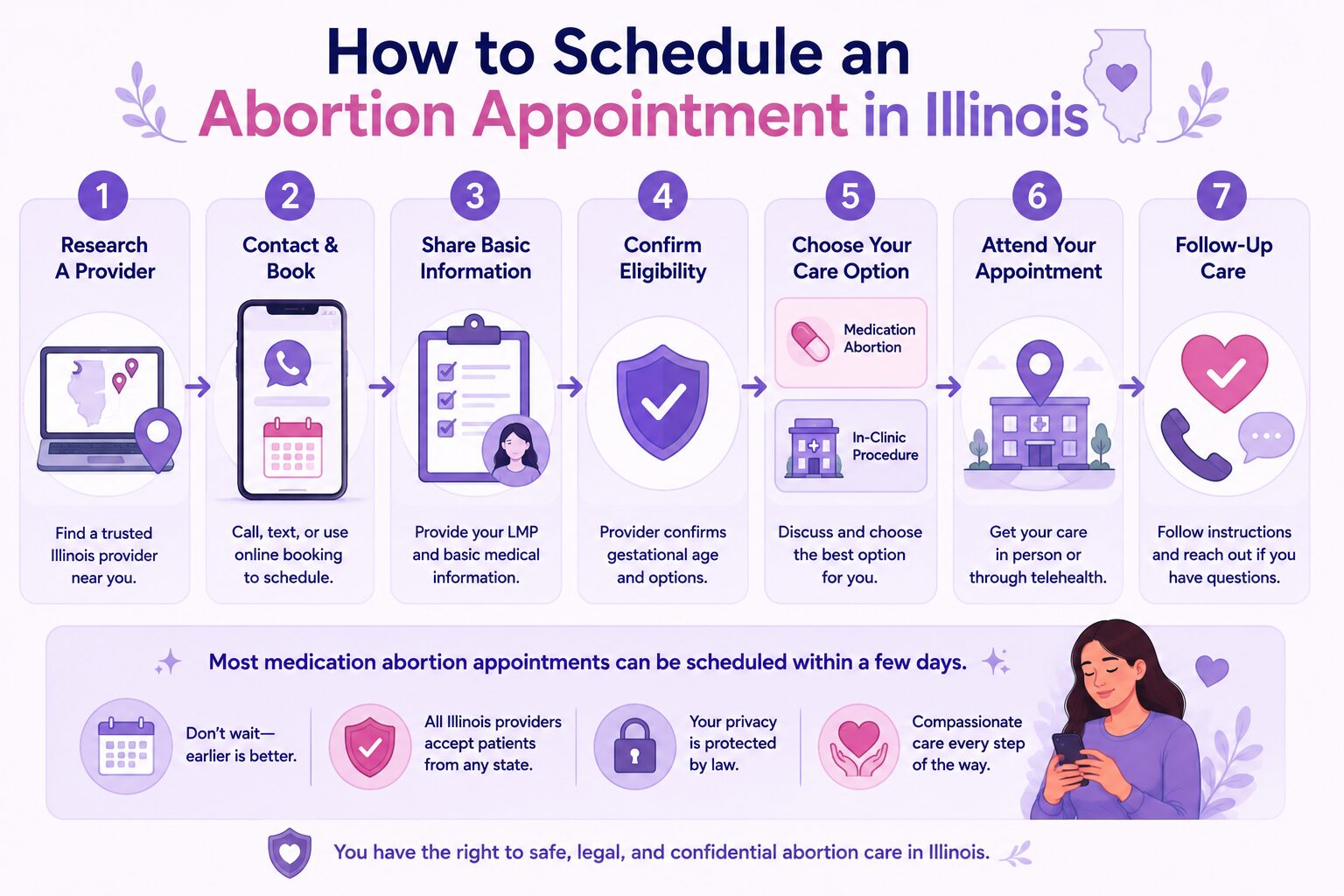
How to Schedule an Abortion Appointment in Illinois
Scheduling is more straightforward than many women expect and faster than scheduling for many other medical procedures.
How Far in Advance Should You Schedule?
For medication abortion which accounts for the majority of abortions in Illinois scheduling can often happen within days of your initial contact with a provider. Telehealth consultations for medication abortion can frequently be arranged same-week. For in-clinic procedures, wait times are typically one to two weeks at most, though this can vary by provider and gestational age.
The general principle: do not wait. Medication abortion is most effective earlier in pregnancy, and the earlier you schedule, the more options you have. If you are approaching 10 weeks of pregnancy, contact a provider immediately.
What You Will Need to Schedule
For most providers, scheduling requires:
- Your contact information
- Your last menstrual period date (to estimate gestational age)
- Basic medical history information
- Payment or financial assistance information
You do not need to provide documentation from your home state, proof of residency, or any state-issued permits. Standard identification (driver’s license or state ID) is helpful but requirements vary by provider.
What First-Time Patients Should Expect
For patients who have never had an abortion or navigated out-of-state care before, the appointment experience is typically more straightforward than anticipated. Initial intake is often done online or by phone before you arrive. The appointment itself for medication abortion is generally brief, involving a consultation with a clinician, review of medical history, and prescription. For procedural abortion, the appointment is longer but is completed in a single visit in most cases.
Our before, during and after care guide walks through exactly what to expect at every stage.
What Types of Abortion Care Are Available in Illinois?
Illinois providers offer the full range of abortion care options both medication abortion and procedural abortion across a range of gestational ages.
Medication Abortion (The Abortion Pill)
Medication abortion using mifepristone and misoprostol is available in Illinois up to 10 to 12 weeks of pregnancy. For patients who qualify, this option can often be accessed through telehealth meaning the consultation happens virtually and medications are either dispensed at the clinic or mailed directly to a home address.
Medication abortion is typically less expensive than procedural abortion, requires no surgical instruments, and can be completed at home after the initial consultation. For patients traveling from other states, this may mean a shorter in-person visit or, in some cases, no in-person visit at all if telehealth is appropriate for their situation.
Our abortion pill service provides complete information about what at-home medication abortion includes and how it works. Our telehealth abortion care service offers virtual consultations for qualifying patients.
Procedural (In-Clinic) Abortion
For patients further along in pregnancy, or those who prefer or need in-clinic care, procedural abortion is available from Illinois providers. First-trimester surgical abortion (vacuum aspiration) and second-trimester procedures (dilation and evacuation) are both performed in Illinois.
Our in-clinic abortion services page covers what to expect from procedural care, how to prepare, and what recovery looks like.
Which Option Is Right for You?
The right type of care depends primarily on gestational age. Medication abortion is appropriate up to 10 to 12 weeks. Procedural abortion is available beyond that window. Your provider will confirm gestational age and recommend the most appropriate option during your initial consultation. Our abortion by gestational weeks guide helps you understand what options are available at each stage.
How Much Does Traveling to Illinois for an Abortion Cost?
This is one of the most important practical questions and one of the biggest barriers for women from restricted states who are managing tight budgets.
Procedure Costs
The cost of abortion care itself varies by type and gestational age:
| Type of Care | Approximate Cost Range |
| Medication abortion (telehealth) | $150 — $500 |
| Medication abortion (in-clinic) | $300 — $600 |
| First-trimester procedural abortion | $400 — $900 |
| Second-trimester procedural abortion | $700 — $2,000+ |
These ranges are approximate and vary by provider. Our abortion pill cost guide and abortion costs in Illinois guide provide current, detailed cost information.
Travel and Lodging Costs
Beyond the procedure itself, travel costs vary significantly based on your distance from Illinois:
- Transportation: $30 to $500+ depending on distance and mode (gas, bus, train, or flight)
- Lodging: $80 to $200 per night if an overnight stay is needed
- Food and incidentals: $50 to $100 per day
- Lost wages: Highly variable a significant hidden cost for hourly workers
- Childcare: $50 to $200+ if you have children at home
For patients driving from Indiana or Missouri, the total travel cost may be modest: a tank of gas and a few hours. For patients from Tennessee, Arkansas, or further south, the travel burden is more significant.
Costs People Forget to Plan For
The expenses most commonly overlooked are lost wages, childcare, and the cost of a return trip if a second visit is required. Some procedures, particularly second-trimester procedures may require two appointments on consecutive days, making an overnight stay necessary. Planning for this in advance prevents surprises.
What Financial Assistance Programs Can Help?
Cost should not be the reason someone cannot access care. Abortion funds exist specifically to remove financial barriers and they are more accessible than many people realize.
National Organizations That Help With Illinois Travel
The National Abortion Federation Hotline (1-800-772-9100) provides funding assistance for both procedures and travel for qualifying patients. The Brigid Alliance specifically helps patients who need to travel long distances for later abortion care, covering transportation, lodging, and meals.
The National Network of Abortion Funds connects patients with state and regional funds, many of which specifically serve patients traveling to Illinois from neighboring restricted states.
Illinois-Specific Assistance
Several Illinois-based funds provide direct assistance to out-of-state patients traveling for care, including help with lodging, transportation, and procedure costs. Our guide to finding abortion financial aid programs provides a practical starting point for identifying and accessing these resources.
Employer Benefits
A growing number of employers offer travel reimbursement benefits for employees who need to travel for abortion care. Check your benefits package or speak confidentially with HR many employees do not know this coverage exists until they need it.
How to Protect Your Privacy When Traveling to Illinois
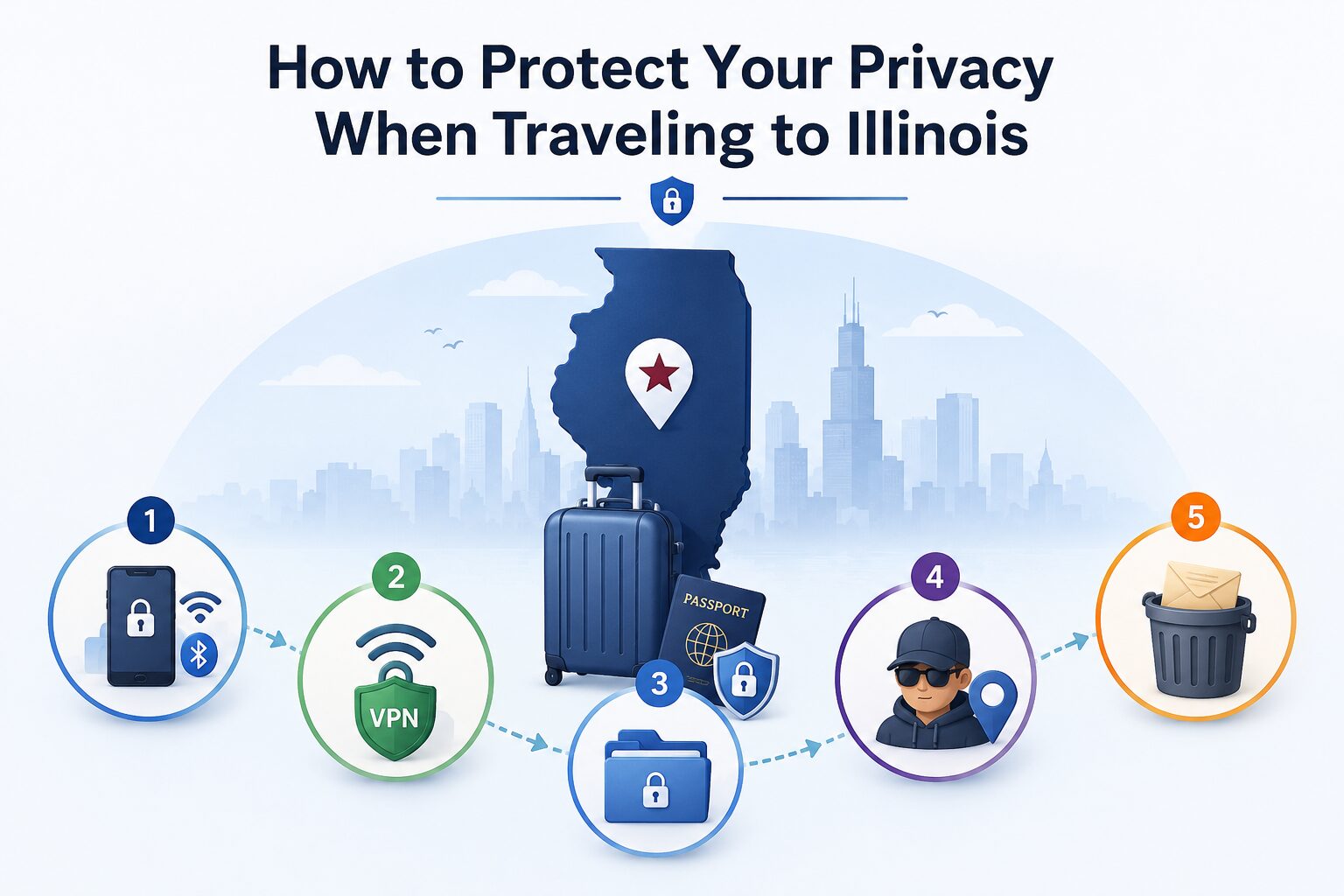
Privacy concerns are legitimate and worth taking seriously not because traveling for abortion care is legally risky for patients under current law, but because digital records, financial trails, and location data can create complications in certain personal and legal situations.
Digital Privacy Before You Travel
Use a private browser (Firefox Focus, Chrome incognito, or Tor) for all abortion-related research. Turn off location services on your phone before searching for providers or directions. Avoid using workplace devices or networks. Delete browser history after each session.
Payment Privacy
Cash payments for travel expenses, gas, food, lodging create no financial record. If using a card, a prepaid debit card purchased with cash is more private than a credit or bank card linked to a shared account. Be aware that card statements create a record that others on shared accounts may see.
Medical Privacy
Your medical records from care in Illinois are protected by HIPAA. Illinois shield laws prevent Illinois providers from cooperating with out-of-state subpoenas for abortion-related records. Your care in Illinois is, from a medical records perspective, as private as any other medical appointment.
Our abortion privacy guide, online privacy and abortion access resource, and how to keep your abortion private guide cover every layer of privacy protection for patients traveling for care.
What Happens After Your Appointment?
Recovery from abortion care whether medication or procedural typically allows patients to travel home the same day or the following morning.
Medication Abortion Recovery
After receiving the abortion pill, most patients take the second medication (misoprostol) at home, 24 to 48 hours after the first. The heaviest cramping and bleeding typically occur within a few hours of misoprostol and subside within 24 hours. Most patients feel well enough to travel the following day.
For complete guidance on what to expect physically, our guides on abortion pill bleeding and abortion pain management cover every aspect of the recovery experience.
Procedural Abortion Recovery
Recovery from first-trimester procedural abortion is typically faster than many patients expect most people rest for a few hours and feel well enough to travel home the same day. Second-trimester procedures may require a longer recovery period and potentially a second-day appointment.
Follow-Up Care
Follow-up care, typically a pregnancy test three to four weeks after the procedure to confirm the abortion is complete, can be managed remotely through telehealth in most cases. You do not need to return to Illinois for follow-up if a virtual appointment is appropriate. Our telehealth abortion care service provides remote follow-up support for patients who received initial care in Illinois.
For broader reproductive health needs, including STI and STD testing, birth control and contraceptive services, and women’s primary care, consolidating multiple healthcare needs into a single Illinois visit reduces the total number of trips and out-of-pocket travel costs.
We Are Here to Help You Plan
Serenity Choice Health offers comprehensive reproductive healthcare for both Illinois residents and out-of-state patients. Our licensed providers understand the practical and legal landscape of traveling for care and are here to guide you through every step from understanding your options to scheduling your appointment to follow-up care after you return home.
Schedule a confidential consultation or explore our services to take the first step toward care.
Frequently Asked Questions
Can I get an abortion in Illinois if I live in another state?
Yes. Illinois accepts out-of-state patients without any residency requirement. You simply need to be present in Illinois when care is provided.
Do I need any special documentation to get an abortion in Illinois from another state?
No special documentation is required. Standard identification is helpful. You do not need state permits, out-of-state referrals, or any documentation from your home state.
How quickly can I get an appointment in Illinois?
For medication abortion via telehealth, consultations can often be arranged within days. For in-clinic care, wait times are typically one to two weeks. Contact a provider as early as possible to preserve the most options.
Can someone drive me to Illinois for an abortion?
Yes. Providing transportation to someone traveling for legal medical care in Illinois is legal. There is no federal prohibition on this, and state-level civil liability attempts have not been enforced in this context.
How much does it cost to travel to Illinois for an abortion?
Procedure costs range from approximately $150 for early medication abortion to $2,000+ for later procedural care. Travel costs vary by distance. Financial assistance is available through national and Illinois-specific abortion funds.
Is my medical information private if I get an abortion in Illinois?
Yes. HIPAA protects your medical records, and Illinois shield laws prevent providers from cooperating with out-of-state subpoenas for abortion-related records.
Can I do follow-up care remotely after returning home?
In most cases, yes. A follow-up pregnancy test at three to four weeks can be managed through telehealth without returning to Illinois.
What if I cannot afford to travel?
Financial assistance is available. The National Abortion Federation Hotline, the Brigid Alliance, and Illinois-specific abortion funds provide grants covering procedure costs, travel, lodging, and childcare.
For complete reproductive healthcare guidance, visit our medication abortion explained guide, our abortion procedures explained guide, and our abortion safety and medical facts resource.

Dr. James Carter is a board-certified physician and lead clinician at Serenity Choice Health, specializing in reproductive health access and medication abortion protocols. With over 20+ years of experience, he combines clinical expertise with patient-centered care to ensure safe, compassionate, and confidential reproductive healthcare.