
Many patients leave a gynecology appointment believing they have been screened for sexually transmitted infections only to discover later that a Pap smear and an STI test are not the same thing. This misunderstanding is more common than most people realize, and it can create a dangerous gap in sexual healthcare, allowing infections to go undiagnosed and untreated simply because patients assumed they were already covered.
Knowing exactly what a Pap smear does, and does not, test for helps you make informed decisions about your reproductive and sexual health. This guide breaks down the real difference, clears up the confusion, and explains exactly what to ask for at your next appointment.
What Does a Pap Smear Actually Test For?
What Happens During a Pap Smear?
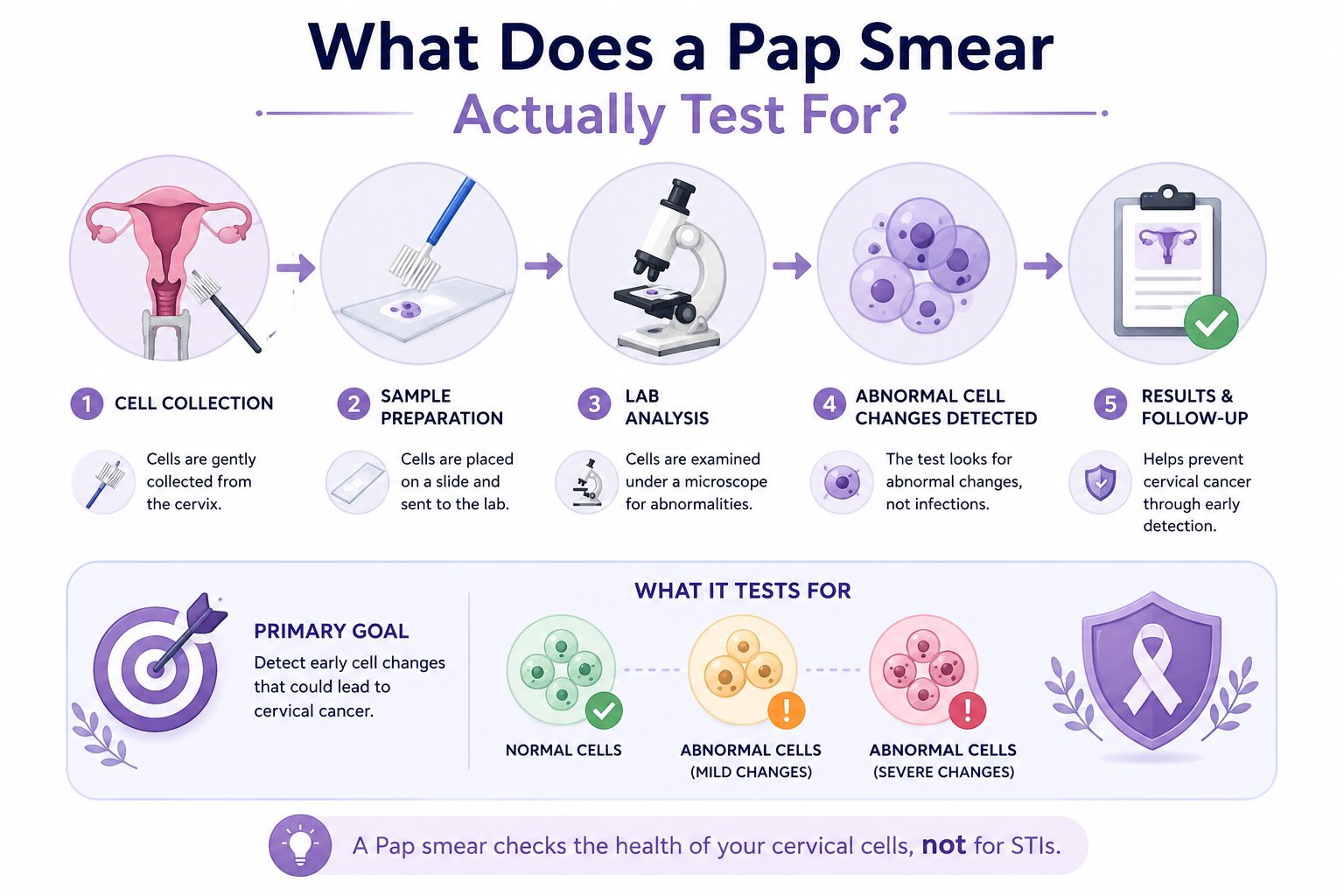
A Pap smear is a routine procedure performed during a pelvic exam. A healthcare provider uses a small brush or spatula to collect a sample of cells from the surface of the cervix. The procedure itself takes only a minute or two and is typically done as part of a regular gynecological visit.
How Cervical Cells Are Collected and Analyzed
Once collected, the cervical cells are sent to a laboratory, where they are examined under a microscope for any abnormal changes. The lab is looking specifically for cellular irregularities, not for the presence of bacteria, viruses, or other organisms associated with most sexually transmitted infections.
The Primary Goal: Cervical Cancer Prevention
The entire purpose of a Pap smear is cervical cancer prevention. It is designed to catch precancerous changes in cervical cells early, long before they would ever develop into cancer, giving providers the opportunity to monitor or treat those changes proactively.
How Abnormal Cervical Cell Changes Are Identified
When abnormal cells are found, they are categorized by severity, ranging from mild changes that often resolve on their own to more significant changes that require closer monitoring or treatment. This grading system helps providers determine the right follow-up plan, which may include repeat testing, colposcopy, or further evaluation.
The Role of HPV in Cervical Cancer Screening
Human papillomavirus is the primary cause of the cervical cell changes a Pap smear is designed to detect. This connection is why HPV testing is often performed alongside a Pap smear, even though the two are technically separate tests looking for different things.
Does a Pap Smear Test for STIs?
The Short Answer Most Patients Need
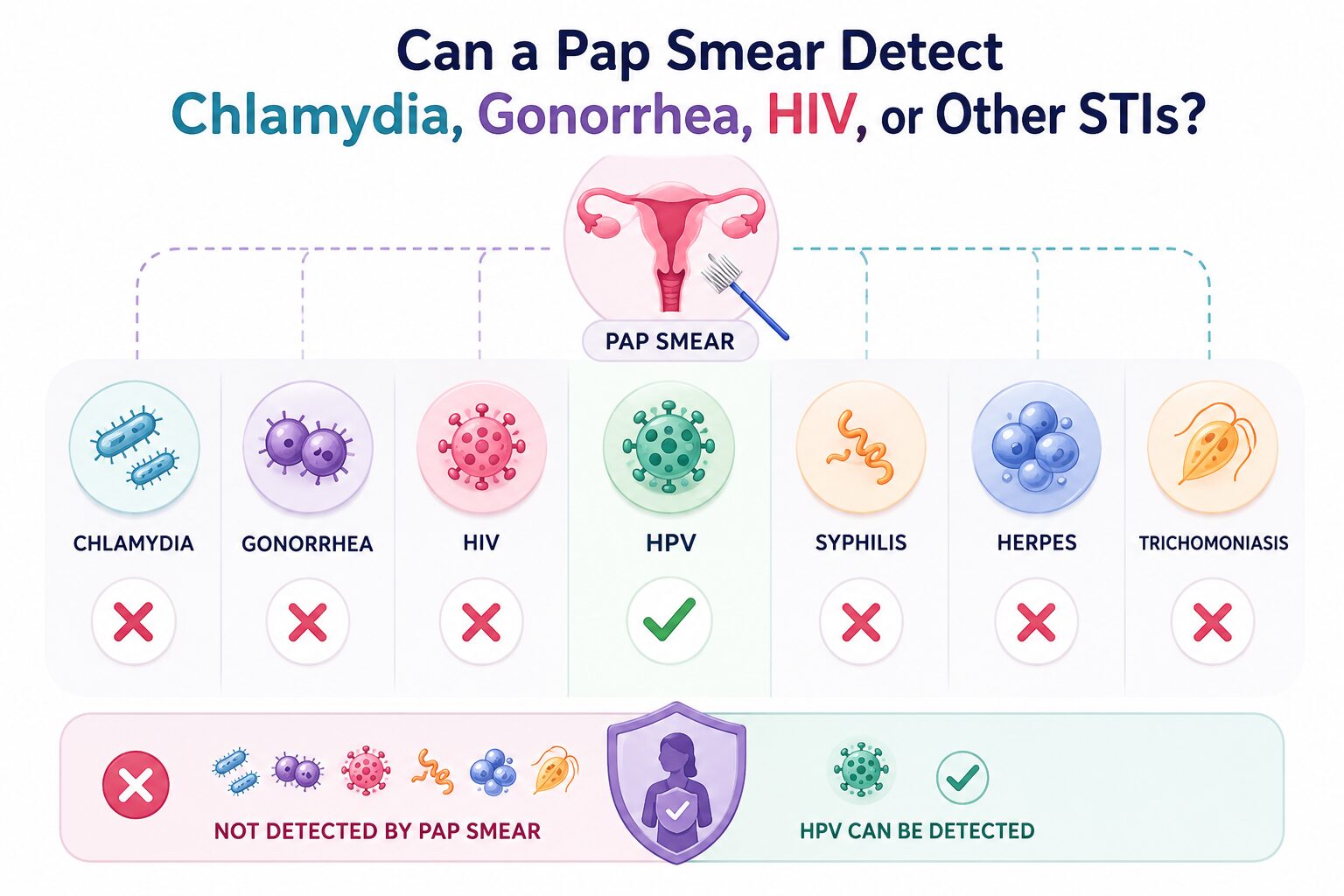
No, a Pap smear is not designed to test for most sexually transmitted infections. Its primary purpose is to detect abnormal cervical cell changes that may lead to cervical cancer, not to screen for chlamydia, gonorrhea, HIV, syphilis, or other common STIs. Our dedicated STI and STD testing services are designed specifically for that purpose and can be requested separately from your routine gynecological exam.
Why Pap Smears and STI Tests Are Different Medical Screenings
A Pap smear examines the physical structure and appearance of cervical cells under a microscope. STI tests, by contrast, look for the genetic material, antigens, or antibodies associated with specific infections, using entirely different lab methods. These are simply two different diagnostic tools built for two different purposes. If you have never been tested before, our guide on what happens during an STI test walks through the process step by step so you know exactly what to expect.
Why This Misconception Is So Common
Because both procedures happen during the same type of appointment and often involve a swab or sample collection, it is easy to assume they are part of the same test. Many patients are never explicitly told that they are separate, which leaves room for confusion to take hold.
What Healthcare Providers Assume Patients Already Know
Providers sometimes assume patients understand that STI testing requires a specific request or order, since it is considered a routine part of medical training. This assumption can create a communication gap, especially for patients attending a gynecological appointment for the first time.
Which STIs Can Be Detected During a Gynecological Exam?
STIs That Require Separate Testing
Chlamydia, gonorrhea, HIV, syphilis, herpes, and trichomoniasis all require dedicated testing that is not automatically included in a Pap smear. Each of these infections needs its own specific sample type and laboratory method to be detected accurately. If you are unsure which STIs women should be tested for, that resource outlines the most important screenings based on age and risk level.
Blood Tests vs Swab Tests
HIV and syphilis are diagnosed through blood tests. Chlamydia, gonorrhea, and trichomoniasis are typically detected through a urine sample or a vaginal/cervical swab. Herpes is most accurately diagnosed through a swab of an active sore, though blood testing is sometimes used as well.
Symptoms Doctors May Notice Visually
During a pelvic exam, a provider may visually notice signs such as unusual discharge, sores, irritation, or warts, which can prompt further testing. However, the absence of any visible signs does not rule out infection.
Why Appearance Alone Isn’t Enough for Diagnosis
Most STIs cannot be reliably diagnosed by appearance alone. Many infections look similar to one another, and some including chlamydia and gonorrhea typically present no visible signs at all, making lab testing the only reliable method of diagnosis.
Hidden Infections With No Symptoms
Chlamydia causes no symptoms in roughly 70 percent of women who have it. This is precisely why a visual exam, or a Pap smear, cannot serve as a substitute for actual STI screening. In fact, it is entirely possible to have an STI without any symptoms at all, which is why routine testing matters regardless of how you feel.
Can a Pap Smear Detect HPV?
The Special Relationship Between HPV and Pap Smears
HPV holds a unique position in this conversation because, unlike other STIs, it is closely tied to what a Pap smear is actually looking for. A Pap smear can reveal cellular changes caused by HPV, even though it is not technically an HPV test itself.
HPV Testing vs Pap Testing
A Pap test examines cervical cells for abnormal changes. An HPV test specifically checks for the genetic material of high-risk HPV strains. Both can be performed using the same sample collected during a pelvic exam, but they are analyzed differently and answer different questions.
What “Co-Testing” Means
Co-testing refers to performing both the Pap smear and the HPV test from the same sample during the same visit. This combined approach is now standard for women starting at age 30 and gives providers a more complete picture of cervical cancer risk.
When HPV Screening Is Recommended
Current guidelines recommend a Pap smear alone every three years for women ages 21 to 29. From age 30 onward, co-testing with both Pap and HPV every five years, or a Pap smear alone every three years, is recommended.
Understanding Positive HPV Results
A positive HPV result means a high-risk strain of the virus was detected, not that cervical cancer is present. Many HPV infections clear on their own within one to two years. A positive result simply means closer monitoring is needed going forward.
Can a Pap Smear Detect Chlamydia, Gonorrhea, or Other STIs?
Chlamydia
A Pap smear does not test for chlamydia. Diagnosis requires a urine sample or a separate swab specifically processed for chlamydia detection.
Gonorrhea
Like chlamydia, gonorrhea is not detected through a Pap smear. It requires its own urine or swab-based test using different lab methods entirely.
HIV
HIV is never detected through a Pap smear. It requires a blood test that checks for HIV antibodies and antigens.
Syphilis
Syphilis also requires a blood test and is not part of cervical cell analysis in any way.
Herpes
Herpes is diagnosed through a swab of an active sore, or sometimes a blood test, neither of which overlaps with the Pap smear process.
Trichomoniasis
Trichomoniasis is detected through a vaginal swab or urine sample specifically tested for the parasite that causes the infection, separate from a Pap smear sample.
Infection-by-infection summary: HPV may sometimes be reflected in Pap smear findings, though a separate co-test is often needed for confirmation. Chlamydia, gonorrhea, HIV, syphilis, and herpes are never detected by a Pap smear and always require separate, dedicated testing.
Why Patients Often Think a Pap Smear Includes STI Testing
Similar Appointment Process
Both a Pap smear and STI testing often happen during the same overall visit, using the same exam table and similar instruments, which naturally blurs the line between the two in a patient’s mind.
Similar Sample Collection Methods
Because both tests can involve a swab taken during a pelvic exam, it is easy to assume one sample is being used to check for everything, when in reality, different samples are processed in entirely different ways.
Lack of Communication During Appointments
Time constraints during appointments sometimes mean providers move through the exam without explicitly stating which tests are or are not being performed, leaving patients to make assumptions.
Insurance and Screening Package Confusion
Insurance documentation can also contribute to confusion, since both procedures may appear together on a bill or be referred to broadly as a “well-woman exam,” without clearly itemizing what was actually tested. Read our guide on whether medical information shows up on health records to better understand how your healthcare visits and test results are documented.
Real-World Scenarios Causing Misunderstandings
A common scenario involves a patient who had a Pap smear, received a normal result, and assumed this meant they were also STI-free, only to later test positive for chlamydia or another infection that was never part of the original exam.
Signs You Should Request STI Testing Even If Your Pap Smear Was Normal
New Sexual Partner
Starting a relationship with a new partner is one of the most common and appropriate reasons to request STI testing, regardless of when your last Pap smear occurred.
Multiple Partners
Having more than one sexual partner increases the statistical likelihood of exposure and is a clear signal that routine STI screening should be part of your regular healthcare.
Unprotected Sex
Any instance of unprotected sex is reason enough to request testing, since a normal Pap smear result has no bearing on STI exposure risk.
Unusual Symptoms
Discharge, odor, pelvic pain, burning during urination, or visible sores should prompt STI testing specifically, separate from your routine cervical screening schedule. Book a confidential appointment to get evaluated as soon as symptoms appear.
Partner Diagnosed With an STI
If a partner informs you of a positive STI diagnosis, testing is recommended even without symptoms, since many infections have incubation periods before becoming detectable. Understanding how soon after exposure you should get tested can help you time your appointment correctly and avoid a false negative result from testing too early.
Routine Screening Recommendations
Sexually active women under 25 should be tested annually for chlamydia and gonorrhea regardless of Pap smear timing or results. A normal Pap smear should not create a false sense of security it only speaks to cervical cell health, not to your STI status.
What STI Tests Should You Ask Your Doctor For?
Comprehensive STI Panel Explained
A comprehensive panel typically includes chlamydia, gonorrhea, HIV, and syphilis testing. Herpes, hepatitis, and trichomoniasis are often not included automatically and need to be specifically requested.
Tests Based on Age and Risk Level
Younger women and those with new or multiple partners are generally advised to test more frequently, while testing recommendations for women in long-term monogamous relationships may differ based on shared risk factors.
Which Screenings Are Most Commonly Recommended
Chlamydia and gonorrhea testing are the most commonly recommended screenings for sexually active women under 25. HIV testing is recommended at least once for all adults, with more frequent testing for those at higher risk.
How Often Should You Get Tested?
Annual testing is a reasonable baseline for most sexually active women, with testing every three to six months recommended for those with multiple partners or other elevated risk factors. Learn more about the benefits of telehealth and how virtual care can make routine STI screening more accessible without requiring an in-person visit every time.
Questions to Ask at Your Next Appointment
Ask your provider directly which specific infections are being tested for during your visit, whether your Pap smear includes HPV co-testing, and what additional STI screening might be appropriate based on your sexual history. STI and STD testing can be requested as a separate service alongside your routine gynecological exam.
Pap Smear vs STI Test: Understanding the Difference
A Pap smear’s purpose is cervical cancer prevention, while an STI test’s purpose is identifying sexually transmitted infections. A Pap smear detects abnormal cervical cell changes, whereas an STI test detects specific infections like chlamydia, gonorrhea, HIV, or syphilis. Both may use a swab, but STI testing can also require urine or blood samples depending on the infection. Pap smears are recommended every three to five years depending on age and co-testing status, while STI testing frequency depends on individual risk factors and is often recommended annually or more frequently. Pap smear results are graded by cellular abnormality severity, while STI test results are reported simply as positive or negative for each specific infection tested.
Common Mistakes Patients Make About Pap Smears and Sexual Health Screening
Assuming all testing happens automatically. Many patients believe that attending a gynecological appointment means every possible test is performed by default, when in reality, specific tests must be ordered individually.
Ignoring STI risk after normal results. A normal Pap smear result has no bearing on STI status and should never be interpreted as a clean bill of sexual health.
Skipping routine screening. Some patients avoid STI testing because they feel their Pap smear already “covered” them, leading to missed opportunities for early detection.
Waiting for symptoms before testing. Because most STIs cause no symptoms, waiting to feel unwell before requesting testing allows infections more time to potentially cause complications.
Confusing HPV with all STIs. HPV’s connection to Pap smears sometimes leads patients to assume other STIs work the same way, when in fact HPV is the exception, not the rule, when it comes to overlap with cervical screening. Our women’s primary care services can help clarify exactly which screenings you’ve had and which ones you still need. Our birth control and contraceptive services are also available as part of a complete reproductive health visit. We take your health privacy seriously your information is kept confidential under all applicable healthcare privacy protections.
Frequently Asked Questions
Does a Pap smear automatically test for STDs?
No, a Pap smear does not automatically test for most STDs. Its purpose is to detect abnormal cervical cell changes related to cervical cancer risk, and separate testing must be requested for infections like chlamydia, gonorrhea, HIV, and syphilis.
Can a Pap smear detect chlamydia?
No, a Pap smear cannot detect chlamydia. Diagnosing chlamydia requires a separate urine sample or swab specifically processed to identify the bacteria that causes the infection.
Can a Pap smear detect gonorrhea?
No, gonorrhea is not detected through a Pap smear. It requires its own dedicated urine or swab test, using lab methods entirely different from cervical cell analysis.
Does a Pap smear test for HPV?
A Pap smear itself does not directly test for HPV, but it can reveal cervical cell changes caused by the virus. A separate HPV co-test, often done using the same sample, specifically checks for high-risk HPV strains.
If my Pap smear is normal, can I still have an STI?
Yes, absolutely. A normal Pap smear only reflects the health of your cervical cells and has no bearing on whether you have chlamydia, gonorrhea, HIV, or other sexually transmitted infections.
Why didn’t my doctor test me for STDs during my Pap smear?
STI testing is not automatically included with a Pap smear and must be specifically requested or ordered based on your risk factors and symptoms. If you want STI testing, it’s important to ask your provider directly during your appointment.

Dr. James Carter is a board-certified physician and lead clinician at Serenity Choice Health, specializing in reproductive health access and medication abortion protocols. With over 20+ years of experience, he combines clinical expertise with patient-centered care to ensure safe, compassionate, and confidential reproductive healthcare.