
Medication abortion is highly effective, but it does not work in every case. If you have taken abortion pills and are still experiencing pregnancy symptoms, have very little or no bleeding, or later receive a pregnancy test that remains positive, you may wonder whether the abortion was successful.
An abortion pill that didn’t work can refer to an ongoing pregnancy, where the pregnancy continues after the medications, or an incomplete abortion, where some pregnancy tissue remains in the uterus.
Symptoms alone cannot always tell you what happened. A healthcare professional may need to evaluate you to determine whether the pregnancy has ended and whether additional care is needed.
For an overview of the medication process, see medication abortion explained.
How Does the Abortion Pill Work?
Medication abortion commonly uses two medicines: mifepristone and misoprostol.
Mifepristone blocks progesterone, a hormone needed to maintain pregnancy. Misoprostol causes the uterus to contract and helps the body pass the pregnancy tissue.
The combination is an established medication-abortion approach. However, a small number of pregnancies may continue after treatment.
You can learn more about the medicines and their roles in how the abortion pill works.
Signs the Abortion Pill May Not Have Worked
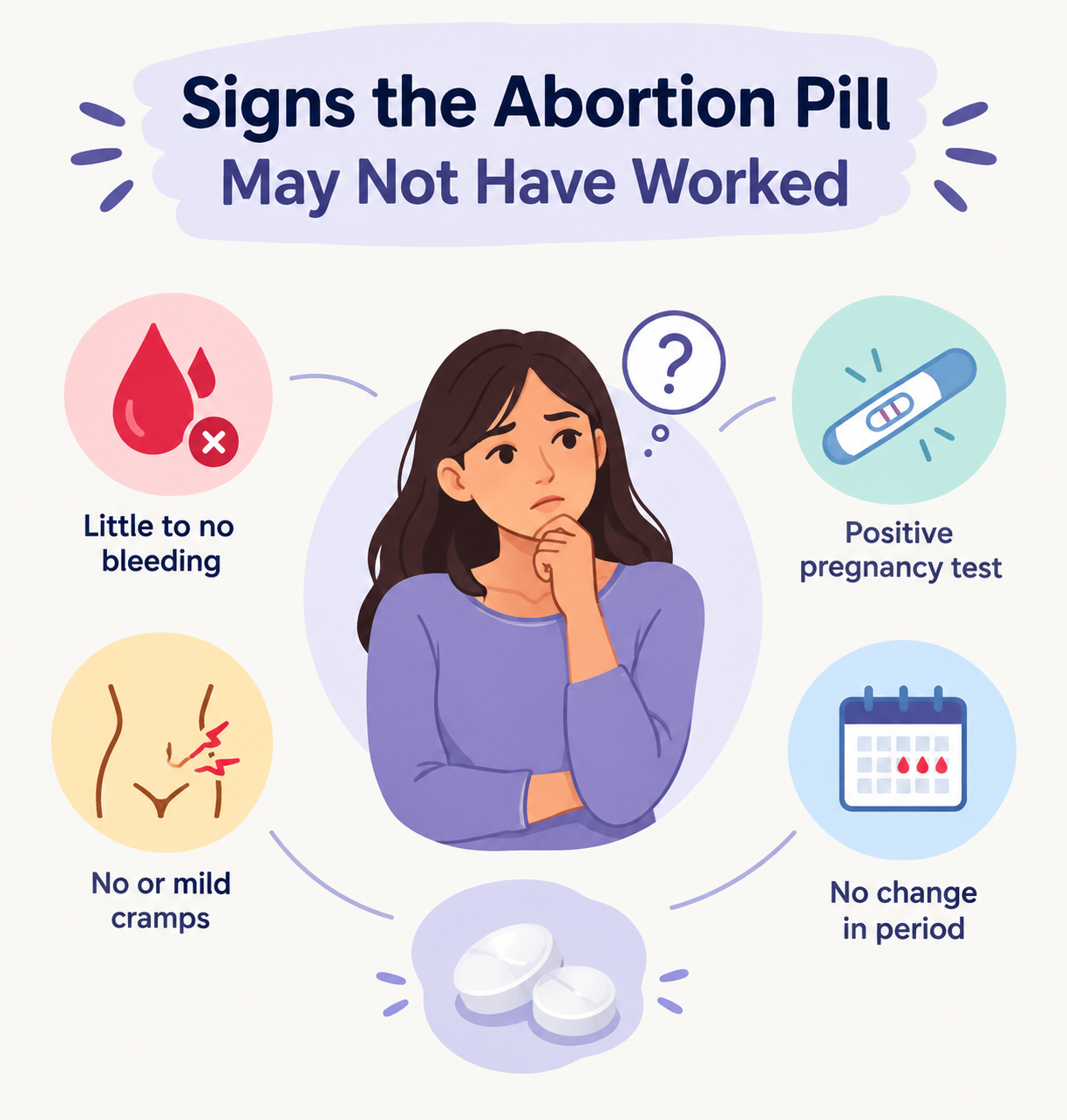
There is no single symptom that proves an abortion failed. However, several findings can indicate that you should contact a healthcare provider.
1. Pregnancy Symptoms Continue
Pregnancy symptoms such as nausea, breast tenderness, fatigue, or other changes can take time to improve after an abortion.
However, persistent or increasing pregnancy symptoms can be a reason to check whether the pregnancy is continuing.
See why pregnancy symptoms can continue after an abortion for more information.
2. Little or No Bleeding After Misoprostol
Bleeding is generally expected after misoprostol. If you have no bleeding or only minimal bleeding, contact your healthcare provider for advice.
No bleeding does not automatically prove that the abortion failed. It can have several explanations, but ongoing pregnancy should be considered.
Read more about no bleeding after misoprostol and what it can mean.
3. A Pregnancy Test Remains Positive
Pregnancy tests detect human chorionic gonadotropin, or hCG. This hormone can remain in the body for some time after a successful abortion.
Therefore, taking a standard home pregnancy test too soon does not necessarily mean the abortion failed.
If a pregnancy test remains positive when your healthcare provider instructed you to test, or becomes stronger rather than weaker, follow up with a clinician.
For more information, see when to take a pregnancy test after abortion pills.
4. Pregnancy Symptoms Do Not Improve as Expected
Continuing pregnancy symptoms deserve attention, particularly when they occur together with minimal bleeding or other concerns.
A provider may recommend follow-up testing to determine whether the pregnancy is ongoing.
You can also review how to know if the abortion pill worked for additional information about signs of completion.
Why Might the Abortion Pill Not Work?
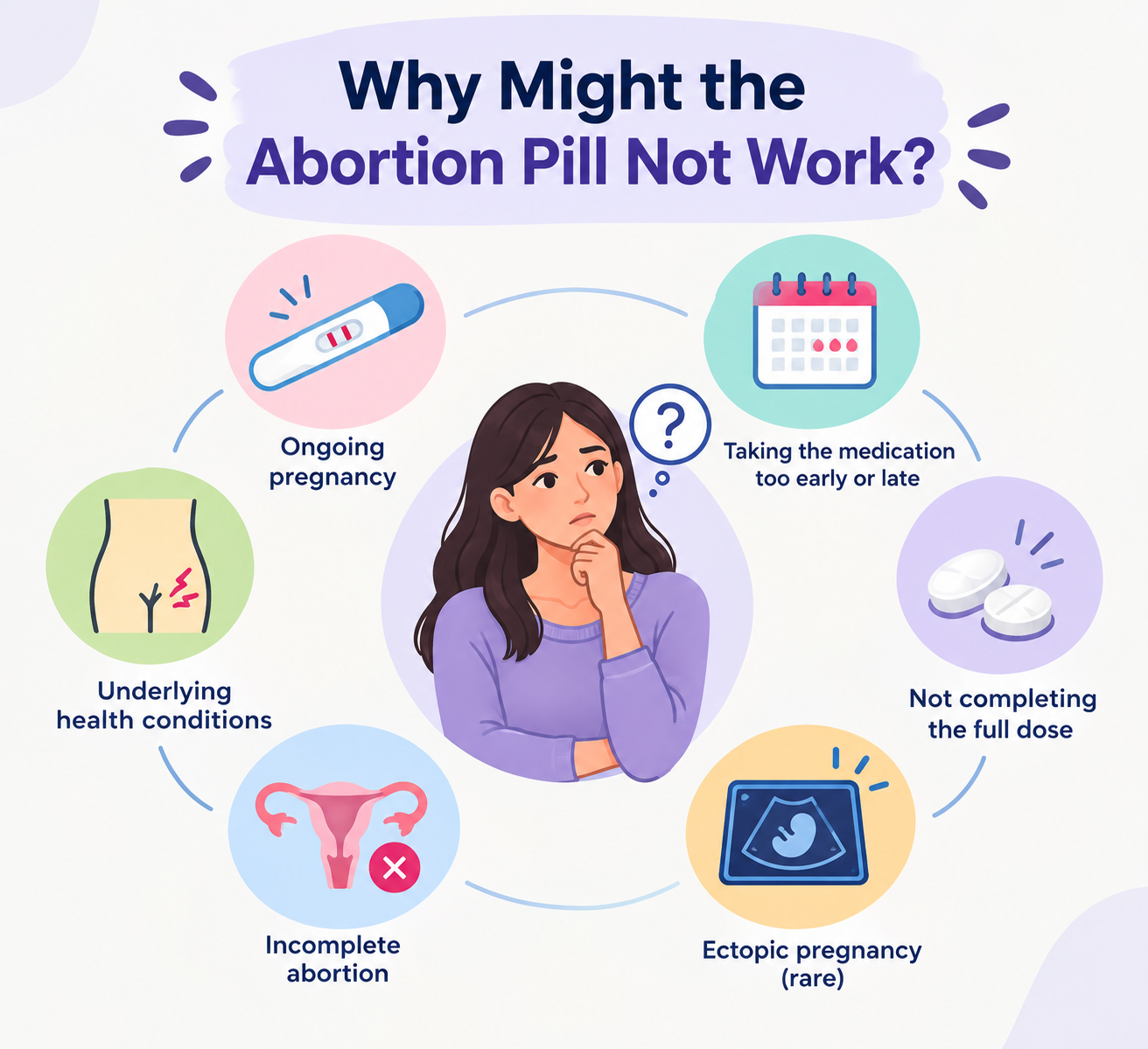
Medication abortion can fail for several reasons. In many situations, there is no way to identify the exact reason without a clinical evaluation.
Possible factors can include:
- The pregnancy continues despite treatment.
- The pregnancy is farther along than expected.
- The medication regimen was not completed as directed.
- The medicines were not absorbed properly.
- The pregnancy is ectopic rather than located inside the uterus.
- The abortion is incomplete and some pregnancy tissue remains.
The exact medication regimen and eligibility depend on factors such as pregnancy duration and individual health circumstances.
If you are concerned that the medication did not work, a healthcare professional can help determine the appropriate next step rather than relying on symptoms alone.
What If There Was No Bleeding After Misoprostol?
No bleeding after misoprostol is a reason to contact your healthcare provider.
Some people may experience bleeding later, while others may have little bleeding for reasons that do not necessarily mean the pregnancy is continuing. However, minimal or absent bleeding can also occur with an ongoing pregnancy.
Do not assume the abortion was successful simply because you do not have severe symptoms.
See don’t bleed after misoprostol for additional guidance.
How Is a Failed Medication Abortion Confirmed?
A healthcare provider may use your symptoms, pregnancy history, examination, pregnancy testing, ultrasound, or other appropriate evaluation to determine what happened.
WHO guidance indicates that when pregnancy symptoms continue or bleeding is minimal or absent, further evaluation can be appropriate.
An ultrasound can help determine whether an ongoing pregnancy is present and can also help evaluate other possible causes of symptoms.
A pregnancy test by itself may not immediately distinguish between a recently completed abortion and an ongoing pregnancy because hCG can remain detectable after an abortion.
For more information about testing and follow-up, see do you need follow-up after abortion pills.
What Happens If the Abortion Pill Failed?
If an evaluation confirms that the pregnancy is still ongoing, the next step depends on your medical situation and your preferences.
A clinician may discuss options that can include:
- Additional medication
- A uterine-evacuation procedure
- Further evaluation before deciding on treatment
WHO guidance recognizes additional misoprostol or vacuum aspiration as management options for an ongoing pregnancy after a failed medication abortion.
The appropriate option depends on factors such as pregnancy duration, symptoms, clinical findings, and your circumstances.
If you want to understand the alternatives to medication abortion, see abortion pills vs. surgical abortion.
What If the Abortion Was Incomplete?
An incomplete abortion is different from an ongoing pregnancy.
With an incomplete abortion, the pregnancy has ended but some tissue remains in the uterus. Depending on the circumstances, a healthcare professional may recommend observation, additional medication, or a procedure.
Symptoms can overlap, so it is important not to diagnose an incomplete abortion based only on bleeding or cramping.
If you are experiencing symptoms after an abortion, bleeding after the abortion pill can help explain what may be expected and when additional evaluation may be needed.
Could It Be an Ectopic Pregnancy?
An ectopic pregnancy occurs when a pregnancy develops outside the uterus, most commonly in a fallopian tube.
Medication abortion does not treat an ectopic pregnancy. WHO guidance recommends evaluation for ectopic pregnancy when someone has symptoms suggesting an ongoing pregnancy after medication abortion.
This is particularly important if you develop unusual or severe symptoms.
Possible warning signs include:
- Severe or persistent abdominal or pelvic pain
- Pain that is mainly on one side
- Shoulder pain
- Significant dizziness or weakness
- Fainting
- Vaginal bleeding combined with significant pain
These symptoms can have other causes, but severe pain, fainting, or other signs of possible ectopic pregnancy require urgent medical evaluation.
Read one-sided pain after abortion for more information.
When Should You Go to the Emergency Room?
Seek emergency medical care for severe symptoms such as:
- Very heavy bleeding
- Severe or worsening abdominal or pelvic pain
- Fainting or severe dizziness
- Shoulder pain accompanied by concerning abdominal symptoms
- Severe weakness
- Signs of serious infection
- Any symptom that makes you feel seriously unwell
Do not wait for a routine appointment if you believe you may have an emergency.
For additional information, see when to go to the ER after abortion pills.
What Should You Do If You Think the Abortion Pill Didn’t Work?

If you are concerned that the abortion pill did not work, the safest approach is to obtain appropriate follow-up rather than taking additional medication without medical guidance.
Step 1: Review Your Symptoms
Consider:
- When you took each medication
- Whether you experienced bleeding
- How heavy the bleeding was
- Whether pregnancy symptoms are continuing
- Whether you have pain, fever, dizziness, or other concerning symptoms
Step 2: Follow the Recommended Testing Schedule
Your provider may give you specific instructions about when to use a pregnancy test or whether you need another form of evaluation.
Testing too early can cause confusion because hCG may remain in your body after a successful abortion.
Step 3: Contact a Healthcare Provider
If pregnancy symptoms continue, bleeding is absent or unusually light, or you are uncertain whether the abortion was completed, contact a qualified abortion provider.
Step 4: Get Urgent Care for Warning Symptoms
Severe pain, heavy bleeding, fainting, or symptoms suggesting an ectopic pregnancy should not be managed by waiting for a routine follow-up.
Can You Take More Abortion Pills If the First Attempt Did Not Work?
Sometimes additional medication is used when an abortion is incomplete or the pregnancy is ongoing. However, the appropriate treatment depends on the specific clinical situation.
Do not automatically repeat doses based solely on internet advice. A provider can determine whether additional medication, an in-clinic procedure, or further testing is appropriate.
If you are unsure what happened after taking misoprostol, see misoprostol and what should you expect.
Can Pregnancy Symptoms Continue After a Successful Abortion?
Yes. Pregnancy-related hormones do not disappear immediately after an abortion.
Some symptoms can therefore continue temporarily even when the abortion has been completed.
The important distinction is between temporary symptoms during recovery and symptoms that suggest an ongoing pregnancy or complication. Follow-up testing or evaluation may be necessary when symptoms persist or when the expected course is unclear.
Does a Positive Pregnancy Test Always Mean the Abortion Failed?
No.
A pregnancy test can remain positive after an abortion because hCG may remain detectable after the pregnancy has ended.
The timing of the test matters. If you test according to your provider’s recommended schedule and receive a concerning result, contact the provider for guidance.
For more information, see positive pregnancy test four weeks after abortion.
What Should You Expect From Follow-Up Care?
Follow-up is used when there is a medical concern, uncertainty about whether the abortion was completed, or ongoing pregnancy symptoms.
Depending on your situation, follow-up may involve:
- Reviewing symptoms
- Pregnancy testing
- Blood hCG testing
- Physical examination
- Ultrasound
- Discussion of additional treatment if needed
WHO guidance notes that routine follow-up is not necessarily required after every uncomplicated medication abortion, but evaluation is appropriate when symptoms suggest an ongoing pregnancy or another medical concern.
Getting Help After an Abortion Pill That Didn’t Work
Finding out that a medication abortion may not have been completed can be stressful, especially when you are unsure what your symptoms mean.
You do not have to determine the cause on your own. A qualified healthcare provider can review your symptoms, determine whether the pregnancy is ongoing or incomplete, and discuss appropriate next steps.
Serenity Choice Health provides abortion care and reproductive healthcare services for patients seeking clear, confidential information and professional guidance. If you are concerned that your abortion pill did not work, contact the care team to discuss your symptoms and available next steps.
Conclusion
An abortion pill that didn’t work does not always produce obvious symptoms. Continued pregnancy symptoms, minimal or absent bleeding, or a concerning pregnancy test can indicate that further evaluation is needed, but these signs do not automatically prove that the abortion failed.
The most appropriate next step is to follow your provider’s testing instructions and seek clinical evaluation when there is uncertainty. If you develop severe pain, heavy bleeding, fainting, or other emergency symptoms, seek urgent medical care.
Getting timely follow-up can help determine whether the pregnancy has ended, whether additional treatment is needed, and whether another condition such as an ectopic pregnancy needs to be ruled out.
FAQ Section
How do I know if the abortion pill didn’t work?
Continuing pregnancy symptoms, minimal or absent bleeding, or concerning follow-up pregnancy-test results can indicate that an abortion may not have been completed. A healthcare provider may need to perform testing or an ultrasound to confirm.
Is no bleeding after misoprostol a sign that the abortion failed?
No bleeding can be a warning sign that requires follow-up, but it does not prove that the abortion failed. Contact your healthcare provider for appropriate evaluation.
Can you still be pregnant after taking the abortion pill?
Yes. Medication abortion is highly effective, but an ongoing pregnancy can occur. Persistent pregnancy symptoms or minimal bleeding may require further evaluation.
Can a pregnancy test stay positive after an abortion?
Yes. Pregnancy tests detect hCG, which can remain in the body after an abortion. Testing too soon can therefore produce a positive result even when the abortion was successful.
What happens if the abortion pill fails?
If an ongoing pregnancy or incomplete abortion is confirmed, a healthcare provider can discuss appropriate options, which may include additional medication or a procedure depending on the circumstances.
When should I seek emergency care after taking abortion pills?
Seek urgent medical care for severe or worsening pain, very heavy bleeding, fainting, severe dizziness, shoulder pain with concerning symptoms, or other signs of a serious complication.

Dr. James Carter is a board-certified physician and lead clinician at Serenity Choice Health, specializing in reproductive health access and medication abortion protocols. With over 20+ years of experience, he combines clinical expertise with patient-centered care to ensure safe, compassionate, and confidential reproductive healthcare.