
Experiencing bleeding, cramping, or passing tissue after an abortion can raise an important question: Could the abortion be incomplete?
An incomplete abortion occurs when some pregnancy tissue has passed from the uterus but some tissue remains. It can happen after a spontaneous miscarriage or after an induced abortion. Depending on the situation, the remaining tissue may pass naturally, may be managed with medication, or may need a procedure performed by a qualified healthcare professional.
Not every episode of bleeding or cramping means an abortion is incomplete. Bleeding and cramping are expected parts of many medication and procedural abortions. The key is understanding which symptoms can be part of normal recovery and which require medical assessment.
WHO guidance recognizes medical and procedural approaches for managing incomplete abortion, with treatment selected according to factors such as the clinical situation, pregnancy duration, symptoms, and available care.
If you are currently experiencing heavy bleeding, severe or worsening pain, fever, fainting, weakness, or other concerning symptoms after an abortion, seek urgent medical care rather than trying to determine the cause yourself.
What Is an Incomplete Abortion?
An incomplete abortion means that some pregnancy tissue has been expelled from the uterus, but not all of the pregnancy tissue has passed.
The term is used in medical care to describe a situation where tissue remains after a pregnancy ends. It is different from a complete abortion, in which the pregnancy has ended and the pregnancy tissue has been expelled.
An incomplete abortion can occur following:
- Medication abortion
- A miscarriage
- A surgical or procedural abortion
- Other circumstances in which a pregnancy ends but tissue remains in the uterus
WHO clinical guidance describes incomplete abortion as a condition that may require medical management, procedural management, or observation depending on the person’s clinical circumstances.
If you recently used abortion medication and are unsure whether it worked, information about how to know if the abortion pill worked can help explain expected changes and follow-up.
You can also learn more about how the abortion pill works and the abortion pill process.
What Causes an Incomplete Abortion?
An incomplete abortion occurs when pregnancy tissue does not completely leave the uterus.
After a medication abortion, the uterus contracts and expels pregnancy tissue. Sometimes tissue remains after the process. After a miscarriage, the same issue can occur when the pregnancy ends but some tissue remains.
An incomplete abortion does not automatically mean that someone did something wrong. It can occur despite following medical instructions correctly.
For people using abortion medication, it is also important to distinguish an incomplete abortion from an abortion that has not occurred. A person may have an ongoing pregnancy, an incomplete abortion, or a completed abortion, and these situations require different assessments.
If you are concerned that the abortion medication did not work, see what happens when abortion pills don’t work and what an unsuccessful abortion may mean.
Signs and Symptoms of an Incomplete Abortion
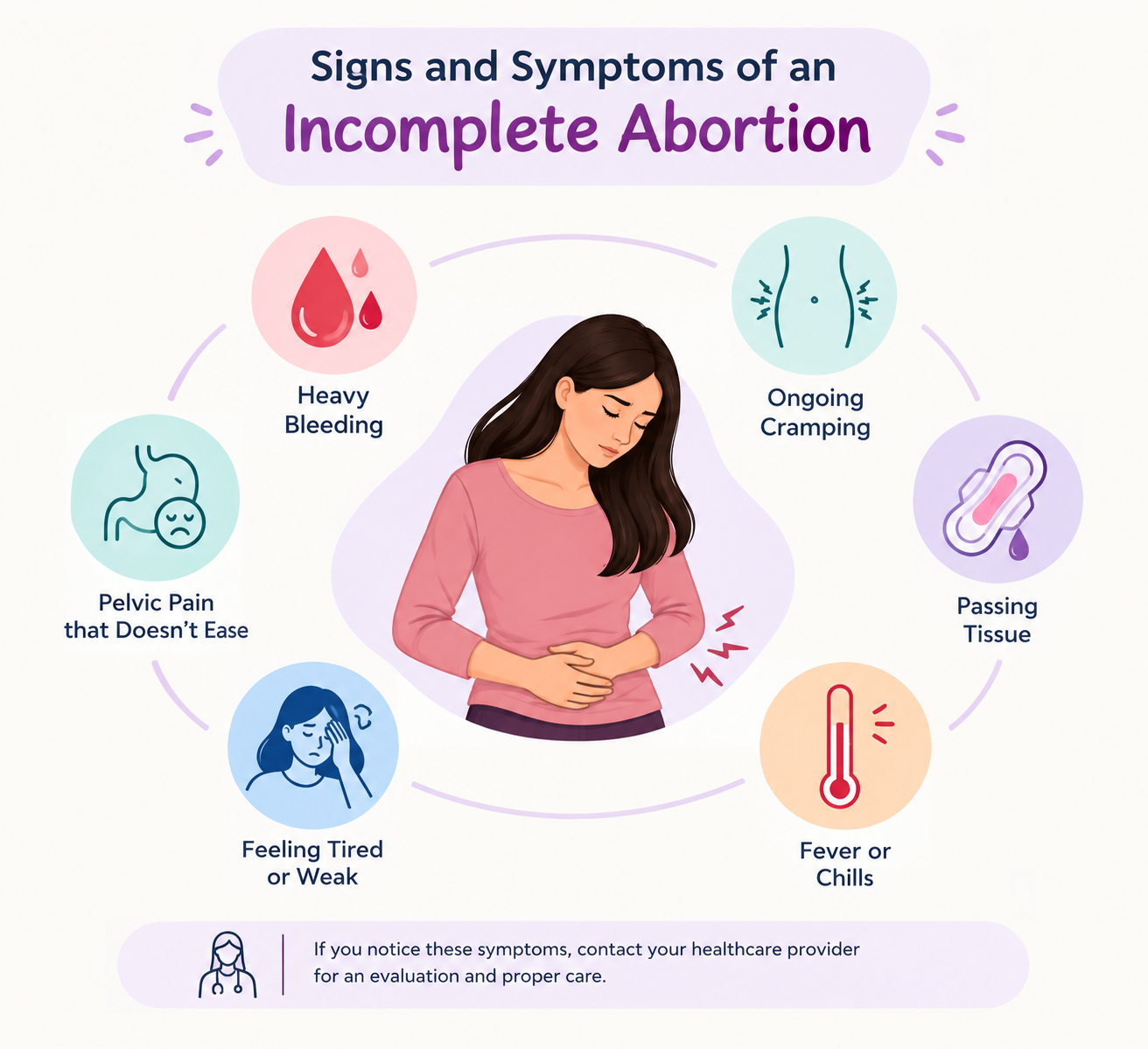
Symptoms can vary. Having one of these symptoms does not by itself confirm an incomplete abortion.
Possible signs include:
Continued or Prolonged Vaginal Bleeding
Some bleeding is expected after an abortion. However, bleeding that remains unusually heavy, persists with other concerning symptoms, or becomes heavier rather than gradually improving may need medical assessment.
WHO identifies prolonged bleeding among possible symptoms associated with post-abortion complications and emphasizes assessment for hemorrhage when clinically indicated.
For more information about expected bleeding, see bleeding after an abortion pill.
Persistent or Increasing Abdominal Cramping
Cramping is common while the uterus contracts and passes pregnancy tissue. Pain that becomes severe, persists without improvement, or occurs together with heavy bleeding or fever should be evaluated.
If you are experiencing significant cramping, see causes of severe cramping after abortion pills.
Passing Tissue
Passing blood clots or tissue can occur during a medication abortion and does not automatically indicate a complication.
However, if you continue to have significant symptoms after passing tissue, contact a healthcare professional for guidance.
Ongoing Pregnancy Symptoms
Persistent pregnancy symptoms can have several explanations, including hormones that have not yet returned to baseline. They do not by themselves prove that an abortion is incomplete or unsuccessful.
If pregnancy symptoms continue, see why pregnancy symptoms continue after abortion.
Fever or Chills
Fever, chills, worsening abdominal or pelvic pain, uterine tenderness, or foul-smelling discharge can be warning signs of infection. WHO recommends prompt assessment when infection is suspected.
Read more about fever after an abortion pill and when to call a doctor.
Foul-Smelling Vaginal Discharge
An unusual or foul-smelling discharge, particularly when accompanied by pelvic pain or fever, can indicate infection and requires medical evaluation.
See foul-smelling discharge after abortion for additional information.
Is Bleeding After an Abortion Always a Sign of Incomplete Abortion?
No.
Bleeding is a normal part of many abortions, particularly medication abortion. Cramping and bleeding can continue for days or, in some cases, longer during recovery.
The presence of bleeding alone cannot establish that pregnancy tissue remains in the uterus.
Likewise, the absence of heavy bleeding does not necessarily prove that an abortion is incomplete. WHO’s clinical handbook notes that minimal or no bleeding after completing a medical abortion regimen can require assessment, particularly when there are other signs suggesting that the abortion may not have occurred.
For this reason, symptoms need to be considered together with the pregnancy history, timing, clinical examination, and other appropriate assessment.
How Is an Incomplete Abortion Diagnosed?
A healthcare professional may evaluate:
- Your pregnancy history
- When the abortion or miscarriage occurred
- Which medications or procedures were used
- The amount and duration of bleeding
- Pain and cramping
- Fever or other infection symptoms
- Pregnancy symptoms
- Physical examination findings
- Pregnancy testing or laboratory testing when appropriate
- Ultrasound when clinically indicated
Ultrasound is not automatically required in every case. WHO notes that routine ultrasound should not be used simply to screen for incomplete abortion because ultrasound findings can correlate poorly with retained pregnancy tissue. Clinical assessment and symptoms remain important.
If you want to understand the role of imaging and testing after abortion, see whether ultrasounds and bloodwork are needed for an abortion.
What Is Retained Pregnancy Tissue?
Retained pregnancy tissue means that some tissue associated with the pregnancy remains inside the uterus after the pregnancy has ended.
Retained tissue may contribute to:
- Ongoing bleeding
- Persistent cramping or pelvic pain
- Infection
- Delayed completion of the abortion
However, symptoms such as bleeding and cramping have several possible causes. A healthcare professional should determine whether retained tissue is actually present.
If you are concerned about an abortion that may not have completely worked, medication abortion explained provides broader information about the process.
Treatment Options for Incomplete Abortion
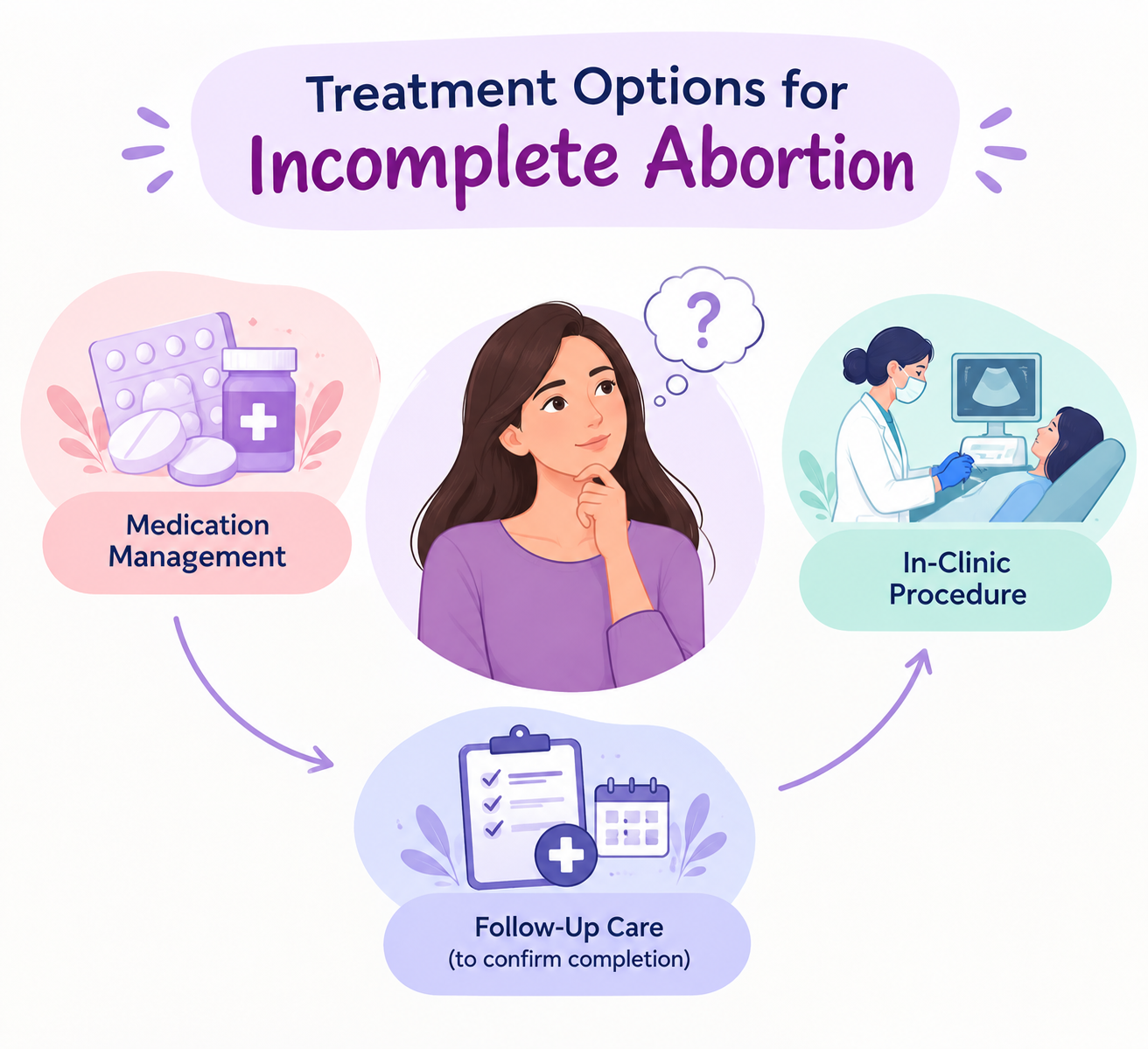
Treatment depends on the individual’s symptoms, clinical findings, pregnancy duration, and whether there is infection, heavy bleeding, or another complication.
The main approaches include expectant management, medication, and uterine evacuation by an appropriate procedure.
1. Expectant Management
In some clinically stable situations, a healthcare professional may recommend waiting for the remaining tissue to pass naturally.
This approach is generally considered only when the person’s condition allows for observation and appropriate follow-up.
A provider may discuss:
- Expected bleeding and cramping
- Warning signs
- Follow-up timing
- When to seek urgent care
- Whether additional assessment is needed
Expectant management should not be confused with ignoring symptoms. Follow-up is important when retained tissue is suspected.
2. Medication Management
Medication can be used in appropriate circumstances to help the uterus expel remaining pregnancy tissue.
Misoprostol is one medication used in medical management of incomplete abortion. WHO guidance includes medical management as an evidence-based option, with the regimen depending on the clinical circumstances and gestational age.
The correct medication, dose, route, and timing should be determined according to appropriate clinical guidance rather than copied from another person’s experience.
For information about misoprostol, see misoprostol and what to expect.
You can also review mifepristone and misoprostol together to understand how these medications are used for medication abortion.
3. Procedural Treatment
A healthcare professional may recommend a procedure to remove remaining tissue when it is clinically appropriate.
Vacuum aspiration is one established approach. WHO guidance specifically describes vacuum aspiration for uterine evacuation in relevant situations and recommends against routine sharp curettage when vacuum aspiration is available.
Procedural management may become particularly important when there is:
- Heavy or ongoing hemorrhage
- Infection associated with retained tissue
- Significant clinical instability
- Tissue that has not passed and is causing complications
- A need for prompt completion based on clinical findings
Learn more about what happens during a surgical abortion and surgical abortion procedures.
What Happens If an Incomplete Abortion Causes an Infection?
Retained tissue can be associated with infection, although not every incomplete abortion causes an infection.
Possible signs include:
- Fever
- Chills or flu-like symptoms
- Increasing pelvic or abdominal pain
- Foul-smelling vaginal discharge
- Uterine tenderness
- Feeling increasingly unwell
WHO recommends antibiotic treatment for infection and appropriate evacuation when retained tissue is suspected to be contributing to the infection. Severe infection may require hospitalization.
For additional information, read infection after abortion and symptoms you should not ignore.
If you have a fever after medication abortion, see when fever after an abortion pill needs medical attention.
When Is Incomplete Abortion an Emergency?
Seek urgent medical care if you experience symptoms such as:
- Very heavy vaginal bleeding
- Fainting or severe weakness
- Severe or worsening abdominal or pelvic pain
- Fever with significant abdominal or pelvic pain
- Foul-smelling discharge with other signs of infection
- Difficulty breathing or signs of severe illness
- Symptoms suggesting shock or major blood loss
- Severe one-sided pain or other symptoms that could indicate an ectopic pregnancy
WHO emphasizes immediate evaluation when ectopic pregnancy is suspected and prompt stabilization and treatment or referral for significant hemorrhage.
For practical guidance, see when to go to the ER after abortion pills.
Severe one-sided pain should also be evaluated promptly because an ectopic pregnancy requires different treatment. See one-sided pain after abortion.
Incomplete Abortion vs. Normal Abortion Recovery
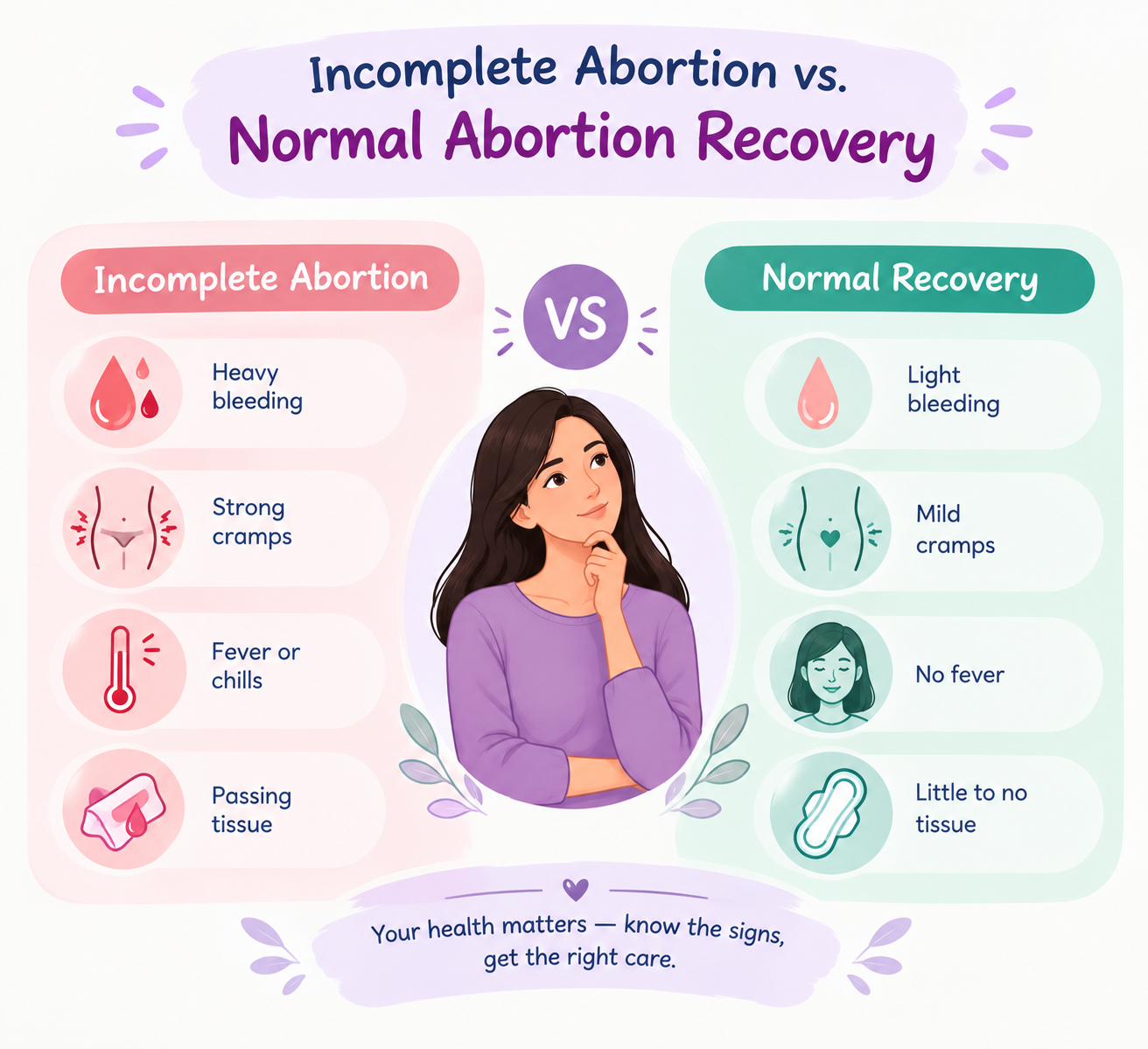
It can be difficult to distinguish normal recovery from a complication based only on symptoms.
| Symptom | Can occur during normal recovery? | When evaluation is important |
|---|---|---|
| Vaginal bleeding | Yes | If unusually heavy, prolonged, or worsening |
| Cramping | Yes | If severe, persistent, or worsening |
| Blood clots | Yes | If accompanied by concerning symptoms |
| Passing tissue | Yes | If symptoms continue or worsen |
| Pregnancy symptoms | May persist temporarily | If pregnancy may be ongoing |
| Fever | Not something to ignore | Especially with pelvic pain or foul discharge |
| Foul-smelling discharge | Not expected | Prompt assessment is appropriate |
| Severe weakness/fainting | Not expected | Urgent medical care |
Normal recovery varies between individuals. NHS guidance notes that cramps and vaginal bleeding can occur after abortion, while persistent pain or bleeding that does not improve, continuing pregnancy symptoms, or signs of infection warrant medical advice.
You can also read your abortion experience before, during, and after care for broader recovery information.
What If There Is No Bleeding After Misoprostol?
Minimal or no bleeding after completing a medical abortion regimen can sometimes require evaluation, particularly if there are other signs that the pregnancy may still be ongoing.
It does not automatically mean that an abortion is incomplete.
A healthcare professional may assess whether the pregnancy has ended, whether an ectopic pregnancy needs to be ruled out, or whether another explanation is more likely.
Read what to know about no bleeding after misoprostol and what to do if you don’t bleed after misoprostol.
Can an Abortion Be Incomplete After Taking Abortion Pills?
Yes. An abortion can occasionally be incomplete after medication abortion.
However, symptoms alone cannot always distinguish between:
- A normally progressing medication abortion
- An incomplete abortion
- An ongoing pregnancy
- An ectopic pregnancy
- Another medical condition
If you are concerned that the medication did not fully work, do not simply repeat medication without appropriate guidance. Contact a qualified abortion provider or healthcare professional who can determine the appropriate next step.
For additional context, see how to know if an abortion pill worked and 7 signs an abortion pill is working.
How Is an Incomplete Abortion Followed Up?
Follow-up depends on the treatment approach and clinical circumstances.
A provider may use:
- Symptom assessment
- A pregnancy test at an appropriate interval
- Clinical examination
- Ultrasound when indicated
- Blood testing when clinically necessary
A pregnancy test can remain positive for some time after an abortion because pregnancy hormone levels do not immediately return to non-pregnant levels.
For related information, see how long hCG stays after abortion and when to take a pregnancy test after abortion pills.
Can an Incomplete Abortion Affect Future Fertility?
When appropriately treated, an incomplete abortion does not generally mean that future fertility will be permanently affected.
The important issue is receiving appropriate care when complications such as heavy bleeding or infection occur.
After an abortion, fertility can return quickly. If you are thinking about pregnancy in the future, see can you get pregnant after an abortion and how fertile you are after an abortion.
What Should You Do If You Think Your Abortion Is Incomplete?
If you are worried about an incomplete abortion:
- Pay attention to your symptoms, especially bleeding, pain, fever, and discharge.
- Contact your abortion provider or healthcare professional for individualized guidance.
- Do not assume that bleeding alone proves retained tissue.
- Seek urgent care if you have severe pain, very heavy bleeding, fainting, fever with significant pain, or other emergency symptoms.
- Complete recommended follow-up if your provider advises testing or examination.
The goal is not simply to determine whether tissue remains. A healthcare professional also needs to consider other possible complications, including infection and ectopic pregnancy when clinically appropriate.
Getting Professional Help After an Abortion
Serenity Choice Health provides abortion-related information and care designed to help patients understand their options and know when follow-up may be necessary.
If you are concerned about symptoms after taking abortion medication or undergoing an abortion, access abortion care in Illinois or learn more about what is included in Serenity Choice Health abortion care.
For people considering remote care where legally and clinically appropriate, telehealth abortion care may also be worth discussing with a qualified provider.
The right next step depends on your symptoms, medical history, pregnancy duration, and clinical assessment.
Conclusion
An incomplete abortion occurs when some pregnancy tissue has passed but some remains in the uterus. Possible symptoms include continued bleeding, persistent or worsening cramping, fever, foul-smelling discharge, and other signs of complications. However, many symptoms—particularly bleeding and cramping—can also occur during normal abortion recovery.
Diagnosis should be based on appropriate clinical assessment rather than symptoms alone. Depending on the situation, management may involve observation, medication, or a uterine evacuation procedure. WHO guidance supports individualized management based on the person’s condition and emphasizes prompt treatment of hemorrhage, infection, and suspected ectopic pregnancy.
If you think your abortion may be incomplete, contacting a qualified healthcare professional can help determine whether you need testing, treatment, or reassurance about normal recovery.
FAQ Section
What are the most common signs of an incomplete abortion?
Possible signs include continued or prolonged bleeding, persistent or worsening cramping, passing tissue with ongoing symptoms, fever, foul-smelling discharge, or other symptoms suggesting that the abortion has not fully completed. These symptoms do not confirm an incomplete abortion by themselves.
Can you have an incomplete abortion without heavy bleeding?
Yes. Heavy bleeding is not required for an incomplete abortion. Some people may have continued or unusual bleeding, while others may have relatively little bleeding. Minimal or no bleeding after a medical abortion can also require assessment when an abortion may not have occurred.
How is an incomplete abortion treated?
Treatment depends on the person’s symptoms and clinical findings. Options can include expectant management, medication such as misoprostol in appropriate circumstances, or uterine evacuation using an appropriate procedure. WHO guidance supports individualized management based on the clinical situation.
How do I know if tissue is still in my uterus?
Symptoms alone cannot reliably confirm retained tissue. A healthcare professional may evaluate your history and symptoms and may use examination, pregnancy testing, ultrasound, or other testing when clinically appropriate. Routine ultrasound is not required for every case.
When should I go to the emergency room after an abortion?
Seek urgent medical attention for very heavy bleeding, fainting or severe weakness, severe or worsening pain, fever with significant pelvic or abdominal pain, foul-smelling discharge with other signs of infection, or symptoms that could indicate an ectopic pregnancy or another serious complication.
Can an incomplete abortion affect future pregnancy?
An incomplete abortion itself does not necessarily mean that future fertility will be affected. Prompt evaluation and appropriate treatment are important when complications such as infection or significant bleeding occur.

Dr. James Carter is a board-certified physician and lead clinician at Serenity Choice Health, specializing in reproductive health access and medication abortion protocols. With over 20+ years of experience, he combines clinical expertise with patient-centered care to ensure safe, compassionate, and confidential reproductive healthcare.